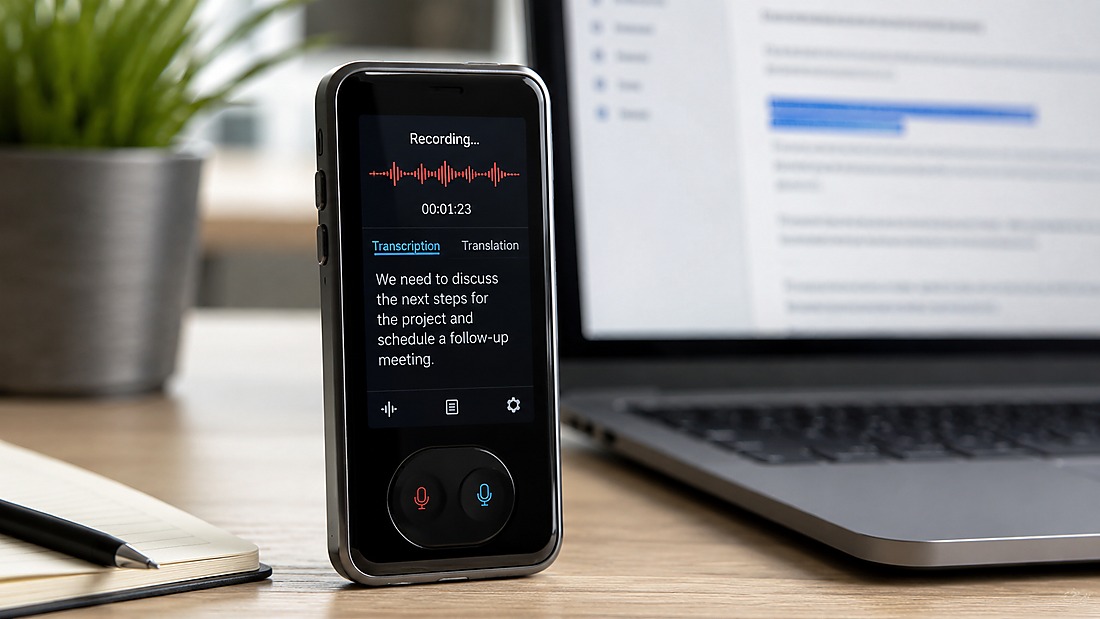
Most AI translator sourcing conversations start in the wrong place: with a language count and a target price. The decision that actually determines cost, timeline and risk is the engagement model — whether you buy an ODM platform and adapt it, or commission OEM work on hardware, firmware and software. In 2026 that decision is being reshaped by three technical shifts: translation moving partly on-device, offline language packages becoming a purchasable feature rather than a fixed one, and buyers asking harder questions about where voice data goes.
This article separates the four customization layers buyers actually negotiate, explains how 2026 trends change the OEM-versus-ODM calculus, and gives a decision table and verification checklist you can use before requesting quotes. Any volume, MOQ or timing references below are typical industry or internal reference values, not guaranteed commercial terms; final scope depends on the selected model, BOM, technical evaluation and official quotation.
What OEM and ODM actually mean for AI translator hardware
In consumer electronics, the OEM/ODM label is often used loosely. For AI translators it is more useful to split the project into four layers, because buyers rarely customize all four at once.
- Hardware and industrial design. Enclosure, microphone array and acoustic sealing, screen or camera module (for OCR pens), battery, and PCB layout. Full custom ID usually means tooling; adapting an existing public mold does not.
- Firmware. Touch behavior, button mapping, indicator logic, power management, and — where the platform supports it — offline language package loading and switching.
- Translation engine and software integration. The ASR (speech recognition), NMT (machine translation) and TTS (speech synthesis) chain, the companion app or on-device UI, cloud backend, API accounts and terminology databases.
- Branding and packaging. Logo, color box, manual languages, accessory set, language-list card.
A practical definition: an ODM ai translator project starts from a platform the manufacturer already developed and sells, and you customize layers 3 and 4, sometimes layer 2. An OEM ai translator project assumes the buyer defines more of the product — often including hardware changes and deeper software integration — and the manufacturer builds to that definition. In practice most projects sit between the two, which is why the layer model matters more than the label.
Device form should be settled before any of this. Translation pens, pocket touchscreen translators and translator earbuds share many mature components but differ in acoustics, software architecture and offline capability. A pen project and an earbud project with the same language list can have very different engineering risk.
How 2026 trends shift the OEM vs ODM decision

Trends matter here only where they change a sourcing decision. Four do.
1. On-device versus cloud translation
Cloud-first translators capture audio on the device and process ASR, NMT and TTS in the app or cloud. They are cheaper to build, easier to expand linguistically and easier to update — but they need connectivity and create recurring service cost. Offline or hybrid designs add local compute, memory and storage, raising hardware cost and language-package management complexity.
Manufacturer-side reasoning: if offline translation is a core selling point, it should be treated as an architecture requirement from day one, not a firmware feature added later. Retrofitting meaningful offline capability onto a cloud-first platform is usually a platform change, not a customization. That pushes the project toward OEM or deep ODM.
2. Offline language packages as a configurable feature
Offline language support is increasingly negotiated as a package — which languages, in what priority, with what terminology. This is a software and storage decision tied to the chipset. Buyers who need a specific offline set should confirm it against the exact platform, because a platform that supports many online languages may support far fewer offline.
3. Language-count claims under scrutiny
“Supports 40 languages” can mean 40 online languages, 40 language pairs, 40 with offline packages, or 40 in a marketing list where several are partial. In 2026, distributors and retail buyers are more likely to ask for the distinction in writing. A custom ai translator brief that specifies online and offline language sets separately gets cleaner quotes and fewer disputes at sample approval.
4. Data privacy expectations
Voice audio and translated text are personal data in many markets. Buyers increasingly ask whether traffic passes through a factory-operated cloud, whether they can use their own API account, whether raw audio storage can be disabled, and who owns terminology data. These are contract and architecture questions, not features. They favor buyers who define the software layer early — which usually means more OEM-style control, or an ODM partner willing to document data flows.
Regulatory and privacy requirements vary by market and configuration and should be confirmed with a qualified advisor; this article does not provide legal or compliance advice.
Decision table: which model fits your project
Use this as a first filter before requesting quotes. Volume references are indicative only; confirm against the specific platform and quotation.
| Buyer situation | Likely fit | Why | Main risk |
|---|---|---|---|
| Market test or small pilot, standard features, logo and packaging only | ODM platform, light private label | Fastest path; no tooling; existing firmware | Limited differentiation; language set fixed by platform |
| Retail brand needing distinct ID and packaging, standard translation features | ODM plus custom ID/tooling | Differentiation where it is visible to shoppers without rebuilding software | Tooling cost and schedule; acoustic changes if the enclosure changes |
| Brand with a specific offline language set or terminology need | Deep ODM or OEM software work | Offline packages and terminology are platform- and storage-dependent | Higher MOQ and NRE; longer validation |
| Enterprise or regulated buyer needing own cloud/API account and defined data flow | OEM-style software integration | Control of ASR/NMT/TTS providers and data retention | Integration effort; contract complexity |
| Technology company with its own app and translation backend | OEM hardware plus SDK/API integration | Hardware becomes a component of the buyer’s product | SDK access and source-code rights must be agreed in writing |
Two rules of thumb from the manufacturing side. First, if your differentiation is visible to the end user mainly through branding and packaging, ODM is usually the better use of capital. Second, if your differentiation depends on the translation experience itself — offline coverage, terminology, data handling, app ownership — budget for software integration and treat hardware as the simpler half of the project.
Verification checklist before you request quotes
Send these questions with your RFQ. Suppliers who answer precisely are easier to compare; vague answers are a warning sign, not a negotiating position.
- Language claims: How many languages are supported online, how many offline, and as language pairs or single languages? Which are partial or beta?
- Offline scope: Which exact offline packages are available on this platform, at what storage cost, and can priority and terminology be customized?
- Engine ownership: Which ASR, NMT and TTS providers are used? Can we switch providers or bring our own backend? Can we use our own API account?
- Data flow: Does audio or text pass through a factory cloud? Can raw audio storage be disabled? Who owns terminology and language data?
- Firmware and source: What firmware customization is included, and under what terms is source-code access available, if at all?
- Certification scope: Which certificates are planned for this exact model and configuration, who is the certificate holder, and which market requirements apply? Certification support at factory level does not mean every model already holds those certificates; confirm model-specific status and the certificate holder with the applicable authority or laboratory.
- Quality plan: What is tested at final inspection — speech recognition, latency, offline functions, OCR where applicable, Bluetooth stability — and at what AQL?
- Commercials: MOQ by customization level, sample fee and lead time, tooling ownership, and what triggers NRE.
For acoustic products such as translator earbuds, add a request for the microphone alignment and sealing control plan. Small assembly deviations can degrade speech recognition in ways visual inspection will not catch.
Requirements brief template for a custom ai translator project
Quotes are only comparable when the brief is. Before a finished specification exists, a one-page brief covering the points below reduces quote ambiguity and shortens sample cycles.
- Device form: pen, pocket translator or earbuds.
- Primary use case: travel, business meetings, education, enterprise deployment.
- Connectivity model: Wi-Fi, Bluetooth via phone, hotspot, or cellular module if required.
- Online language set and offline language set, listed separately, with priority order.
- OCR or camera translation requirement, if any.
- App model: white-label app, customized UI, or customer-owned app via SDK/API.
- Data requirements: own API account, storage restrictions, terminology database.
- Branding scope: logo, packaging, manual languages, accessories.
- Target markets and expected certification scope per market.
- Volume expectation for pilot and first production run, and whether tooling is anticipated.
This brief also protects the buyer later: it becomes the reference document when sample approval and mass-production freeze are discussed.
Contract points to settle before tooling or development
Several items that buyers assume are standard are actually project- and contract-specific. Define them in writing before development starts:
- Tooling ownership: who owns molds and fixtures, and what happens to them if the relationship ends.
- Firmware and software rights: what customization is delivered, whether source-code access is included, and under what license.
- Cloud and API accounts: who holds the accounts, who pays for usage, and how data flows are documented.
- Exclusivity: whether the platform, ID or language configuration is exclusive to you, for how long, and in which markets.
- Certification responsibility: who applies, who holds certificates, and who pays for testing and re-testing after changes.
- Change control: how BOM, firmware or language-package changes are approved and how they affect certification and schedule.
None of these should be assumed as included. They are negotiated per project, and the signed agreement governs.
Pineeon Manufacturer-Side Recommendation
Pineeon is a B2B private label smart wearable, computer peripheral and AI hardware OEM/ODM manufacturer based in Shenzhen, China, operating since 2000 and ISO 9001:2015-certified, serving brands and buyers in 40+ countries. From that position, our recommendation to buyers comparing models is straightforward:
- Start with the device form and the offline question. These two decisions determine the platform, the chipset class and most of the cost. Everything else is easier to change later.
- Choose ODM when speed and cost matter more than software control. A platform adaptation with logo, packaging and light UI changes is usually the right first step for market testing.
- Choose OEM-style engagement when the translation experience is the product. Own API accounts, offline language sets, terminology and data flows belong in the brief, not in a later change request.
- Verify claims at sample stage. Test your actual language pairs, accents and terminology. Supplier-claimed accuracy and latency figures are references, not guarantees.
- Scope certification per model and market. Certification requirements, applicable standards, testing scope and approval depend on the specific model, configuration, target market, laboratory and authority, and approval is not guaranteed. Buyers should confirm the applicable requirements and model-specific status with the relevant authority, qualified laboratory or regulatory advisor before making retail claims.
You can review the AI translator platforms and customization options on our AI translator OEM/ODM product page, then send a requirements brief for an initial evaluation. Pineeon evaluates customer requirements before recommending a project approach, and final scope should be confirmed before quotation and development.
Frequently asked questions
Is ODM always cheaper than OEM for AI translators?
Not always, but it usually is at low volume. ODM avoids tooling and spreads existing development cost. OEM becomes more economical when your volume supports the NRE and when the differentiation you need cannot be achieved on an existing platform.
Can we move from an ODM platform to OEM later?
Sometimes, but plan for it. If you expect to need your own app, API account or offline language set later, raise it during platform selection so the architecture does not have to be rebuilt.
Who owns the translation data in a custom project?
It depends on the contract and architecture. Raw audio, translated text, terminology databases and cloud accounts should each be addressed explicitly in the agreement; do not assume the buyer owns them by default.
How do we compare language claims across suppliers?
Ask each supplier to list online and offline languages separately, mark partial or beta languages, and state whether counts refer to languages or language pairs. Then test the pairs that matter to your market at sample stage.
Does factory certification support mean the product is certified?
No. Factory-level support for certification or compliance applications is a capability, not evidence that a specific model holds a certificate. Confirm model-specific certification status and the certificate holder with the applicable authority or laboratory before making retail claims.