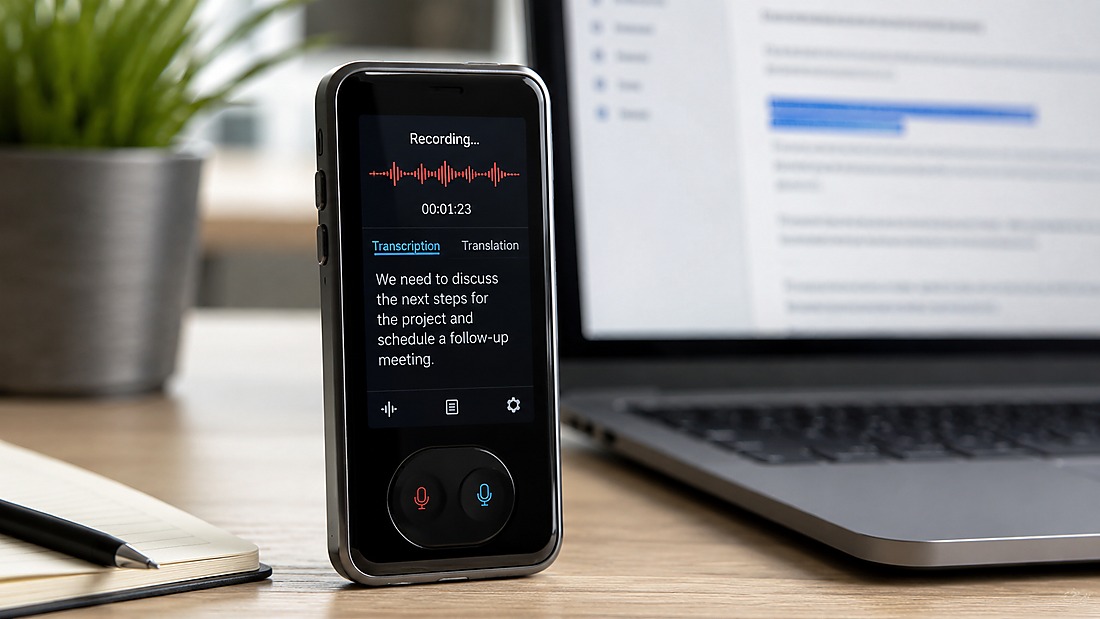
Retailers and importers comparing an OEM ai translator project with an ODM ai translator project are usually not asking which label sounds better. They are asking a commercial question: how much of this product do we need to control, and how much can we safely leave to a manufacturer’s existing platform? For AI translators, that question is harder than for a cable or a mouse because the product is part hardware, part firmware, part translation engine and part app or cloud service. A change in any one layer can alter cost, time, certification scope and who owns what after launch.
This article separates the four customization layers that matter for translation devices, maps typical buyer situations to OEM or ODM routes, and gives a pre-quote briefing checklist you can use before contacting an ai translator manufacturer. It is written from the manufacturer side, where scope decisions are made before a quotation is meaningful.
What OEM and ODM actually mean for an AI translator
In general trade usage, OEM means the buyer brings a defined specification and the factory builds to it; ODM means the factory offers an existing design that the buyer adapts, often with branding and limited changes. That definition is useful but too coarse for translation hardware. A translation pen, a pocket touchscreen translator and translator earbuds share consumer-electronics components, yet their software architecture and acoustic requirements differ. So the practical question is not “OEM or ODM?” but “which layers are buyer-defined and which are factory-defined?”
Most projects sit on a spectrum. A retailer may take a factory platform, apply its logo and packaging, and accept the standard app and translation engine. Another buyer may define the enclosure, the offline language package, the app flow and the cloud backend, and use the factory for manufacturing and integration. Both are legitimate; they carry different control, cost exposure and time-to-market profiles.
The four customization layers to decide before you request a quote

Translation devices carry software dependencies that most peripherals do not. Treating customization as a single “level” hides where the real cost and risk sit. Split the project into four layers and decide each one explicitly.
Layer 1: Hardware and industrial design
This covers the device form (pen, pocket translator or earbuds), enclosure, display or camera module where applicable, microphone architecture, battery and wearing or handling ergonomics. A public-mold platform with logo and packaging changes is the fastest and lowest-NRE route. New tooling, a different microphone array or a redesigned acoustic chamber increases NRE, sample time and validation work. For translator earbuds, microphone alignment and acoustic sealing are process-critical because small assembly deviations can reduce speech-recognition performance.
Layer 2: Firmware and translation engine
This is where AI translators differ most from ordinary peripherals. The translation chain is typically ASR (speech recognition), NMT (machine translation) and TTS (speech synthesis). The engine can run cloud-first, on-device, or in a hybrid arrangement. Engine selection affects user experience, recurring service cost, offline capability and data flow. It is usually a software or cloud-layer change rather than a low-level firmware change, which is why “firmware customization” is often the wrong label for what a buyer actually needs.
Layer 3: App and cloud integration
Some pocket translators operate standalone; translator earbuds typically rely on an app and/or cloud service for most translation logic. App customization ranges from basic white-label (logo, splash screen, app name) through UI and language-priority changes to advanced work such as enterprise terminology databases, customer backend integration or a customer-owned app using a hardware audio SDK. Each step changes who maintains the software after launch.
Layer 4: Branding and packaging
Logo, color box, manual language, accessory set and language-list card. This layer is commercially visible but technically the simplest. It should not be allowed to obscure decisions in Layers 2 and 3, which determine whether the product actually performs as the retailer promises.
OEM vs ODM decision matrix for retailers
Use the table below to match your situation to a starting route. It is a starting point for discussion, not a quotation.
| Buyer situation | Likely starting route | What you control | Main trade-off |
|---|---|---|---|
| Reseller testing a new category; brand not yet defined | ODM / private label on an existing platform | Branding, packaging, manual language, limited app white-label | Fastest to market; least differentiation; dependent on factory roadmap |
| Established brand with a defined spec and its own app team | OEM with buyer-defined hardware and software integration | ID, firmware behavior, app, engine choice, data flow | Higher NRE and longer validation; more internal engineering effort |
| Education or travel brand needing specific language pairs and terminology | ODM base plus deep language-package customization | Offline language set, terminology, UI language priority | Higher MOQ and NRE; offline capability constrained by chipset and storage |
| Enterprise solution provider needing its own cloud backend | OEM software integration on a selected hardware platform | ASR/NMT/TTS providers, API accounts, data retention | Contract-heavy; requires clear ownership of accounts and data |
| Retailer needing a low-cost promotional SKU | ODM standard model with logo and packaging | Branding only | Lowest cost exposure; minimal control over engine and updates |
Two patterns are common in practice. First, buyers underestimate the software layer and over-specify the enclosure. Second, buyers assume that because they paid for tooling, they automatically own the firmware or the translation engine. Neither assumption is safe. IP, tooling, firmware and source-code ownership are contract-defined, and they should be written down before development starts.
How translation engine choice interacts with OEM vs ODM scope
“Supports N languages” is not a hardware specification. It is a statement about the software platform, the language packages loaded and the engine behind them. Online language counts, offline language counts and accuracy claims must be verified per configuration. A device may support a wide online language list while offering a much smaller offline set, and the offline set is what determines usefulness in weak-network travel or classroom settings.
Cloud-first architecture lowers hardware cost and simplifies language expansion, but it introduces connectivity dependence, ongoing service cost and data-privacy considerations. Offline or local-AI architecture reduces network dependence but requires more local compute, memory and storage, and raises language-package management complexity. The buyer should decide whether offline translation is a critical requirement before chipset and software architecture are selected. If it is critical, that decision pushes the project toward deeper ODM or OEM engagement because the language package and storage plan must be engineered, not simply switched on.
Engine choice also affects who carries recurring cost. If the factory operates the cloud, the buyer may inherit a service dependency. If the buyer uses its own API account, the buyer controls billing and data flow but must manage integration. These are commercial and contractual questions as much as technical ones. Ask directly: does translation traffic pass through a factory-operated cloud, can we use our own API account, can we switch engines, who stores raw voice and translated text, and can storage be disabled?
Pre-quote briefing checklist
Manufacturers evaluate requirements before recommending an approach. A clear brief shortens quotation and reduces rework. Prepare the following before you request pricing.
- Device form: translation pen, pocket touchscreen translator or translator earbuds.
- Target markets: destination countries and any radio, battery or labeling considerations.
- Online languages: the language pairs you will advertise.
- Offline languages: which pairs must work without a network, if any.
- Connectivity: Wi-Fi, Bluetooth, smartphone hotspot or cellular module (cellular adds certification complexity).
- OCR or camera translation: required or not.
- App model: factory white-label app, customized factory app, or your own app via SDK/API.
- Engine and data: preferred ASR/NMT/TTS providers, own API account, data-retention rules.
- Branding: logo, packaging, manual languages, accessory set.
- Ownership: who owns tooling, firmware, source code, language data and cloud accounts.
- Compliance responsibility: who prepares documentation, who holds certificates, which markets.
- Volume expectation: sample, pilot and first production order quantities.
On compliance, be precise. Certification scope, required documents, testing scope and approval depend on the specific product model, configuration, target market, laboratory and applicable authority. Buyers should confirm current requirements with the applicable authority, a qualified laboratory or a regulatory advisor, and should not treat general factory support as a model-specific certificate. Approval is not guaranteed.
Sample evaluation and QC checkpoints for translation devices
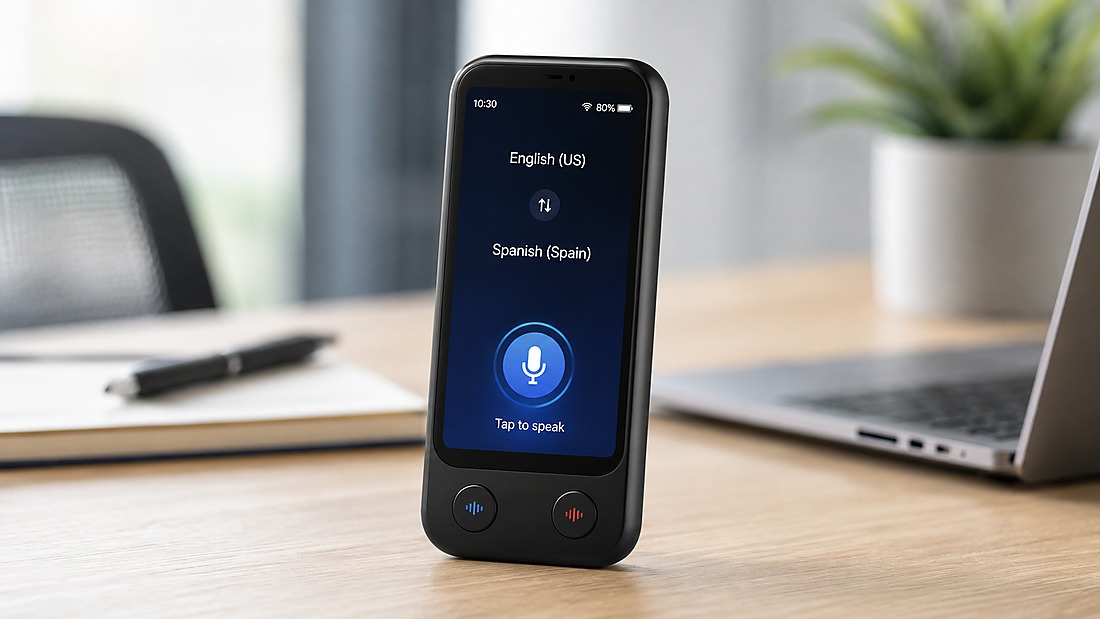
Generic hardware checks are not enough. Translation quality is a system outcome, so evaluate the sample against your actual language pairs, accents and terminology.
- Speech recognition across target accents and noisy environments.
- Translation latency on the networks your customers will use.
- Offline language packages, if specified, tested with the network disabled.
- OCR scanning accuracy where applicable, including curved or low-contrast text.
- Microphone noise reduction and, for earbuds, acoustic sealing consistency across units.
- Bluetooth stability and reconnection behavior.
- App onboarding, language selection and update flow.
- Battery behavior under continuous translation, not just standby.
- Packaging, manual and language-list accuracy.
During production, a typical quality framework runs IQC, IPQC, FQC and OQC, with final checks covering speech recognition, translation latency, offline functions, OCR where applicable and Bluetooth stability. Exact AQL levels and reliability criteria should be agreed in the project quality plan rather than assumed.
Pineeon Manufacturer-Side Recommendation
Start with the software and language decision, not the enclosure. In our experience evaluating AI translator projects, the buyers who get predictable results are the ones who can answer three questions before quotation: which language pairs must work offline, who owns the translation engine and data, and who maintains the app after launch. Once those are settled, the OEM-versus-ODM choice usually becomes obvious. A retailer without an app team should take an ODM platform and invest in branding and language-package clarity. A brand with a defined spec and software capability should treat the factory as a manufacturing and integration partner and keep control of the engine and app.
Pineeon is a private label Smart Wearable, Computer Peripheral & AI Hardware OEM/ODM manufacturer based in Shenzhen, China, ISO 9001:2015-certified and serving brands and buyers in 40+ countries since 2000. We evaluate customer requirements before recommending a project approach. For AI translator projects, review the AI Translator OEM/ODM product page and bring a completed pre-quote brief to the discussion. Final specifications, MOQ, lead time, customization scope and commercial terms are subject to the selected model, technical evaluation and official quotation.
Frequently asked questions
Is OEM always more expensive than ODM for an AI translator?
Not necessarily in unit price, but OEM usually carries higher upfront NRE and longer validation. ODM can be cheaper to start and more expensive to differentiate later if the platform cannot support your language or app requirements.
Can we use our own translation engine in an ODM project?
This can be evaluated in deeper ODM or OEM software integration. Whether it is feasible depends on the hardware platform, SDK/API access and contractual arrangements. Engine switching is usually a software or cloud-layer change, not a hardware change.
Who owns the firmware and source code?
Ownership is contract-defined. Do not assume that paying for tooling or development transfers firmware, source code, language data or cloud accounts. These rights should be written into the signed project agreement.
Does Pineeon guarantee certification approval?
No. Final approval depends on the specific model, configuration, target market, laboratory and applicable authority, and buyers should confirm current requirements with the applicable authority, a qualified laboratory or a regulatory advisor. Approval is not guaranteed.
How do we verify “supports N languages” before ordering?
Ask for the language list per configuration, separate online and offline lists, and test the actual pairs on a sample with the network disabled where offline is claimed. Supplier-claimed accuracy percentages should not replace your own testing.