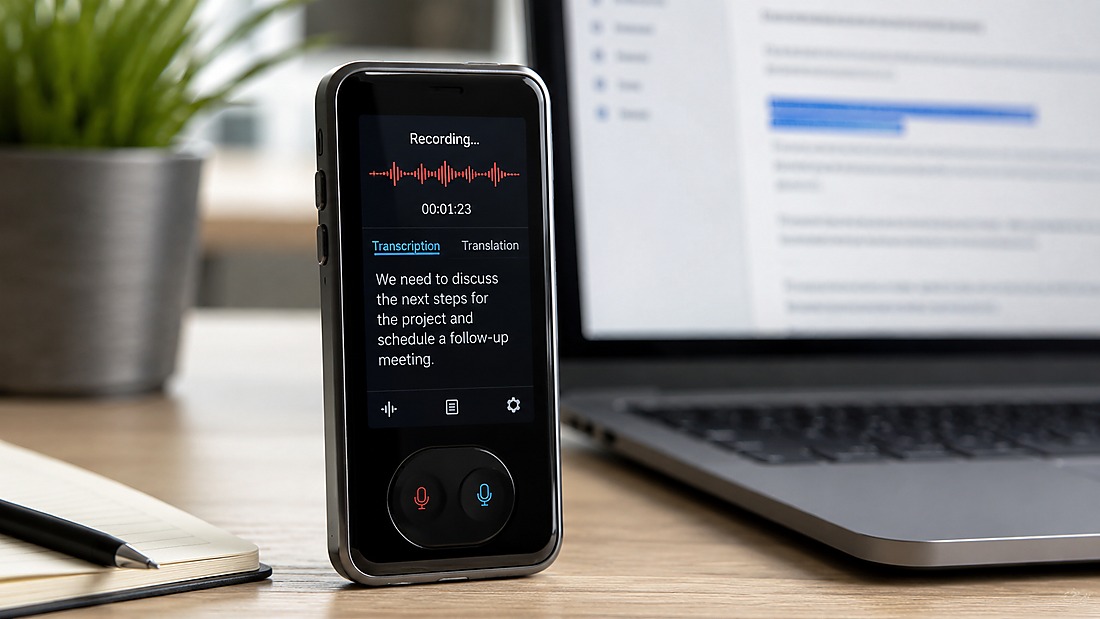
Most startup founders approaching an AI translator manufacturer ask the same question in slightly different words: “Can we get a custom AI translator without paying for a full custom development?” The honest answer depends less on the factory and more on which layers of the product you intend to control. An AI translator is not a single object. It is a stack of hardware, firmware, a translation engine, a companion app or device UI, and branding and packaging. OEM, ODM and private label are shorthand for who owns and changes which layer.
This article separates those layers, maps common startup situations to the most suitable model, and explains what to write into a project agreement before samples begin. It is written from the manufacturer side, where most launch problems are visible early and become expensive later.
Define the layers before you choose a model
In AI translator projects, “OEM” and “ODM” are often used loosely. For decision-making, define them by layer:
- Hardware and enclosure: the product form (translation pen, pocket touchscreen translator or translator earbuds), PCB, microphone architecture, battery and mechanical structure.
- Firmware: device-level behavior such as button mapping, touch response, indicator behavior, power management and, on offline-capable devices, local language package handling.
- Translation engine: the ASR (speech recognition), NMT (machine translation) and TTS (speech synthesis) chain, whether cloud-based, offline, or a customer-owned backend.
- App or device UI: the companion mobile app, or the on-device interface for standalone touchscreen translators.
- Branding and packaging: logo, color box, manual languages, accessory set and retail presentation.
Under private label, you typically select an existing platform and change branding, packaging and light software elements such as app name, splash screen and language priority. Under ODM, the manufacturer supplies a developed platform and you customize selected layers — often the app UI, language packages or translation engine integration — within the platform’s technical limits. Under OEM, you bring or specify the design and the manufacturer builds to it; the scope of what you truly own still depends on the contract, not the label.
The practical implication: asking “OEM or ODM?” before defining your layer priorities usually produces quotes that are not comparable. Two factories may both say “ODM” while one includes app UI changes and the other only changes the logo.
Match your startup situation to the right route

Most early-stage translator projects fall into one of four situations. The table below is a starting point for internal alignment, not a substitute for a technical evaluation.
| Your situation | Most suitable starting route | What you control | Main trade-off |
|---|---|---|---|
| No specification yet; validating a market | Private label on an existing platform | Brand, packaging, light app/UI changes | Low differentiation; limited control over engine and data flow |
| Clear product spec; existing brand and channel | ODM with defined customization scope | Selected hardware, firmware, app and engine layers | Customization boundaries set by the platform architecture |
| Existing app or translation backend | ODM/OEM with SDK or API integration | Translation engine, data flow, app experience | Integration effort and compatibility must be proven in samples |
| Differentiated hardware concept | OEM development | Enclosure, acoustics, firmware and software per agreement | Higher NRE, longer timeline, tooling and IP terms to negotiate |
A common mistake is treating private label as a stepping stone that automatically converts into a custom product later. It can, but only if the platform you choose supports the deeper changes you will eventually need. If offline translation or a customer-owned translation engine is on your roadmap, raise it before the first sample, not after the first production run.
Why the translation engine decides more than the hardware
For an AI translator, the user experience is dominated by the translation chain, not the enclosure. A cloud-first architecture captures audio on the device and performs ASR, NMT and TTS in the app or cloud. It lowers hardware cost and makes language expansion easier, but it requires connectivity, introduces recurring service cost and raises data-handling questions. An offline-capable architecture moves more processing onto the device, which increases local compute, memory and storage requirements and complicates language-package management.
This is where OEM and ODM scope often becomes ambiguous. Changing the ASR, NMT or TTS provider is usually a software or cloud-layer change, not a hardware-firmware change. If your project agreement does not state who owns the translation engine configuration, the cloud account, the API billing and the stored voice or text data, you may find that a “custom” device still routes traffic through a factory-operated service you cannot audit or migrate.
Before signing, get written answers to these questions:
- Does translation traffic pass through a factory-operated cloud, and can it be disabled?
- Can we use our own translation API account and switch engines later?
- Who stores raw voice audio and translated text, and for how long?
- Can offline terminology packages be customized for our vertical?
- Who owns the language and terminology data we contribute?
These are contract questions as much as engineering questions. A manufacturer can describe the architecture, but data rights, source-code access and cloud ownership must be defined in the signed agreement.
Brief the factory so OEM and ODM quotes are comparable
Quotes diverge mainly because briefs are vague. A useful pre-quotation briefing covers the items below. Send the same brief to every candidate so you can compare scope, not just price.
- Product form: translation pen, pocket touchscreen translator or translator earbuds. These are distinct architectures with different acoustic and software requirements.
- Target languages: online languages required at launch, and separately any offline languages. Do not treat a supported-language count as a hardware specification.
- Offline requirement: state whether offline translation is critical, optional or out of scope. This single answer changes chipset, storage and cost direction.
- Connectivity: Wi-Fi, Bluetooth, smartphone hotspot, or an independent cellular module if truly required. Cellular changes the certification path substantially.
- App or standalone UI: companion app, on-device UI, or both; and whether you will supply your own app.
- Translation engine: factory default, customer-selected provider, or customer-owned backend.
- Branding and packaging: logo, color box, manual languages, accessory set.
- Destination markets: this drives which compliance work is applicable and must be scoped early.
- Volume expectation: sample, pilot and first production order, so MOQ and NRE are quoted against a realistic plan.
Ask each manufacturer to state, in writing, which of these items are included, which are optional and which are outside the platform’s capability. That single document prevents most later disputes.
Confirm what is truly customizable under each model
“Customizable” is one of the least precise words in sourcing. Use the following questions to convert it into specifics:
- Which app elements can change — name, splash screen, interface layout, language priority, terminology database?
- Can the firmware be modified for button mapping, touch behavior and indicator logic, and is source-code access available if we need to maintain it ourselves?
- Can offline language packages be added or removed, and what storage does that require?
- Is the enclosure a public mold, a modified mold, or a new tool? Who owns the tooling, and what happens to it if we change suppliers?
- What sample rounds are included, and what is tested in each round — speech recognition, latency, offline packages, OCR where applicable, microphone noise reduction, Bluetooth stability?
- What is the packaging scope: standard box with sticker, or fully custom graphics and manual languages?
Tooling ownership, firmware ownership and exclusivity are frequently assumed rather than negotiated. A startup that assumes OEM means full IP ownership may discover that the enclosure tool, the firmware baseline and the app framework remain the manufacturer’s platform assets. That may be perfectly acceptable — but it should be a decision, not a surprise.
Compliance scope is project- and market-dependent
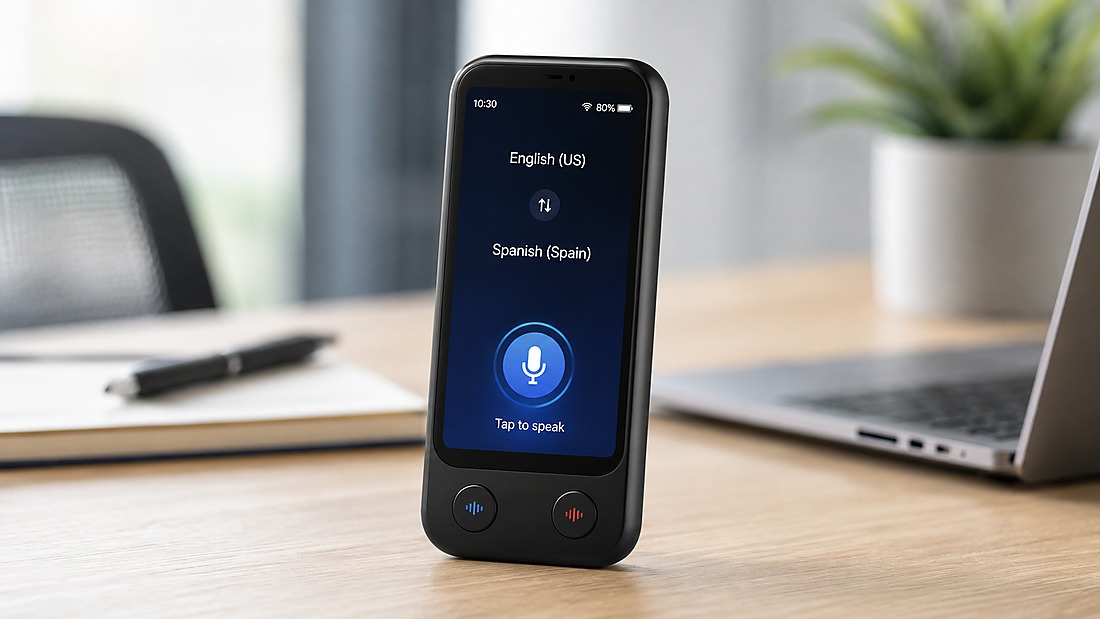
AI translators usually use Wi-Fi, Bluetooth or a smartphone hotspot, which keeps the certification path relatively simple compared with cellular devices. If a device contains an independent SIM-based cellular module, additional cellular and operator approvals must be evaluated.
Whether CE, FCC, RoHS or other approvals apply, and what documentation or testing is needed, depends on the specific model, configuration, target market, laboratory and applicable authority. Buyers should confirm current requirements with the applicable laboratory, authority or qualified advisor, and define certificate-holder arrangements in the commercial agreement. Final certification scope, required documents, testing scope and approval are project-dependent and cannot be assumed in advance.
Common startup mistakes and how to avoid them
Assuming ODM means no differentiation. Differentiation can come from the app experience, terminology database, language priorities, packaging and channel positioning even on a shared platform. What you cannot do is claim hardware exclusivity you did not negotiate.
Assuming OEM means full IP ownership. Ownership of firmware, source code, tooling, language models and cloud backend must be written into the contract. Ask for the specific clause, not a verbal assurance.
Underestimating firmware and app integration. Integrating a customer-owned translation engine or app is real engineering work. It should appear in the sample plan with defined acceptance tests, not be treated as a configuration toggle.
Choosing a platform that cannot grow. If offline capability or a different engine is likely within two product cycles, confirm the platform can support it before the first order.
Treating reference ranges as commitments. MOQ, sample lead time and production lead time are project-dependent. Use them for planning, then confirm against an official quotation.
Pineeon Manufacturer-Side Recommendation
From the factory side, the cleanest startup projects are not the ones with the most customization requests; they are the ones where the buyer has decided which layers matter. Our recommendation is a staged approach:
- Start with a defined product form and offline decision. Choose translation pen, pocket translator or translator earbuds, and state clearly whether offline translation is required. This determines chipset direction, storage and cost structure before any quotation is meaningful.
- Use private label or light ODM to validate the market if your specification is not yet fixed. Confirm early that the chosen platform can later support the app, engine or offline changes on your roadmap.
- Move to deeper ODM or OEM only with a written layer map. List hardware, firmware, engine, app, data and branding, and mark each as factory-standard, customizable or customer-owned.
- Define data and engine ownership before samples. Decide whether you will use a factory cloud, your own API account or your own backend, and put it in the agreement.
- Scope compliance against destination markets early. Certification is a schedule risk, not a paperwork step at the end.
Pineeon is a Shenzhen-based, ISO 9001:2015-certified OEM/ODM manufacturer serving brands and buyers in 40+ countries since 2000. We evaluate customer requirements before recommending a project approach, because the right route depends on the level of hardware, firmware, software, tooling, branding and packaging customization you actually need. You can review the platform options on our AI translator OEM/ODM product page and then brief us against the checklist above.
What to confirm before you commit
Before approving a sample or placing a production order, confirm in writing: the layer map (who owns and changes what), the translation engine and data-flow arrangement, tooling and firmware ownership, the sample acceptance tests, the compliance scope for each destination market, and the commercial terms for MOQ and lead time. If any of these is answered only verbally, treat it as unresolved.
Related Pineeon Resources