Sustainability questions arrive late in most AI translator projects — usually after a retail buyer, distributor or tender reviewer asks for “environmental documentation” and the sourcing team has nothing to send. The problem is not that manufacturers refuse to answer. It is that “sustainable” and “eco-friendly” are not specifications. They cannot be quoted, sampled or inspected unless the buyer converts them into product, packaging, documentation and process requirements before the RFQ goes out.
This framework is written from the manufacturer side of OEM/ODM projects. It separates what can be verified from what is marketing language, shows where sustainability decisions actually sit in an AI translator bill of materials, and gives you a supplier questionnaire and weighted scorecard you can send to an AI translator manufacturer today. It applies whether you are sourcing a translation pen, a pocket touchscreen translator or translator earbuds — three product forms with different acoustic, battery and software architectures.
Why “Sustainable AI Translator” Is a Sourcing Problem, Not a Label
A sustainable ai translator is not a product category with a fixed definition. It is a set of decisions a buyer makes and a supplier documents. Those decisions fall into four buckets:
- Product: enclosure material, battery chemistry and capacity, standby power behavior, repairability, accessory count.
- Packaging: carton material and recycled content, printed manual reduction, plastic insert elimination, cable and adapter inclusion.
- Documentation: RoHS declarations, material declarations, test reports, CE/FCC documentation where applicable to the target market.
- Supplier process: incoming material control, restricted-substance management, quality system, change notification.
Only the third and fourth buckets are auditable in a meaningful way before mass production. The first two are design choices you can specify. That distinction matters because many buyers receive a glossy “green” brochure that answers none of the four.
Manufacturer-side reality: an AI translator is a mature consumer-electronics assembly — audio SoC or application processor, microphone array, battery, display on some models, and a cloud or on-device translation chain (ASR, NMT, TTS). Most of its environmental footprint is locked in at component selection and packaging design, not at final assembly. If you want leverage, you have to intervene at RFQ stage.
Where Sustainability Decisions Actually Sit in an AI Translator BOM
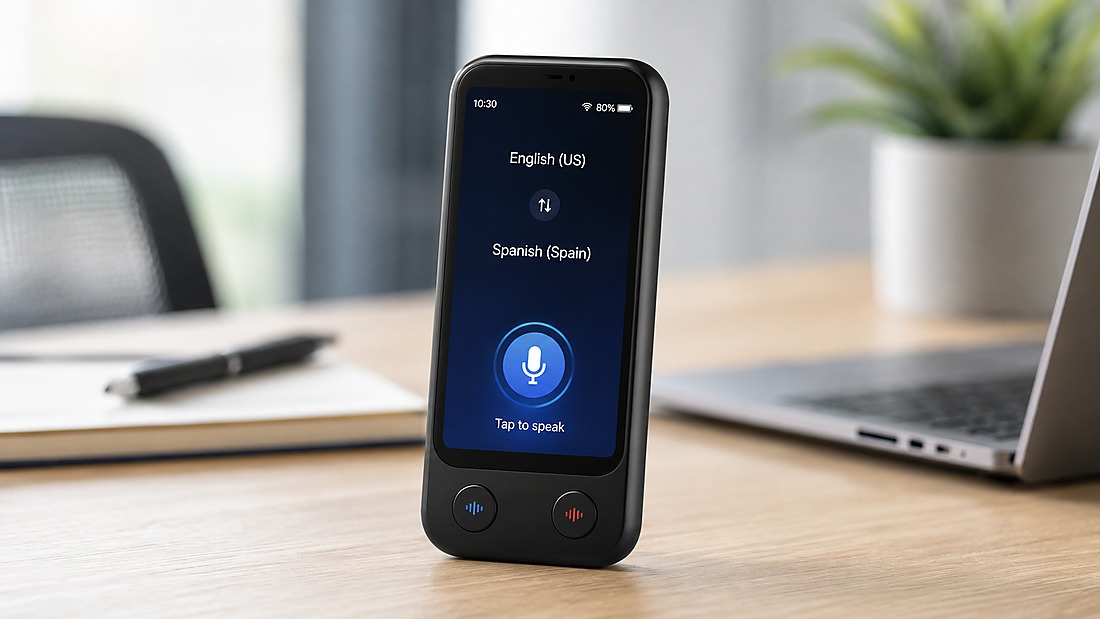
Buyers often ask suppliers for a “sustainability plan” when they should be asking about specific line items. The table below maps the decision points that matter for an eco-friendly ai translator project and notes who controls each one.
| BOM / process area | Buyer decision | Supplier decision | What to request as evidence |
|---|---|---|---|
| Enclosure material | Specify PC/ABS vs. recycled-content resin where the platform allows | Mold design, cosmetic yield, flame requirements | Material datasheet; supplier statement on recycled content if claimed |
| Battery | Capacity vs. runtime target; charging-case inclusion for earbuds | Cell selection, protection circuit, transport documentation where applicable | Battery specification sheet; transport documents for the shipping mode |
| Standby and power behavior | Define auto-sleep, screen timeout, Bluetooth idle policy | Firmware implementation | Firmware behavior description; test method for standby current |
| Packaging | Recycled-content carton, soy/water-based ink, manual reduction, insert material | Print process, structural design, MOQ impact | Packaging spec sheet; material declaration for carton and inserts |
| Accessories | Cable inclusion, adapter inclusion, language-list card vs. printed manual | Standard accessory set | Accessory list per SKU; confirmation of what is excluded |
| Restricted substances | Require RoHS-scope declaration for the target market | Supplier chain declarations, incoming inspection | RoHS declaration and supporting test report where applicable |
| Radio/EMC compliance | Confirm CE/FCC scope for destination market | Test support, technical file preparation | Test reports and declaration of conformity for the specific model |
Two cautions. First, recycled-content resin can change cosmetic appearance and molding yield; on a small pocket translator with a visible housing, that trade-off must be sampled, not assumed. Second, battery capacity is a sustainability lever only if it is matched to real runtime needs — an oversized cell adds mass and shipping cost without improving the user experience.
RoHS, CE and FCC: How Compliance Documentation Fits a Sustainability File
Buyers sometimes treat RoHS as a “sustainability certificate.” It is not. RoHS restricts specific hazardous substances in electrical and electronic equipment; it is a compliance requirement, and its exact scope and current substance list are market-dependent and subject to verification with the applicable authority or a qualified laboratory. What RoHS does give you is a documented material-control trail — which is exactly what a sustainability due-diligence file needs.
A practical documentation stack for a RoHS compliant ai translator project typically includes:
- A RoHS declaration covering the specific model and configuration.
- Supporting test reports from an accredited laboratory, where the buyer or market requires them.
- CE documentation — declaration of conformity and technical file — for EU-bound models, where applicable.
- FCC documentation for US-bound models, where applicable.
- Battery transport documentation for the shipping mode used.
- A change-notification clause so that component substitutions do not silently invalidate the file.
Pineeon is ISO 9001:2015-certified. Whether a specific AI translator model already holds a given certificate, and which party holds it, must be confirmed for the specific project with the applicable authority, laboratory or supplier. Final certification scope, required documents, testing scope and approval depend on the specific product model, configuration, target market, laboratory and applicable authority — and approval is not guaranteed. Buyers should confirm model-specific certificate status and certificate-holder arrangements in the commercial agreement.
Manufacturer-side reasoning: the most common documentation failure is not a failed test. It is a configuration change after testing — a different battery cell, a substituted microphone, a new enclosure resin — that was never reflected in the technical file. Build change notification into the contract, not just the questionnaire.
Battery, Power and Standby: The Engineering Side of “Green”
For a portable translation device, energy behavior is the most technically honest sustainability conversation you can have with a supplier. It is also the easiest to specify.
Ask for the power architecture in plain terms:
- Runtime target vs. cell capacity. Runtime depends on the product form and the selected platform. Translator earbuds, pocket translators and translation pens each have different power profiles, and endurance shifts with screen use, microphone activity, Bluetooth, local AI processing, network connectivity and speaker volume. Treat any endurance figure as model-specific reference information unless the supplier has verified it through testing.
- Standby policy. Auto-sleep timing, screen timeout, Bluetooth idle disconnect and wake behavior. These are firmware settings a buyer can request and a supplier can document.
- Charging architecture. Whether a charging case is included, whether a wall adapter is bundled, and whether the adapter is necessary for the target market.
- Offline vs. cloud processing. Offline language packages require more local compute, memory and storage — which affects power draw. A cloud-first architecture lowers hardware cost but introduces continuous connectivity and cloud-service dependency. Neither is automatically “greener”; the right choice depends on the use case.
Do not accept a battery-life figure as a sustainability claim. Ask for the test method and the conditions under which the number was produced, and treat all endurance values as model-specific reference information unless verified by the supplier’s testing.
Packaging and Accessories: The Fastest Wins in a Custom AI Translator Project
Packaging is where a custom ai translator or private label ai translator project can make verifiable changes without touching the hardware. It is also where buyers most often over-specify and create cost they did not intend.
Decisions you can put directly into the RFQ:
- Carton: specify recycled-content board and request the material declaration. Confirm print process (water-based or soy-based inks where the printer supports them).
- Inserts: replace molded plastic or EVA inserts with molded pulp or paper-based structures where the product’s drop protection allows. This must be validated — a pocket translator with a glass touchscreen needs real protection, and a cheaper insert that fails drop testing is not a sustainability win.
- Manuals: move the full manual to a QR-linked digital version and keep a short quick-start card in the box. Confirm the language set required for the destination market; some markets require a printed manual in the local language.
- Accessories: decide deliberately whether to include a charging cable, a wall adapter and a language-list card. Every excluded accessory reduces material and shipping weight — but it must be consistent with retail expectations and any marketplace requirements.
- Shipper cartons: specify a carton specification that survives the intended freight mode without over-boxing.
Manufacturer-side caution: packaging changes interact with MOQ and tooling. A custom structural insert or a new carton size is a project cost, and it may push a small order into a higher volume band. Confirm the packaging BOM and its MOQ impact before you commit to a retail listing.
A Supplier Questionnaire for AI Translator Manufacturers
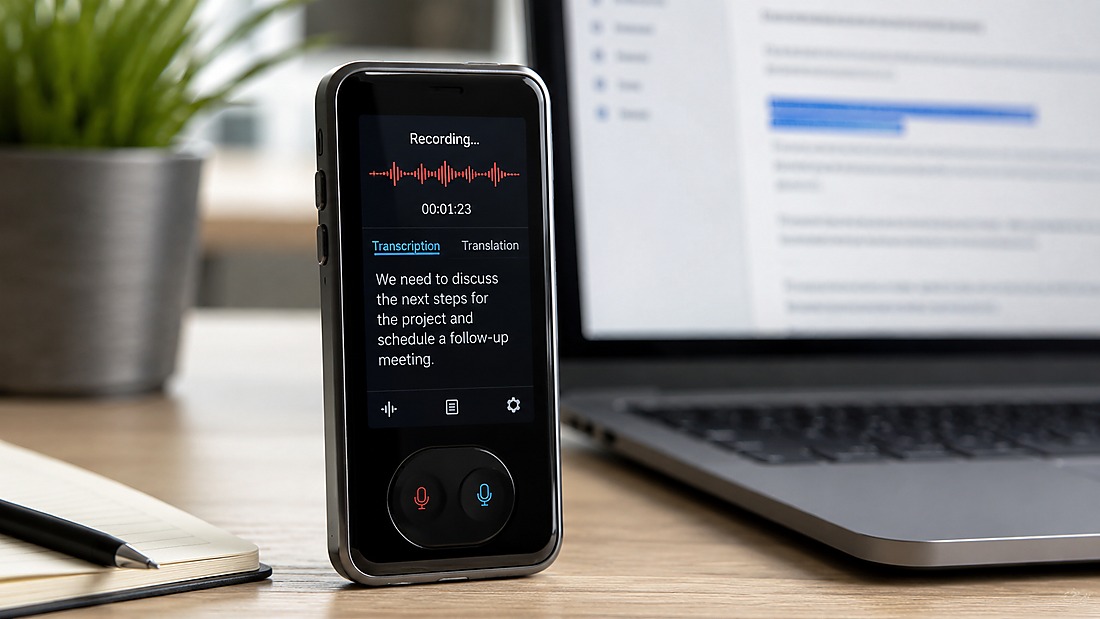
Send this to any ai translator supplier you are evaluating. Score answers on evidence, not enthusiasm. “Yes” without a document is a zero.
- Which quality management system is in place, and is it independently certified? (Pineeon: ISO 9001:2015.)
- Can you provide a RoHS declaration for the specific model and configuration we are quoting? Which laboratory produced the supporting report, if any?
- Which CE and FCC documents can you support for our target market, and which party holds the certificate?
- What is your process for component substitution, and how do you notify customers when a substitution could affect compliance documentation?
- What enclosure materials are available, and can you provide material datasheets?
- What battery cells are used, and what transport documentation is provided for the shipping mode?
- What are the firmware standby and auto-sleep defaults, and can they be configured for our project?
- What packaging materials and print processes are standard, and what recycled-content options are available?
- Which accessories are included by default, and which can be removed?
- What incoming inspection is performed on batteries, housings and electronic components?
- Can you provide a sample of the proposed packaging and enclosure finish before mass production?
- Which claims in your marketing material can you support with a document, and which are descriptive only?
Weighted Scorecard: Comparing Suppliers on Verifiable Criteria
Use a 1–5 scale per criterion, multiply by the weight, and compare totals. Adjust weights to your market — an EU retail buyer will weight documentation more heavily than a distributor focused on price and lead time.
| Criterion | Weight | What a 5 looks like |
|---|---|---|
| Compliance documentation for the specific model | 25% | Model-specific RoHS declaration, CE/FCC documents where applicable, clear certificate-holder arrangement |
| Quality system and incoming inspection | 20% | Certified QMS, documented IQC/IPQC/FQC/OQC flow, battery and housing inspection records |
| Material and packaging transparency | 20% | Datasheets available, recycled-content options quoted with MOQ impact stated |
| Power and standby design | 15% | Documented standby policy, test method for runtime, battery spec sheet provided |
| Change notification and traceability | 10% | Written substitution process with customer notification |
| Claim substantiation | 10% | Every environmental claim backed by a document; unsupported claims withdrawn on request |
A supplier that scores well on documentation but poorly on change notification is a future compliance problem. A supplier that scores well on packaging but cannot produce a model-specific declaration is a retail-listing risk. The scorecard is designed to surface both.
Verifying Claims Before You Commit to an OEM AI Translator Project
Separate claims into three tiers and treat each differently.
- Tier 1 — Documented: RoHS declaration, test report, certificate of conformity, material datasheet, battery specification. These can be checked against the model and configuration.
- Tier 2 — Process-based: quality system certification, incoming inspection procedure, change-notification process. These can be verified through an audit or a documented procedure review.
- Tier 3 — Descriptive: “eco-friendly,” “green,” “sustainable,” “environmentally responsible.” These are not verifiable on their own. Ask which Tier 1 or Tier 2 item supports the statement. If none does, treat the claim as marketing.
For an OEM ai translator project, add one more check: confirm that the documentation will be issued in the name your retail channel requires, and that the certificate-holder arrangement is written into the agreement. Certification ownership is a commercial term, not an afterthought.
Pineeon Manufacturer-Side Recommendation
From the factory side, the buyers who get the cleanest sustainability outcomes are the ones who bring a short, specific requirement list to the RFQ rather than a broad “green” brief. Our recommendation:
- Define the product form first. Translation pen, pocket translator and translator earbuds have different acoustic, battery and software architectures. Sustainability requirements should follow the form — earbuds need charging-case and acoustic-sealing decisions; pocket translators need screen and standby decisions.
- Put documentation in the RFQ, not the follow-up. Ask for the model-specific RoHS declaration and the applicable CE/FCC documents with the quotation. Which documents can be provided, and their final scope, must be confirmed for the specific model, configuration and target market with the applicable authority, laboratory or supplier.
- Specify packaging as a line item. Recycled-content carton, insert material, manual format and accessory list should each be a written requirement with a sample approval step.
- Write change notification into the contract. This protects the compliance file more than any single test report.
- Sample before you scale. Recycled-content resin, molded-pulp inserts and reduced manuals all need physical validation against drop, print and retail requirements.
If you are planning a private label or OEM AI translator program, start from the AI Translator product platform and bring your sustainability requirements into the first requirement-confirmation call, before quotation and sample development.
Related Pineeon Resources
FAQ
Is RoHS the same as a sustainability certification?
No. RoHS restricts specific hazardous substances in electrical and electronic equipment. It is a compliance requirement, and its current scope is market-dependent and subject to verification. It is useful in a sustainability file because it produces a documented material-control trail, but it does not certify a product as “sustainable.”
Can I require recycled-content packaging on a small private label order?
Often yes, but it depends on the packaging structure and order volume. A carton material change is usually straightforward; a new structural insert may involve tooling and a higher MOQ. Confirm the packaging BOM and its MOQ impact before committing to a retail listing.
Does Pineeon hold CE, FCC and RoHS certification for every AI translator model?
No such blanket claim should be made. Whether a specific model holds a given certificate, and which party holds it, must be confirmed for the specific project with the applicable authority, laboratory or supplier. Final certification scope and approval depend on the specific model, configuration, target market, laboratory and applicable authority, and approval is not guaranteed. Confirm model-specific status before you rely on it.
How do I verify an “eco-friendly AI translator” claim?
Ask which document supports the statement. If the answer is a material datasheet, a RoHS declaration, a packaging specification or a quality-system certificate, the claim has a basis. If the answer is another adjective, treat it as descriptive marketing and do not repeat it in your own retail materials.
Does offline translation make an AI translator more sustainable?
Not automatically. Offline language packages require more local compute, memory and storage, which affects power draw and hardware cost. Cloud-first architectures reduce hardware cost but depend on continuous connectivity and cloud services. The right choice depends on the use case, the target market and the buyer’s data-handling requirements.
What is the single most useful sustainability requirement to add to an RFQ?
A model-specific compliance documentation package plus a written change-notification clause. Together they make the rest of the sustainability conversation auditable, and they protect your retail listing after mass production begins.
Editorial note: This article provides general B2B sourcing and manufacturing information. Legal, regulatory, certification, intellectual-property and market-entry requirements vary by jurisdiction and project. Obtain qualified professional advice and verify the requirements that apply to your product and target market.