The Complete Checklist for AI Translator OEM vs ODM Options
Published November 23, 2026 · Pineeon Insights
Choosing between OEM and ODM for an AI translator is not a branding decision. It is a decision about who controls the hardware definition, the translation software stack, the tooling, the certification file and the data flowing through the device. Buyers who treat OEM and ODM as interchangeable labels often discover the difference only after they have paid a tooling deposit or approved a sample that cannot be legally sold in their target market.
This checklist is written from the manufacturer side of the table. It is designed to be used before you request quotations, before you approve a sample and before you sign a supply agreement. It does not assume a specific model, MOQ or certification outcome, because those depend on the selected platform, configuration and destination market.
Start with the product form, not the engagement model
AI translators are not a single product category. The current manufacturing framework distinguishes three hardware forms, and each one changes what OEM or ODM actually means for your project:
- Translation pen or stick — handheld device with OCR scanning, photo translation, two-way voice translation and, on selected models, offline dictionaries and AI Q&A.
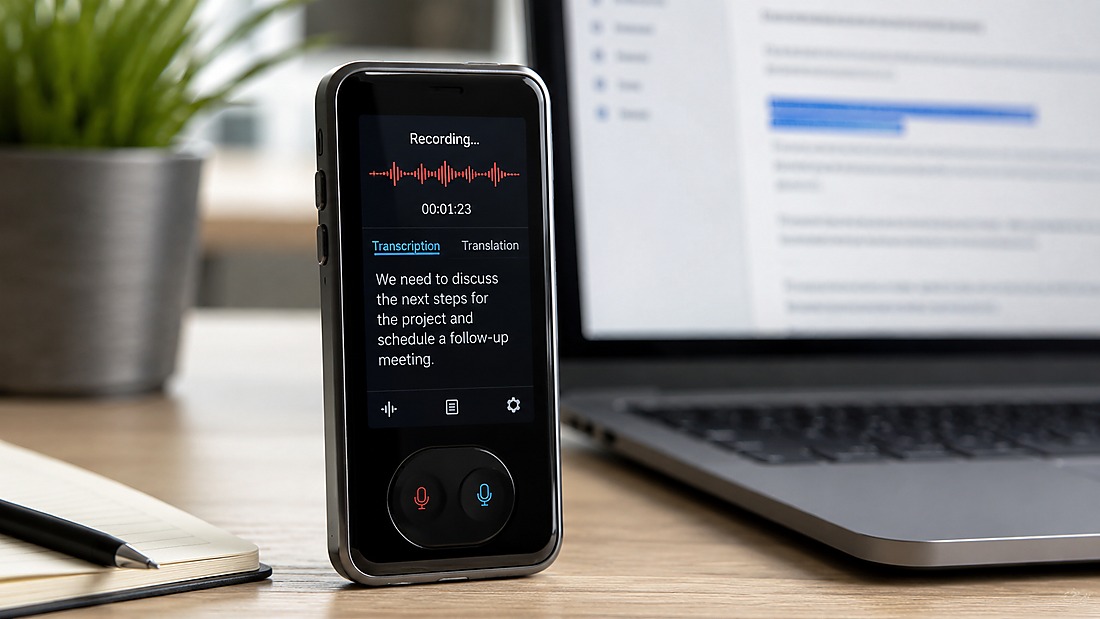
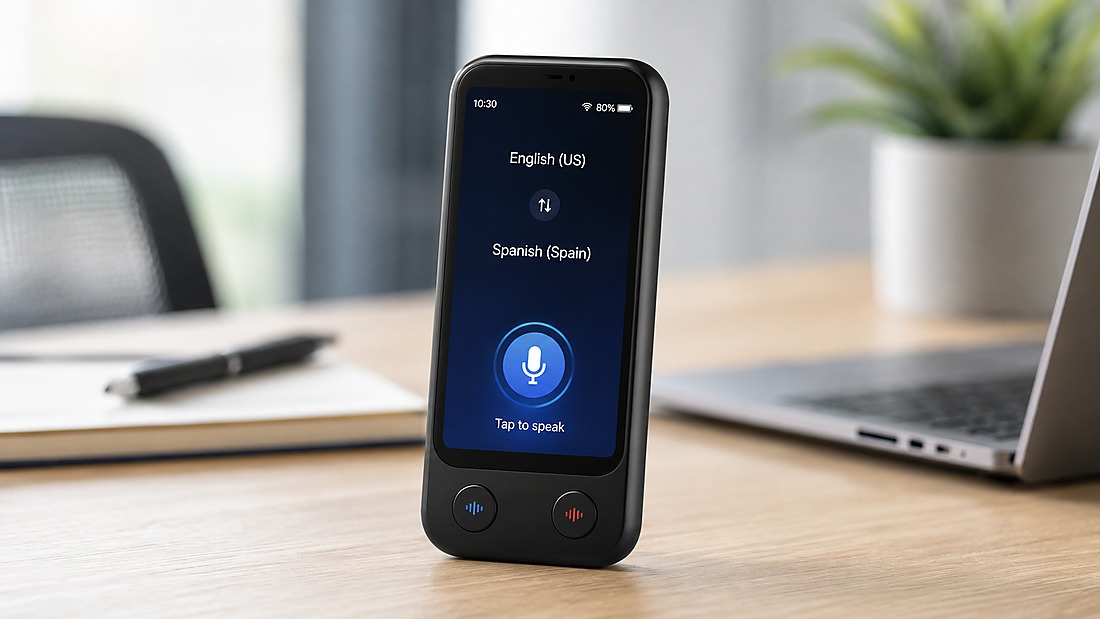
- Pocket translator — standalone touchscreen device with real-time subtitles, speaker and private-listening modes, and standalone operation without mandatory smartphone pairing.
- Translator earbuds — TWS-style device where audio capture and playback sit in the earbuds, while most translation logic is typically handled by the companion app and/or a cloud translation service.
Why this matters commercially: a translation pen project is largely a firmware, OCR and language-package exercise. A pocket translator project is a device-UI and standalone-software exercise. A translator earbuds project is an acoustic, app and cloud-integration exercise. The same factory may support all three, but the customization effort, sample validation criteria and quality risks are different. Define the form first, then decide whether OEM or ODM fits the work you actually need.
OEM vs ODM decision matrix for AI translators

Use the table below to locate your project. “OEM” here means the buyer defines more of the product and the manufacturer builds to that definition. “ODM” means the buyer adopts a manufacturer-developed platform and customizes selected layers. In practice, most AI translator projects sit on a spectrum, so treat each row as a question to answer rather than a binary label.
| Decision area | OEM-leaning project | ODM-leaning project | What to confirm before quotation |
|---|---|---|---|
| Enclosure and ID | Buyer-owned industrial design, new tooling | Existing public mold with logo and color changes | Tooling cost, tooling ownership, mold maintenance responsibility |
| Hardware architecture | Buyer specifies chipset class, microphone layout, battery target | Manufacturer platform BOM, limited component changes | Which components are fixed and which are negotiable |
| Firmware | Deeper changes, possibly source access by contract | Standard firmware with button mapping, indicator behavior, language priority | Whether source code or only binary configuration is provided |
| App / device UI | Customer-owned app or fully custom UI | White-label app: logo, splash screen, app name; optional UI layout changes | Who maintains the app after launch, and who pays for OS updates |
| Translation engine | Buyer-selected ASR, NMT and TTS providers or own backend | Manufacturer-default cloud chain | API account ownership, engine switching rights, per-minute cost responsibility |
| Offline languages | Defined offline package, terminology and priority | Standard offline set where the platform supports it | Storage, memory and licensing implications of each offline language |
| Branding and packaging | Custom color box, accessories, manuals, language cards | Standard box with sticker and manual customization | Artwork approval cycle and packaging MOQ |
| Certification documentation, testing and compliance-support capabilities vary by supplier and project. Confirm the exact scope, responsible parties and available records in writing before relying on them. | Buyer-defined market scope and certificate holder | Manufacturer-supported standard CE, FCC and RoHS applications | Who holds the certificate, who pays, who owns the test reports |
A practical rule: if your differentiation lives in the translation experience — engine choice, terminology, offline coverage, data handling — you need ODM depth in software even if the hardware is standard. If your differentiation lives in the enclosure, brand and channel, an ODM platform with OEM-level branding may be the faster and lower-risk route.
Pre-quotation briefing: what to define before contacting a factory
Most misquoted AI translator projects are misquoted because the buyer has not defined the software and market scope. A factory cannot price an offline-language package it has not been asked for, or certify a device for a market it has not been told about. Prepare the following briefing before you request an OEM AI translator or ODM quotation:
- Device form — pen, pocket translator or earbuds.
- Online language list — the specific language pairs you must support at launch, not a headline count.
- Offline requirement — which languages must work without connectivity, and in which use scenarios.
- Connectivity architecture — Wi-Fi, Bluetooth to phone, hotspot, or a cellular module if truly required.
- OCR or camera translation — required or not; this affects the optical module and firmware.
- Target markets — this drives the certification scope, manual languages and plug/charger accessories.
- App ownership model — white-label app, customized UI, or customer-developed app using an SDK/API.
- Data questions — whether raw voice or translated text may leave the device, where it is stored, and who owns it.
- Volume expectation — sample, market test, standard private label or deep customization, because these carry different MOQ and NRE profiles.
- Commercial constraints — target landed cost range, launch window and any channel-specific packaging requirements.
If you cannot answer items 2, 3 and 7, you are not ready for a meaningful quotation. You are ready for a technical discussion, which is a different meeting.
Tooling, firmware and software ownership: the clauses buyers forget
Ownership is where OEM and ODM projects most often diverge after the purchase order. The following items should be explicitly written into the signed agreement rather than assumed from the engagement label:
- Tooling ownership — who owns the mold, who may move it, who pays for maintenance and who keeps it if the relationship ends.
- Firmware rights — whether you receive binary configuration only, a licensed firmware build, or source-code access under defined conditions.
- App and software rights — who owns the white-label app build, who maintains it after launch, and what happens when a mobile OS update breaks compatibility.
- Translation engine and API accounts — whether the customer can use its own ASR, NMT and TTS accounts, switch providers, and control billing directly.
- Data ownership — who stores raw audio, who stores translated text, whether storage can be disabled, and who owns terminology databases and language packages.
- Exclusivity — whether the platform, ID or language package is reserved for you in your market, and for how long.
- Certification ownership — who is the certificate holder, who owns test reports, and what happens if you change supplier.
None of these are automatic. A factory may be able to support a customer-owned cloud backend or source-code arrangement, but that is a project- and contract-specific decision, not a default feature of the platform. Ask for the clause, not the verbal assurance.
Certification responsibility split
Certification is a shared activity with a single accountable party. The table below shows a typical split; the exact scope depends on the model, radio configuration, battery design and destination market, and should be confirmed with the applicable laboratory, authority or qualified regulatory advisor.
| Item | Buyer responsibility | Manufacturer support |
|---|---|---|
| Market and standard scope | Define target countries and applicable requirements | Advise on typical scope for the product category |
| CE application | Approve scope, holder arrangement and costs | Provide technical documentation and testing support for applicable CE applications |
| FCC application | Confirm US market requirement and holder | Provide technical documentation and testing support for applicable FCC applications |
| RoHS compliance | Confirm market requirement | Support applicable RoHS compliance applications and material documentation |
| Additional schemes (e.g. UKCA, TELEC, BQB, cellular approvals) | Confirm applicability with a qualified advisor | Evaluate per project; not a standard inclusion |
| Final approval | Accept that approval is granted by the authority or notified body, not the factory | Assist with the application process; cannot guarantee approval |
Certification support is a company-level capability that must be confirmed for the specific project. It does not mean every AI translator model already holds every certificate, and it does not guarantee approval or a fixed timeline. Model-specific certification status must be verified against the actual configuration and market with the applicable laboratory, authority or qualified regulatory advisor.
Sample-to-mass-production gate checklist
Approving a sample is not the same as approving a production configuration. For AI translators, the gap between a good sample and a consistent mass-production unit usually appears in acoustics, firmware version control and language packages. Use these gates:
- Gate 1 — Requirement freeze. Device form, language list, offline scope, app model and target markets are documented and signed off.
- Gate 2 — Engineering sample validation. Test speech recognition in real noise, translation latency on your actual network conditions, offline package behavior, OCR accuracy where applicable, microphone noise reduction and Bluetooth stability.
- Gate 3 — Firmware version lock. Record the exact firmware build, app build and language-package version tested. Require written notice before any change after approval.
- Gate 4 — Acoustic consistency check. For translator earbuds especially, verify microphone alignment and acoustic sealing across multiple units, because small assembly deviations reduce ASR performance without being visible in a visual inspection.
- Gate 5 — Packaging and documentation approval. Approve color box artwork, manual language, language-list card and accessory set before bulk packaging begins.
- Gate 6 — Pilot production review. Review yield data and software/hardware consistency from the pilot batch before releasing mass production.
- Gate 7 — Pre-shipment inspection plan. Agree the AQL level, functional test items and reliability test criteria in the quality agreement rather than assuming a default.
The most common failure mode is approving a sample without recording its firmware and language-package version. When the mass-production units behave differently, there is no baseline to compare against.
Red flags in OEM and ODM proposals
Review proposals against this list before you compare price:
- Customization described only as “full support” with no layer-by-layer scope.
- No statement on who owns tooling, firmware, app code or language data.
- Certification mentioned as “included” without naming the market, standard, holder or model configuration.
- Language counts quoted as a headline number without separating online from offline capability.
- Translation accuracy percentages presented as a guaranteed result rather than a platform reference.
- No sample approval criteria and no firmware version control process.
- MOQ and lead time presented as fixed without reference to the selected platform and customization depth.
- Cloud architecture left undefined, including where voice data is stored and who can access it.
Any one of these is a question to resolve. Several together usually mean the proposal is a template rather than an engineering response.
Pineeon Manufacturer-Side Recommendation
Based in Shenzhen and operating since 2000, Pineeon is an ISO 9001:2015-certified OEM/ODM manufacturer serving brands and buyers in more than 40 countries. Our recommendation for AI translator buyers is to choose the engagement model after the software and market scope is defined, not before.
In practice, that means: start with an ODM platform evaluation to understand what the hardware and default software stack can do; then decide which layers you need to own. If your differentiation is the translation engine, terminology, offline coverage or data handling, negotiate those software and contract terms early, because they determine recurring cost and long-term control more than the enclosure does. If your differentiation is brand and channel, a standard private-label configuration with clear firmware version control and an agreed inspection plan is usually the lower-risk path to launch.
Certification documentation, testing and compliance-support capabilities vary by supplier and project. Confirm the exact scope, responsible parties and available records in writing before relying on them.
To review platform options and start a requirement discussion, see our AI translator OEM/ODM and private label manufacturing page.
What to do next
Turn this checklist into a one-page project brief: device form, language pairs, offline requirement, target markets, app ownership model, data rules and volume expectation. Send that brief with your quotation request. A factory that responds with layer-by-layer scope, ownership clauses and a sample validation plan is giving you a manufacturable project. A factory that responds only with a unit price is giving you a starting point for negotiation, not a plan.
Related Pineeon Resources