12 Things to Know About Smart Ring Sourcing for Fitness Brands
Published November 4, 2026 · Pineeon Insights
A fitness brand sourcing a smart ring is not buying a generic accessory. You are buying a sensor platform that has to survive real training behavior: sweaty fingers, changing ring fit through the day, sleep tracking overnight, and users who compare every heart-rate graph against their watch. That changes what you verify before you commit to a smart ring manufacturer.
This checklist is written from the manufacturer side of OEM/ODM projects. It focuses on the decisions that are expensive to reverse after tooling, sample approval or a purchase order. Where a value depends on the selected model, configuration or market, we say so rather than presenting a typical range as a guarantee.
1. Define the fitness use case before you ask for a quotation
Most weak quotations come from weak briefs. A supplier asked for “a smart ring with heart rate and SpO2” will quote the nearest existing platform, and you will spend the next month discovering it does not match your training features.
Before requesting pricing, lock these requirements in writing:
- Primary metrics: resting heart rate, workout heart rate, HRV, SpO2 spot checks, sleep staging, skin temperature trends, step or activity recognition.
- Sampling behavior: continuous versus interval measurement, and how often the app is expected to sync.
- Workout modes: which activities need live heart-rate display, and whether the ring must work without a phone nearby.
- User profile: ring sizes to be offered, typical finger size distribution in your market, and whether users will wear it 24/7 or only overnight.
- App model: your own app, the supplier’s white-label app, or a hybrid.
These five items determine sensor architecture, battery budget, firmware complexity and app scope. They are also the items that most affect your unit cost. A supplier cannot optimize a ring for battery life and continuous high-frequency PPG at the same time without trade-offs you should understand up front.
2. Match the sensor stack to the metric you actually sell

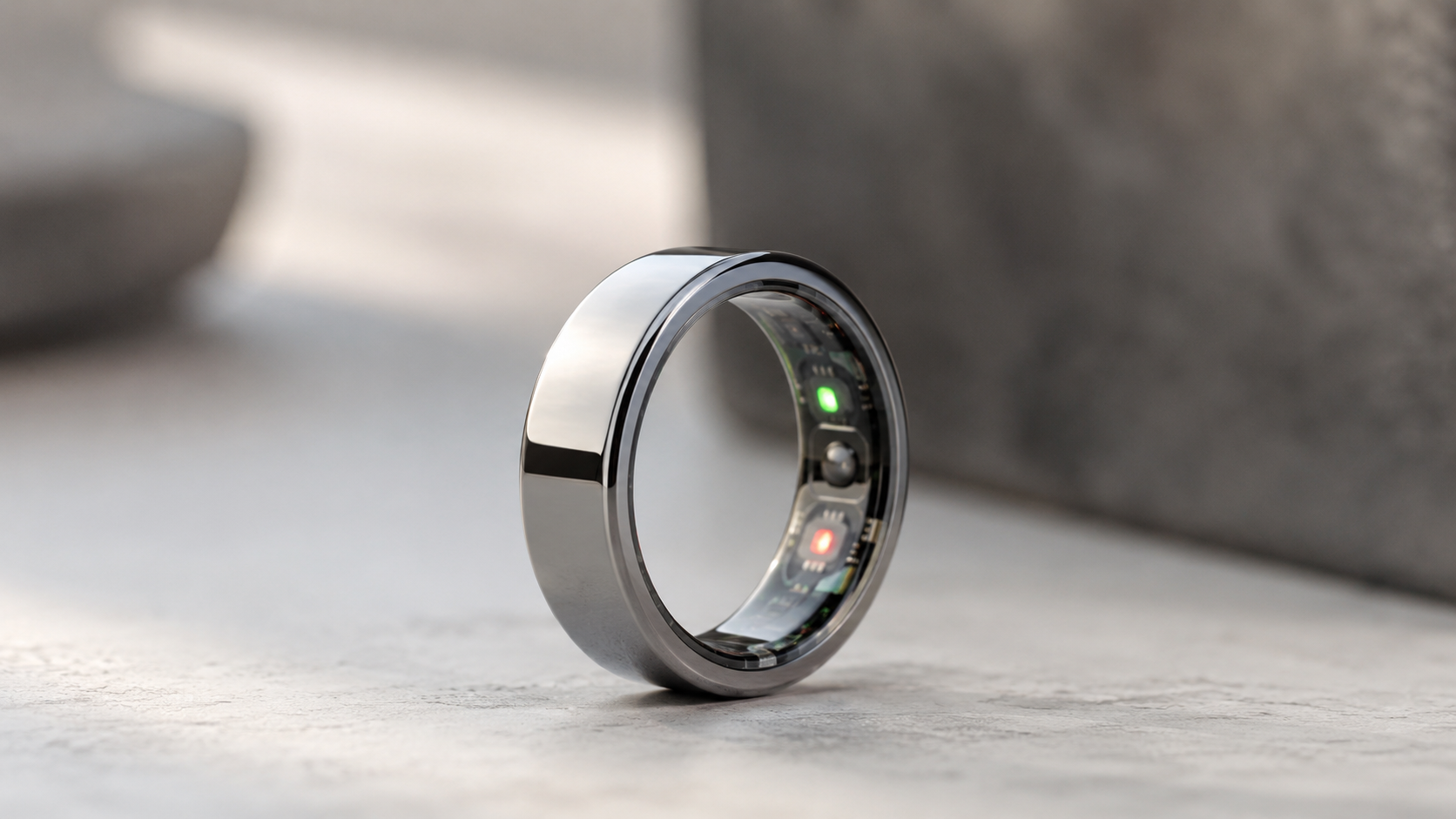
Smart ring sensing is dominated by multi-wavelength PPG for heart rate and SpO2, an accelerometer or IMU for movement and sleep-related inference, and often a skin temperature sensor. Single-lead ECG appears on selected platforms only and should never be assumed as standard across a supplier’s range.
Ask your smart ring supplier to explain, for the specific model you are considering:
- Which PPG component family is used, and whether it is fixed or configurable for your project.
- How optical contact is maintained across ring sizes — the mechanical design matters as much as the chip.
- What firmware and algorithm layer sits between raw sensor output and the metrics shown in the app.
- Which metrics are computed on-device and which are computed in the app or cloud.
Reference component lists are useful for orientation, but a component name in a datasheet is not a confirmed production BOM. Treat any specific chip as unconfirmed until it appears in your approved BOM and golden-sample documentation.
3. Treat ring sizing as a product and returns decision
In small-form-factor wearables, sizing is not a packaging detail. Ring size constrains internal volume, which constrains battery capacity and antenna layout. It also drives fit, and fit drives optical signal quality and comfort.
For fitness buyers, sizing has three commercial consequences:
- Return rate: a ring that fits loosely during workouts produces motion artifacts and poor readings, and users blame the product, not the size.
- SKU complexity: every size is a separate SKU for inventory, packaging and warranty tracking.
- Sampling cost: you need a sizing kit or a multi-size sample set before you can validate fit with real users.
Ask whether a sizing kit can be included in retail packaging, how size tolerances are controlled in production, and what the supplier’s recommended size range is for the selected platform. Confirm the exact size range for your model — do not assume a universal range.
4. Brief the manufacturer when the use case is clear but the spec is not
Many fitness brands arrive with a clear product concept and no engineering specification. That is workable, but only if the brief is structured. A useful briefing pack contains:
- Target user and top three training scenarios.
- Must-have metrics versus nice-to-have metrics.
- Target retail price band and expected order volume band.
- Target markets and languages.
- App ownership preference and any existing backend or platform.
- Branding, packaging and launch window.
With that pack, a manufacturer can propose a platform route: stock private label on an existing mold, standard ODM with firmware and app configuration, hybrid OEM with a dedicated PCBA or sensor configuration, or full custom OEM/ODM with new tooling. Each route has a different minimum order quantity and development cycle. MOQ depends on the selected model, mold, PCBA, firmware, app, material, packaging and certification scope, and must be confirmed in the official quotation rather than assumed from a generic range.
5. Run samples as a fitness validation, not a photo shoot
Sample approval is where fitness brands most often under-test. A ring that looks right and connects to the app is not validated. Build a sample test plan that includes:
- Heart rate comparison during rest, steady-state cardio and interval work.
- SpO2 spot-check behavior and how the app communicates measurement conditions.
- Overnight wear comfort and sleep-data continuity.
- Battery behavior under your intended sampling frequency, not the supplier’s default.
- Water exposure consistent with your claimed use case.
- Bluetooth reconnection after leaving phone range.
- App sync reliability across iOS and Android devices used by your testers.
Sample lead time depends heavily on scope. Logo, packaging or color changes on an existing mold are typically much faster than new enclosure tooling, a custom PCBA or new firmware and app integration. Ask for a sample schedule broken down by task, and treat it as project-dependent.
6. Settle app, SDK and data-access questions early

For a fitness brand, the app is where the product lives. Data access is therefore a commercial term, not a technical afterthought. Before you sign, clarify:
- Whether an Android and iOS SDK is available for your project, and what it exposes.
- Whether raw PPG waveform data is available, or only processed metrics such as heart rate, HRV, SpO2 and sleep-related structured data.
- Whether a cloud API exists for integration with your backend or member platform.
- Who owns the app, the firmware and any custom algorithm work.
- Who controls over-the-air firmware updates after launch.
None of these should be assumed. Open SDK access, raw sensor data, source-code ownership and OTA authority are project- and contract-specific. If your fitness product depends on proprietary analytics, negotiate data rights and firmware ownership in the signed agreement rather than relying on a verbal assurance during sampling.
7. Plan certification before tooling, not after
Certification is a planning sequence, not a final inspection. Radio, battery and enclosure decisions made during tooling affect what can be tested later. A practical sequence for a smart ring project looks like this:
- Confirm target markets and the regulatory scope that applies to a wearable with Bluetooth and a rechargeable battery.
- Confirm the intended claims — wellness versus medical — because claims change the regulatory pathway.
- Agree the test plan and documentation responsibilities with the supplier before tooling release.
- Test pre-production units, not only hand-built samples.
- Confirm certificate holder and model naming before mass production.
Certification scope, required documents, testing scope and approval depend on the specific product model, configuration, target market, laboratory and applicable authority, and approval is not guaranteed. For high-risk regulatory questions, confirm current requirements with the applicable authority, qualified laboratory or regulatory advisor.
8. Verify battery and water-resistance claims against test conditions
Two specifications cause the most post-launch disputes in fitness wearables: battery life and water resistance.
On battery, ask for the test conditions behind any claim: sampling frequency, screen-on time in the app, number of syncs per day, temperature, and ring size tested. Battery life varies by model, size, firmware, sensor sampling and user behavior, so no single figure should be treated as a specification until you have your own test data on production-equivalent units. Do not publish a battery claim before that testing is complete.
On water resistance, IP68 and 5ATM are not technically equivalent and should not be marketed interchangeably. IP68 on representative configurations and 5ATM on selected sports-oriented models are different claims with different test bases. Confirm the exact rating, the test specification and the exclusions — hot water, sauna and prolonged deep diving are commonly excluded. Verify the exact model before you write a marketing claim.
9. Set QC and AQL checkpoints for a small-form-factor device
Ring assembly has less margin for error than a watch or a band. Optical windows, sealing, antenna placement and battery seating are all sensitive to process variation. A QC plan for a smart ring project should name checkpoints, not just promise “strict quality control.”
| Stage | What to verify | Buyer question |
|---|---|---|
| IQC | Incoming sensors, batteries, shells, seals | Which incoming lots are sampled and against what criteria? |
| IPQC | Critical SMT and assembly stages, sealing and optical alignment | Which process steps are inspected in-line? |
| FQC | Functional and appearance checks on finished rings | What functional tests run on every unit? |
| OQC | Outgoing sampling inspection | What AQL level and acceptance criteria apply? |
| Reliability | Water exposure, charging cycles, drop and wear simulation | Which tests are batch-based and how are failures handled? |
AQL 1.5 and AQL 2.5 are common reference levels, but the exact AQL, sampling plan and acceptance criteria must be written into the project quality agreement. Also agree the traceability method — batch labels and serial records — so warranty claims can be traced to production lots.
10. Lock commercial guardrails in the signed agreement
Commercial terms that are “understood” during sampling have a way of disappearing during scale-up. Put these in the contract:
- MOQ: per model, per color and per size, with any ramp or reorder terms.
- Tooling ownership: who owns molds and fixtures, and what happens if you change suppliers.
- IP and exclusivity: industrial design, firmware, algorithms, branding and any exclusivity window.
- Golden sample: the approved reference unit and the change-control process.
- Warranty and failure handling: return thresholds, root-cause analysis and corrective action timelines.
- Certification ownership: certificate holder and model naming.
Ownership of firmware, source code, tooling or intellectual property should not be assumed with any smart ring supplier unless it is defined in the signed project agreement.
11. Compare suppliers with a scorecard, not a price list
Unit price is the easiest number to compare and the least useful on its own. Use a weighted scorecard so that engineering and commercial risk are visible before you negotiate.
| Criterion | What good looks like | Weight (example) |
|---|---|---|
| Sensor and firmware fit | Can explain the metric pipeline and trade-offs for your use case | 20% |
| Sizing and fit process | Sizing kit, tolerance control, fit validation support | 15% |
| App, SDK and data terms | Clear written scope for SDK, API, raw data and ownership | 15% |
| QC and test evidence | Named checkpoints, AQL agreement, reliability test plan | 15% |
| Certification planning | Documentation and testing support with realistic scope | 10% |
| Commercial terms | MOQ, tooling, IP and warranty defined in writing | 15% |
| Communication | Engineering-literate responses within a predictable cadence | 10% |
Score each supplier against the same evidence. A supplier that answers sensor and data questions precisely but quotes a higher MOQ may be the lower-risk choice for a fitness launch.
12. Plan the pilot run before you plan the launch
A pilot run is where you discover whether the approved sample and the production line agree. Define pilot quantity, acceptance criteria, and what must be true before mass production release. Typical gates include golden-sample match, functional yield, water-resistance batch results, app sync stability and packaging/labeling accuracy.
Mass production lead time for smart rings depends on the platform route: standard private label on an existing mold is typically faster than full custom work with new tooling, a dedicated PCBA or new firmware and app integration. Pre-development and certification time sit outside the production window, and Q3–Q4 demand or material shortages can extend schedules. Treat any schedule as project-dependent and confirm it against your purchase order.
Pineeon Manufacturer-Side Recommendation
If you are a fitness brand sourcing a custom smart ring or private label smart ring, the highest-return investment is a written requirements pack before quotation. It forces the sensor, sizing, app and certification conversations into the open while changes are still cheap.
Certification documentation, testing and compliance-support capabilities vary by supplier and project. Confirm the exact scope, responsible parties and available records in writing before relying on them.
Start with the smart ring OEM/ODM product page, then send a brief covering your metrics, sizes, app model and target markets so the platform route can be assessed properly.
FAQ
What MOQ should a fitness brand expect for a private label smart ring?
MOQ depends on the platform route — stock private label on an existing mold, standard ODM, hybrid OEM or full custom — and on mold, PCBA, firmware, app, material, packaging and certification scope. Ask for the MOQ per model, color and size in the official quotation rather than relying on a generic figure.
Can we get raw PPG data from a smart ring supplier?
Raw sensor data access is not standard. It must be separately confirmed and may require explicit ODM contract terms. Ask specifically which data fields the SDK exposes and whether raw waveform access is included.
Is IP68 the same as 5ATM for a fitness ring?
No. They are different claims with different test bases. Confirm the exact rating and test specification for your model, and note that hot water, sauna and prolonged deep diving are commonly excluded.
Does an ISO 9001-certified factory mean the ring is CE certified?
No. Factory quality certification and product certification are separate. Model-specific certification status must be verified with supporting documentation for the exact model and market, and requirements should be confirmed with the applicable authority or qualified laboratory.
How long does a custom smart ring sample take?
It depends on scope. Logo, packaging or color changes on an existing mold are typically faster than new enclosure tooling, a custom PCBA or new firmware and app integration. Ask for a task-level sample schedule and treat it as project-dependent.
Who owns the app and firmware after development?
Ownership is contract-specific. Firmware ownership, source-code ownership, OTA authority and app rights should be defined in the signed agreement rather than assumed from the sample phase.