smart ring sourcing for fitness brands is a key consideration for B2B buyers comparing sourcing, customization and manufacturing options for this project.
Fitness brands looking to add a smart ring to their product lineup face a different sourcing challenge than those buying generic accessories. A smart ring is a sensor-packed wearable that must survive workouts, sweat, and daily wear while delivering accurate health data. The wrong manufacturing partner can lead to poor sensor performance, battery complaints, or compliance delays that stall your launch.
This guide is written from a manufacturer’s perspective, drawing on 20+ years of OEM/ODM experience at Pineeon, an ISO 9001:2015-certified factory in Shenzhen. We’ll walk through the key decisions you need to make when sourcing smart rings for a fitness brand, from evaluating suppliers to managing customization and compliance.
smart ring sourcing for fitness brands: Why Fitness Brands Are Turning to Smart Rings
Smart rings appeal to fitness brands because they offer a discreet, comfortable form factor that users can wear 24/7. Unlike wristbands, rings are less intrusive and can be worn during sleep, making them ideal for recovery tracking, heart rate variability (HRV), and sleep quality analysis—all critical for fitness enthusiasts.
However, the fitness use case imposes specific requirements:
- Durability: The ring must withstand impact, sweat, and frequent hand washing.
- Water resistance: IP68 or better is typically expected for swimming and intense workouts.
- Battery life: Users want at least 4-7 days per charge, which requires efficient power management.
- Sensor accuracy: Heart rate, SpO2, and sleep tracking must be reliable during movement.
- App integration: Fitness brands often need to sync data with popular platforms like Apple Health or Google Fit.
These requirements mean you can’t just pick any smart ring factory. You need a partner that understands sensor integration, firmware optimization, and the specific demands of fitness wearables.
OEM vs. ODM vs. Private Label: Which Model Fits Your Brand?
A structured smart ring sourcing for fitness brands should compare engineering capability, quality control and project fit rather than price alone.
A structured smart ring sourcing for fitness brands should compare engineering capability, quality control and project fit rather than price alone.
Before contacting suppliers, clarify your product strategy. The three common sourcing models are:
| Model | Definition | Best For | Typical MOQ (Reference) |
|---|---|---|---|
| Certification documentation, testing and compliance-support capabilities vary by supplier and project. Confirm the exact scope, responsible parties and available records in writing before relying on them. | Use an existing design with your branding and packaging. | Quick market entry, low investment. | 1,000–3,000 pcs per model |
| ODM (Original Design Manufacturing) | Manufacturer provides the design, but you can customize features, firmware, and appearance. | Brands wanting differentiation without full R&D. | 2,000–3,000 pcs |
| OEM (Original Equipment Manufacturing) | You provide the design or specifications, and the factory manufactures to your exact requirements. | Brands with proprietary technology or unique designs. | 3,000–10,000+ pcs |
Note: MOQ ranges are internal references and must be confirmed with the supplier for your specific project.
For most fitness brands, ODM is a sweet spot. You get a proven hardware platform, but you can customize the firmware algorithms, app UI, and branding to match your fitness niche. If you have a proprietary algorithm or sensor configuration, OEM might be necessary.
Key Technical Specifications to Evaluate
When comparing smart ring suppliers, you need to dig into the technical details. Here are the critical specs to review:
Sensor Architecture
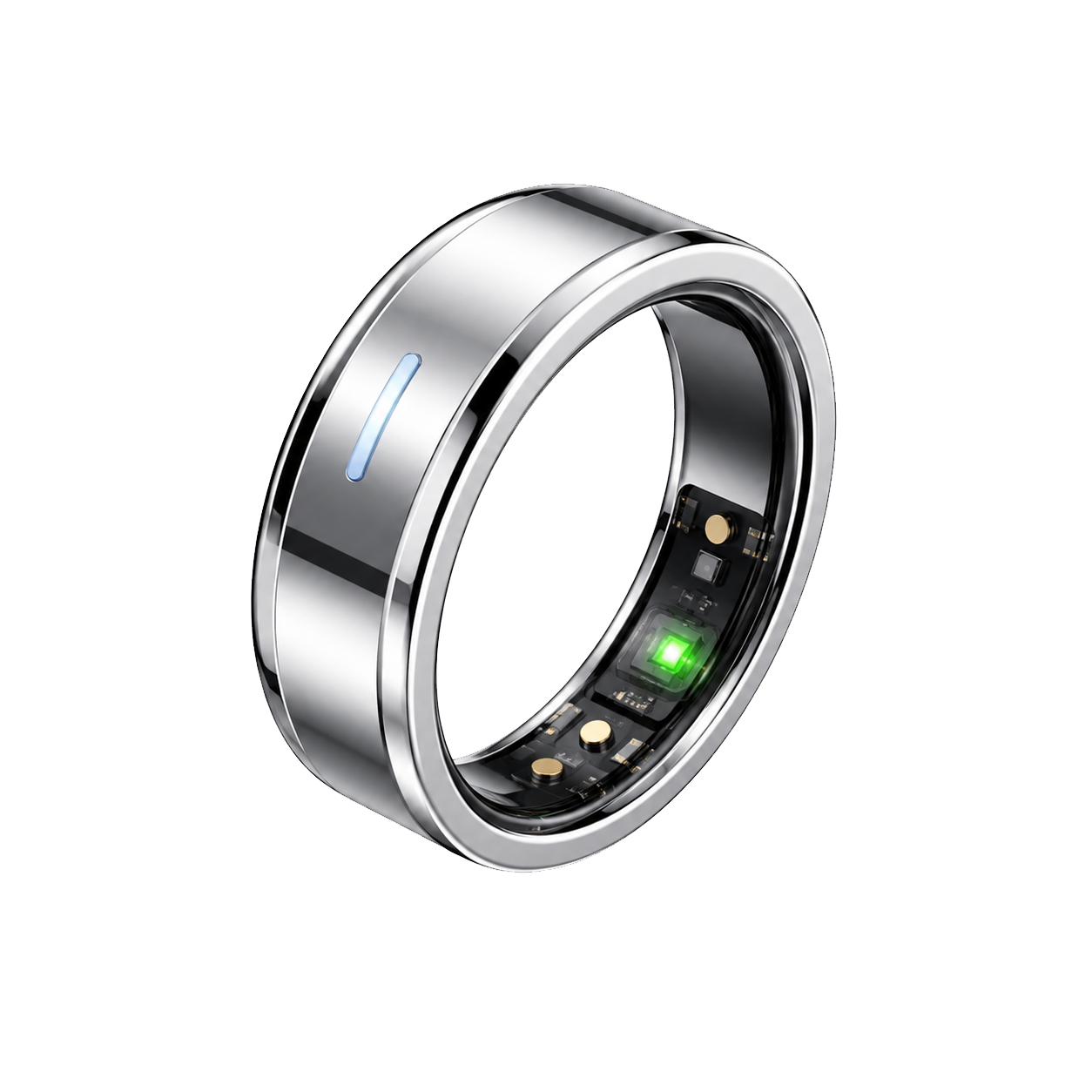
The core of a smart ring is its sensor suite. For fitness tracking, you’ll typically need:
- PPG (Photoplethysmography) for heart rate and SpO2. Look for multi-wavelength PPG for better accuracy.
- Accelerometer/IMU for step counting and activity recognition.
- Skin temperature sensor for recovery and fever detection.
- Optional ECG on some models for advanced heart monitoring.
Ask the supplier which specific sensors they use. Common reference components include Goodix GH3026, MAX30101, or ST LIS2DS12, but the actual BOM must be confirmed for each model.
Battery Life and Charging
Battery life is a major selling point. Typical reference ranges are:
- Standard mode: 4-7 days
- Power-saving mode: 7-10 days
- Charging time: 45-90 minutes
These are estimates and vary by ring size, sensor sampling rate, and firmware. Ensure the supplier provides real-world test data for your target usage.
Water Resistance
For fitness, IP68 is the mainstream standard. Some models offer 5ATM for swimming. Clarify the exact rating and test conditions—IP68 and 5ATM are not equivalent.
Connectivity and App Integration
Most smart rings use Bluetooth Low Energy (BLE). You’ll need to know:
- Does the supplier provide an SDK/API for Android and iOS?
- Can you access raw sensor data (e.g., PPG waveform) for your own algorithms?
- Is there a cloud API for backend integration?
Raw data access may require separate ODM contract terms. Confirm this early if you plan to develop proprietary analytics.
Customization Options: From Hardware to Branding
Customization is where you differentiate your fitness ring. Here’s what you can typically customize:
Hardware Customization
- Materials: Titanium, stainless steel, ceramic, or resin.
- Colors and finishes: Matte, glossy, PVD coating.
- Ring size range: Ensure the design accommodates your target market.
- Sensor configuration: Add or remove sensors based on your feature set.
Firmware Customization
- Algorithms: Adjust heart rate, sleep, or activity algorithms for your fitness focus.
- Features: Enable/disable specific tracking modes (e.g., workout detection).
- Source code access: For deep customization, you may negotiate source-code ownership and OTA authority.
App and Software Customization
- Basic: Logo, app name, splash screen, color theme.
- Mid: UI layout, module order, language packs.
- Advanced: Custom functional modules, integration with your backend, or a fully customer-owned app using SDK/API.
Branding and Packaging
- Logo engraving on the ring.
- Custom color box, gift box, or EVA insert.
- Inclusion of a sizing kit.
- Barcodes, labels, and batch traceability.
Each customization level affects cost and lead time. Full custom hardware can extend development to 45-90 days or more.
The Development Process: From Sample to Mass Production
For B2B buyers, a useful smart ring sourcing for fitness brands also checks documentation, communication and scalability before supplier approval.
For B2B buyers, a useful smart ring sourcing for fitness brands also checks documentation, communication and scalability before supplier approval.
Understanding the development stages helps you plan your timeline and budget. A typical process looks like this:
- Requirement Confirmation: Define ring size, materials, sensors, app requirements, and target markets.
- Quotation and Sample Fee: Agree on costs for samples and tooling.
- Design and Engineering: If custom mechanical design is needed, 3D structure and appearance are confirmed.
- Sample Development: For existing molds, samples can be ready in 3-7 days. New tooling takes 30-45 days.
- EVT/DVT: Engineering and design validation testing to ensure functionality, battery life, water resistance, and app connectivity.
- Golden Sample Approval: You approve the final sample before mass production.
- Mass Production: Typically 15-30 days for standard private label, longer for custom projects.
Always build in buffer time for unexpected issues. Q3-Q4 can extend lead times by 1-3 weeks due to high demand.
Compliance and Certification: What Fitness Brands Must Know
Compliance is a critical but often underestimated part of smart ring sourcing. Requirements vary by target market and product features. Here’s a breakdown:
Common Certifications
- CE: Required for sale in the European Economic Area.
- FCC: Required for wireless devices sold in the US.
- RoHS: Restricts hazardous substances in electronics sold in the EU.
These are the most common, but you may also need Bluetooth Qualification (BQB), CCC for China, or even medical device certifications if you make health claims.
Medical Device Considerations
If your smart ring provides health monitoring that could be interpreted as medical diagnosis (e.g., detecting arrhythmias), you may need FDA 510(k) clearance or EU MDR compliance. This is a separate, regulated project with significant costs and timelines. For consumer wellness devices, avoid making medical claims to stay outside this scope.
How a Manufacturer Can Help
A reputable factory can support applicable CE, FCC, and RoHS certification or compliance applications by providing technical documentation and testing support. However, final certification depends on the specific model, configuration, and target market. Approval is not guaranteed, and you should confirm the scope with the supplier and relevant authorities.
Always verify which certifications the supplier already holds for the specific model you’re sourcing, and clarify who will be the certificate holder.
Quality Control: Ensuring Consistency in Mass Production
Quality control (QC) is what separates a reliable supplier from a risky one. A robust QC process includes:
- IQC (Incoming Quality Control): Inspecting raw materials and components.
- IPQC (In-Process Quality Control): Monitoring SMT and assembly stages.
- FQC (Final Quality Control): Testing functionality and appearance of finished units.
- OQC (Outgoing Quality Control): Sampling inspection before shipment.
Ask the supplier about their AQL (Acceptable Quality Limit) standards. Common references are AQL 1.5 or 2.5, but you should agree on specific criteria in your quality agreement.
Also, check if the factory is ISO 9001:2015 certified, which indicates a formal quality management system. Pineeon is ISO 9001:2015 certified, for example.
Supplier Evaluation Checklist
The goal of a smart ring sourcing for fitness brands is to identify verifiable differences between suppliers and convert them into RFQ questions and acceptance criteria.
The goal of a smart ring sourcing for fitness brands is to identify verifiable differences between suppliers and convert them into RFQ questions and acceptance criteria.
Use this checklist when vetting smart ring manufacturers:
- [ ] Do they have experience with fitness wearables?
- [ ] Can they provide reference components and explain their sensor choices?
- [ ] What is their typical battery life for similar products?
- [ ] Do they offer SDK/API and raw data access?
- [ ] What customization options are available (hardware, firmware, app)?
- [ ] What is their sample lead time and cost?
- [ ] What is their mass production lead time?
- [ ] Do they support CE, FCC, and RoHS applications?
- [ ] What QC processes do they have in place?
- [ ] Can they provide references or case studies (with permission)?
- [ ] Are they ISO 9001:2015 certified?
- [ ] What is their MOQ for your desired customization level?
Don’t just take their word—ask for documentation and, if possible, visit the factory or request a video audit.
Pineeon Manufacturer-Side Recommendation
Based on our experience working with fitness brands, here’s our practical advice:
- Start with a clear product spec. Define your target features, battery life, water resistance, and app integration needs before approaching suppliers.
- Choose an ODM partner for speed. Unless you have proprietary technology, ODM allows you to leverage proven hardware and focus on your brand and software.
- Prioritize sensor accuracy. Ask for test data on heart rate and sleep tracking during movement. A ring that looks good but tracks poorly will fail in reviews.
- Negotiate data access early. If you plan to build your own app or algorithms, ensure the contract includes SDK/API and raw data access rights.
- Plan for compliance from day one. Discuss target markets and certification requirements before finalizing the design. Changes later can be costly.
- Insist on a golden sample. Never skip this step. It’s your baseline for mass production quality.
- Build buffer into your timeline. Assume sample iterations and certification will take longer than expected.
Certification documentation, testing and compliance-support capabilities vary by supplier and project. Confirm the exact scope, responsible parties and available records in writing before relying on them.
Explore our smart ring OEM/ODM solutions to see how we can help.
Frequently Asked Questions
Before final selection, repeat the smart ring sourcing for fitness brands against samples, written specifications and the agreed production scope.
What is the typical MOQ for smart ring private label?
For private label using an existing design, MOQ typically ranges from 1,000 to 3,000 pieces per model. For ODM with more customization, expect 2,000–3,000 pieces. Full custom OEM projects may require 5,000–10,000 pieces. These are reference ranges and must be confirmed with the supplier.
Can I use my own mobile app with a smart ring from an ODM supplier?
Yes, if the supplier provides an SDK/API. You can develop your own app and integrate the ring’s data. However, raw sensor data access may require additional contract terms. Confirm this early in the project.
How long does it take to develop a custom smart ring?
Sample development for existing molds can take 3-7 days, while new tooling takes 30-45 days. Full custom projects, including firmware and app integration, can take 30-60 days for samples and 45-90 days for mass production, excluding certification time.
What certifications do I need to sell smart rings in the US and EU?
For the US, FCC certification is required for wireless devices. For the EU, CE marking (including RED and RoHS) is required. Bluetooth Qualification (BQB) may also be needed. If you make medical claims, additional FDA or MDR compliance is necessary.
How can I ensure the sensor data is accurate for fitness tracking?
Ask the supplier for test data on heart rate and SpO2 accuracy during exercise. Look for multi-wavelength PPG and validated algorithms. You can also request a sample to test with your own fitness protocols.
What is the difference between IP68 and 5ATM water resistance?
IP68 means the device is dust-tight and can be submerged in water up to 1.5 meters for 30 minutes. 5ATM means it can withstand pressures equivalent to 50 meters depth, suitable for swimming. They are not equivalent; choose based on your target use case.
Editorial note: This article provides general B2B sourcing and manufacturing information. Legal, regulatory, certification, intellectual-property and market-entry requirements vary by jurisdiction and project. Obtain qualified professional advice and verify the requirements that apply to your product and target market.