AI Translator Retail Distribution Channels: Common Mistakes to Avoid
Published November 4, 2026 · Pineeon Insights
Most AI translator launches do not fail at the factory gate. They fail earlier, when a brand or importer picks a retail distribution channel after the product configuration is already frozen. Channel choice is not a sales decision layered on top of a finished product; it determines which hardware form, offline language package, packaging, certification scope and after-sales model you actually need. Get the sequence wrong and you end up with a device that is technically fine but commercially mismatched to where it is sold.
This guide is written from the manufacturer side of OEM/ODM projects. It covers the mistakes we see buyers make when planning AI translator retail distribution channels, how each mistake shows up in a real project, and what to confirm with an AI translator supplier before you commit to tooling, language packages or a first purchase order.
Why channel selection must come before configuration lock
An AI translator is not a single product. The current product framework separates translation pens, pocket touchscreen translators and translator earbuds. Each has a different acoustic architecture, software dependency and user expectation. On top of that, the same hardware can be sold as a cloud-first device or with offline language packages, and the companion app can range from a white-label skin to a fully customer-owned application.
Those choices interact directly with the channel:
- Specialty travel retail rewards instant-demo usability, standalone operation and packaging that explains value in seconds. A device that requires app pairing and account setup before the first translation is a poor fit for a shelf where staff cannot onboard every buyer.
- Corporate and enterprise gifting rewards packaging, language-list documentation and predictable configuration. Bulk buyers rarely want a device whose offline capability varies by SKU.
- E-commerce marketplaces reward review resilience, low return rates and clear listing claims. Marketplace returns are driven by unmet expectations, so language-count and latency claims must be conservative and testable.
- B2B reseller networks reward margin structure, spare-unit policy and documentation that a distributor can pass to its own sub-dealers.
The mistake is treating these as interchangeable. If you lock a cloud-only configuration for a travel-retail channel that expects offline use on a plane or in a weak-signal market, no amount of marketing fixes the return rate. Decide the channel, then specify the product against it.
Mistake 1: Over-relying on a single channel before the product is proven

Single-channel concentration is common in first launches because it simplifies forecasting. It also concentrates risk. A private label brand that commits its entire first production run to one marketplace listing has no fallback if listing approval, review velocity or advertising costs move against it. A distributor that commits to one retail chain has no buffer if the chain delists or reduces facings.
Manufacturer-side, the practical consequence is inventory stranded in a configuration that only one channel can absorb. A SKU built with a specific retail packaging format, a channel-specific accessory bundle and a fixed language package is hard to redirect. Multi-channel planning does not require multiple SKUs at launch, but it does require that the base configuration remain sellable through a second channel without rework.
Before you commit, ask the supplier which elements are channel-locked and which are neutral. Logo, packaging artwork and manual language are relatively easy to vary. Offline language packages, app branding and accessory bundles are harder to change after pilot production.
Mistake 2: Ignoring channel-specific certification and labeling scope
Certification is frequently treated as a single checkbox. In practice, the scope depends on the exact model, configuration, radio technology, battery design and destination market. A wholesale AI translator order destined for the EU, the US and Japan does not carry one compliance story.
Certification support and documentation requirements should be discussed with the supplier for each project, but they must not be assumed. Final certification scope, required documents, testing scope and approval depend on the specific product model, configuration, target market, laboratory and applicable authority, and approval is not guaranteed.
The channel-specific mistakes are predictable:
- Assuming a marketplace listing can go live before the responsible-market documentation is settled.
- Assuming a distributor will accept the certificate holder being the factory rather than the brand, or the reverse.
- Forgetting that Bluetooth-based translator earbuds may raise Bluetooth qualification questions that a Wi-Fi pocket translator does not.
- Overlooking that a device with an independent cellular module changes the compliance path substantially compared with Wi-Fi and Bluetooth models.
Confirm with the applicable laboratory, authority or qualified regulatory advisor which requirements apply to your exact configuration and market. Do not let a channel launch date drive a compliance shortcut.
Mistake 3: Mismatching MOQ and inventory to channel velocity
MOQ is one of the most common sources of channel friction. Current internal reference ranges for AI translators are approximately 10 pieces and above for samples or market tests, roughly 500–1,000 pieces for standard private label with logo and packaging customization, and 2,000–5,000 pieces or higher for deep customization such as hardware structure, software UI or offline language packages. These are reference values, not guaranteed commercial terms; final MOQ must be confirmed by official quotation.
The mistake is buying to the MOQ rather than to the channel’s realistic sell-through. A marketplace test channel may only justify a small first order, but the buyer commits to the private label threshold because that is the stated minimum, then carries inventory cost and markdown risk. Conversely, a distributor channel that needs continuous supply may be under-served by a small pilot order, creating stockouts that damage the reseller relationship.
A workable approach is to separate the market-test order from the private label order. Use a small sample or market-test quantity to validate demand and return behaviour in the channel, then commit to the private label volume once the channel proves it can absorb it. Ask the supplier explicitly which customization steps trigger a higher MOQ, because deep offline-language or UI work usually does.
Mistake 4: Underestimating after-sales and firmware update obligations
AI translators are software-dependent consumer electronics. Translation quality, language coverage and app behaviour can change over the product life, and buyers often discover after launch that they have not defined who is responsible for updates.
The channel shapes the obligation. Marketplace sellers face public reviews and platform return windows, so a firmware or app defect becomes visible quickly. Distributors expect a spare-unit and warranty policy they can administer locally. Enterprise gifting buyers expect configuration stability across a single bulk delivery and may not want mid-programme software changes at all.
Before committing, clarify in writing:
- Who owns and issues firmware updates, and on what cadence.
- Whether the companion app is factory-maintained, white-label, or customer-owned.
- Whether translation traffic passes through a factory-operated cloud or a customer-owned API account.
- Who stores raw voice data and translated text, and whether storage can be disabled.
- What the spare-unit and warranty process is per channel.
These are contract-level questions, not marketing questions. SDK access, raw audio access, source-code ownership and cloud account ownership must not be assumed; they are project- and contract-specific.
Mistake 5: Treating language support as a marketing-only decision
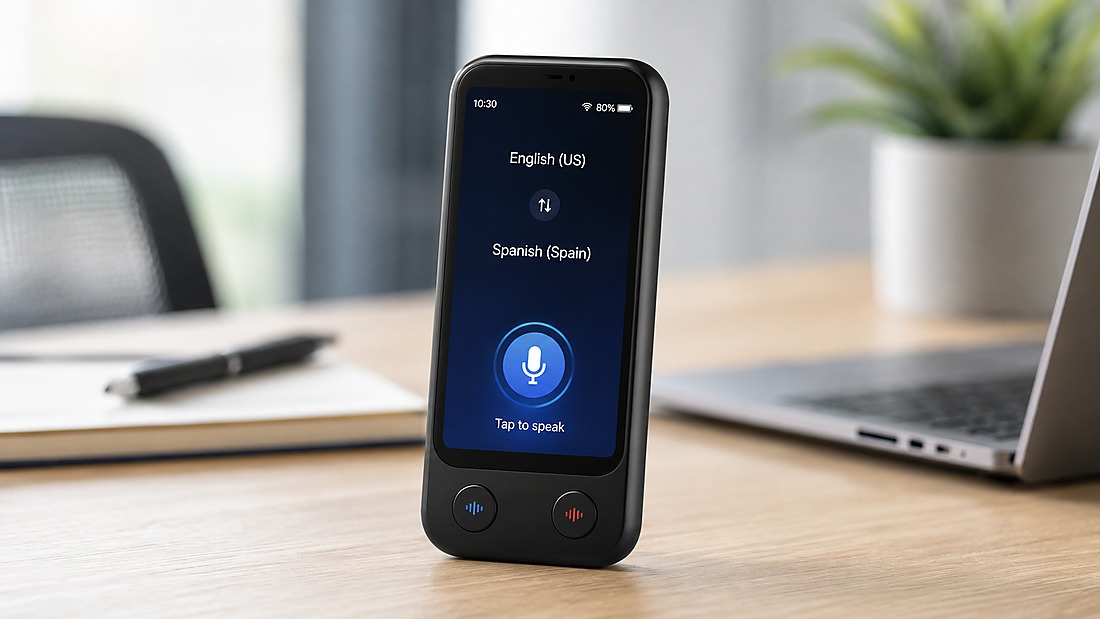
Language claims are where channel expectations and engineering reality diverge most often. Online language counts, offline language counts, accuracy and latency are platform-specific. Industry reference information suggests wide online language coverage and a limited set of offline languages on typical platforms, with selected higher-end platforms supporting far more offline languages. Supplier-claimed accuracy and latency figures exist in the market, but they depend on language pair, accent, terminology, microphone performance, network and translation engine.
The channel mistake is publishing the most generous number the supplier mentioned, then selling into a channel whose buyers test the claim. A travel-retail buyer may try the device in a noisy airport; an enterprise buyer may test industry terminology; a marketplace reviewer may test a less common language pair. If the listing claim is broader than the verified configuration, returns and negative reviews follow.
Separate online and offline capability in every channel asset. State which languages are available offline on the exact SKU being sold. Do not describe cloud translation as offline translation. If offline capability is critical to the channel, make it a specification requirement before chipset and software architecture selection, because offline language packages require additional local compute, memory and storage.
Mistake 6: Creating channel conflict through undisciplined pricing
Brands that sell through both distributors and direct e-commerce frequently create channel conflict without intending to. A distributor that invests in local stock, demo units and retail relationships will disengage if the brand undercuts it on a marketplace listing.
General distribution practice suggests a few disciplines: define a recommended resale price framework before appointing distributors, keep direct-channel promotions time-bound and communicated in advance, differentiate bundles or warranty terms rather than cutting the core unit price, and make the margin structure explicit in the distributor agreement. None of this requires invented market data; it requires that the commercial terms be settled before the first container ships.
From the factory side, the relevant question is whether the product configuration supports differentiation. If every channel receives an identical SKU with identical packaging, price is the only lever left. Packaging, accessory bundles, manual languages and app branding are legitimate ways to differentiate channel offers without changing the core hardware.
Pre-launch channel-readiness checklist for supplier conversations
Use this checklist in your next conversation with an AI translator manufacturer. It is designed to surface channel mismatches before quotation and sample approval.
| Area | What to confirm | Why it matters by channel |
|---|---|---|
| Device form | Translation pen, pocket translator or translator earbuds; standalone or app-dependent | Travel retail needs standalone usability; earbuds suit app-centric buyers |
| Connectivity | Wi-Fi, Bluetooth, hotspot or cellular module | Cellular changes compliance path; offline needs local compute |
| Language scope | Online languages and offline languages for the exact SKU | Marketplace claims must match tested configuration |
| App model | White-label, UI-customized or customer-owned app | Enterprise buyers may require customer-owned backend |
| Data handling | Who stores raw audio and translated text; storage disable option | Privacy expectations differ by market and buyer type |
| Certification | Applicable CE, FCC, RoHS scope; certificate holder; additional market requirements | Distributors and marketplaces ask for documentation |
| MOQ and velocity | Reference MOQ per customization level; pilot vs volume order | Prevents overstock in slow channels and stockouts in fast ones |
| Lead time | Sample and mass-production reference ranges; delay risks | Channel launch dates depend on certification and acoustic tuning |
| After-sales | Firmware update ownership; spare-unit and warranty process | Marketplace returns and distributor support depend on it |
| Packaging | Standard or custom color box; manual languages; accessory bundle | Channel differentiation and retail shelf compliance |
Treat every value in this table as project-dependent until confirmed in an official quotation and, where relevant, by the applicable laboratory or regulatory advisor.
How to verify a supplier is ready for multi-channel distribution
Supplier readiness is not a single audit. It is a set of confirmations that map to your channel plan. Ask for the following, and expect answers that distinguish what is standard from what is project-specific.
- Configuration support: which device forms and connectivity architectures the supplier can actually build, and which offline language packages are available on which platform.
- Documentation: what technical documentation and testing support the supplier can provide for applicable CE, FCC and RoHS projects, and what remains the buyer’s responsibility.
- Software ownership: who owns firmware, app, cloud backend and translation-engine accounts, and how engine switching would work if you change providers.
- Quality process: whether incoming, in-process, final and outgoing quality control are defined, and which functional tests are performed on every unit versus sampled.
- Acoustic control: for translator earbuds, how microphone alignment and acoustic sealing are controlled, because small assembly deviations reduce speech-recognition performance.
- Commercial terms: MOQ, lead time, tooling and NRE for the specific customization level, confirmed in writing.
Pineeon is a B2B private label Smart Wearable, Computer Peripheral and AI Hardware OEM/ODM manufacturer based in Shenzhen, China, operating since 2000 and ISO 9001:2015-certified, serving brands and buyers in 40+ countries. Those facts describe the company; they do not replace model-specific confirmation for your project.
Pineeon Manufacturer-Side Recommendation
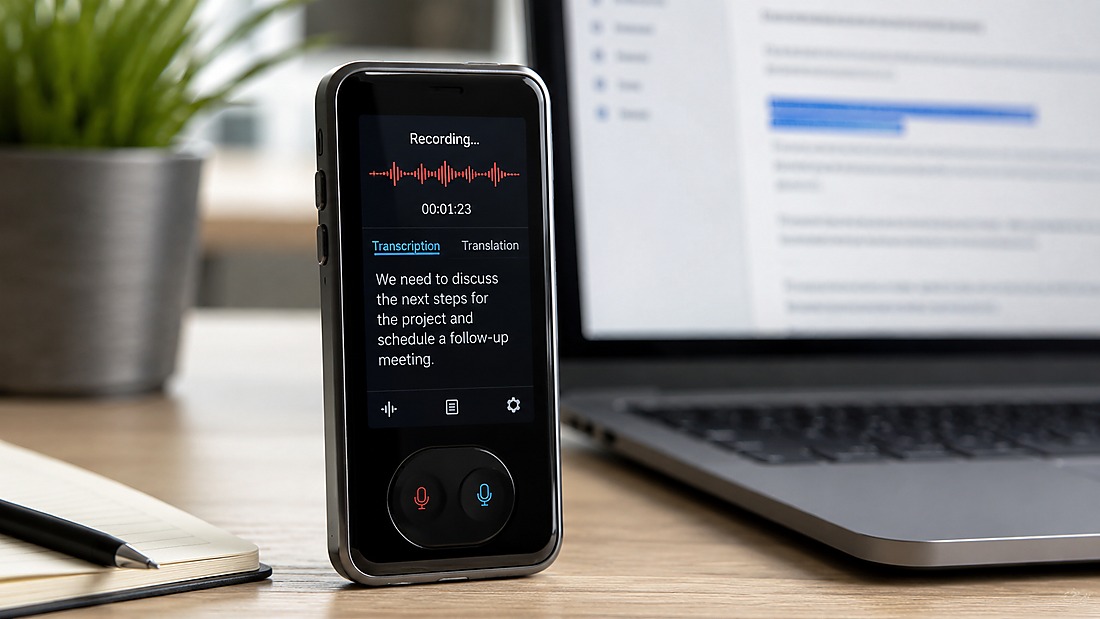
For buyers planning AI translator retail distribution channels, a practical sequence is to settle the channel plan first, then configuration, then certification scope, then commercial terms, then pilot, then volume. Each step should be confirmed for the specific project before the next begins.
Concretely, buyers should consider:
- Name the primary and secondary channels before the first technical call, and state whether offline translation is a hard requirement for either.
- Select the device form against the channel’s demo and onboarding reality, not against a feature list.
- Freeze the language scope, app model and data-handling model in writing before sample approval.
- Confirm applicable certification scope with the laboratory or qualified advisor for the exact configuration and destination markets.
- Run a small market-test order before committing to private label volume, and confirm which customization steps raise MOQ.
- Define firmware update ownership, spare-unit policy and pricing discipline across channels before the first shipment.
For buyers evaluating a private label AI translator OEM/ODM project, the useful next step is a requirement review covering device form, target languages, offline needs, destination markets and channel plan. Final specifications, MOQ, pricing, lead time, certification scope and customization capability are subject to the selected model, technical evaluation and official quotation.
Frequently asked questions
Can one AI translator SKU serve both travel retail and e-commerce marketplaces?
Often yes, if the base configuration is standalone-capable and the language claims are conservative enough for public review. The risk is packaging and onboarding: travel retail needs shelf-explainable value, while marketplaces need listing claims that survive buyer testing. Confirm which elements are channel-locked before pilot production.
Does supplier certification support mean my model is already certified?
No. Certification support and documentation requirements must be confirmed for the specific project with the applicable laboratory, authority or qualified regulatory advisor. Final certification scope, required documents, testing scope and approval depend on the specific model, configuration, target market, laboratory and applicable authority, and approval is not guaranteed.
What MOQ should a distributor expect for a private label AI translator?
Current internal reference ranges are approximately 10 pieces and above for samples or market tests, roughly 500–1,000 pieces for standard logo and packaging customization, and 2,000–5,000 pieces or higher for deep customization. These are reference values only; final MOQ must be confirmed by official quotation for your specific configuration.
Who is responsible for firmware and app updates after launch?
That must be defined in the contract. Depending on the project, the factory may maintain firmware and a white-label app, or the customer may own the app and cloud backend. Firmware, software, cloud backend, language model and API account ownership should be explicitly agreed before development begins.
How should a distributor handle channel conflict with the brand’s direct store?
General distribution practice is to agree a recommended resale price framework, keep direct-channel promotions time-bound and pre-communicated, and differentiate bundles or warranty terms rather than cutting core unit price. The product configuration should leave room for channel differentiation through packaging, accessories and app branding.
Is offline translation necessary for every channel?
No, but it is decisive for some. Travel and field-use channels often expect offline capability, while app-centric earbud buyers may accept cloud translation. Because offline language packages require additional local compute, memory and storage, decide this before chipset and software architecture selection.