An AI Voice Mouse is not a single product category. It is a mature mouse platform combined with microphone input, a desktop software client and cloud AI services. That architecture changes how you should evaluate an AI Voice Mouse manufacturer. A supplier that builds excellent mice may still be the wrong partner if it cannot maintain a software client, document its cloud data flow or support the AI features your brand will advertise.
This guide is written for e-commerce brands, importers and procurement teams comparing manufacturers before requesting quotes, samples or OEM/ODM projects. It gives you a weighted selection framework, the AI-specific questions that separate hardware assemblers from software-capable partners, and a verification procedure you can run before committing to a pilot run.
Why AI Voice Mouse Supplier Evaluation Differs From Standard Mouse Sourcing
In a conventional mouse project, the bill of materials and the tooling largely determine product quality. In an AI Voice Mouse project, the hardware is only one layer. The product’s competitive value depends heavily on companion-software quality, cloud AI integration and long-term software maintenance.
Typical architecture is straightforward: the mouse captures voice through a MEMS microphone, transmits audio to a PC or mobile device over USB or Bluetooth, and the companion software sends audio or text to an ASR or LLM cloud service. The cloud service returns speech recognition, translation or generated output to the software. In most designs, there is no dedicated AI processor inside the mouse.
That means a manufacturer’s real capability is split across three areas: mature mouse hardware, a maintainable software platform, and documented cloud-service integration. A supplier that only provides hardware and a basic software shell will leave your brand exposed when users report transcription errors, translation gaps or privacy concerns.
Weighted Manufacturer Selection Scorecard
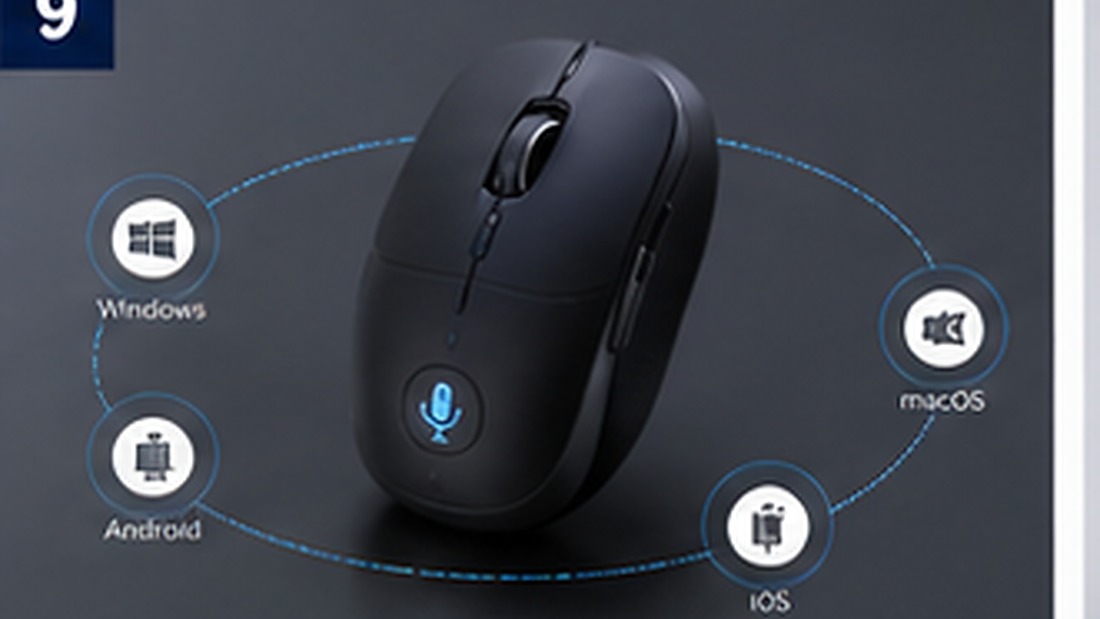
Use a weighted scorecard rather than a single pass/fail checklist. The weights below reflect the risk profile of an AI Voice Mouse project, where software and data handling carry more long-term risk than the mouse mechanism itself.
| Evaluation area | Suggested weight | What to verify |
|---|---|---|
| Mouse hardware platform | 15% | Optical sensor options, wireless mode (2.4GHz, Bluetooth or dual), DPI range, button and scroll-wheel feel, battery capacity and charging interface |
| Microphone and audio capture | 15% | Single or dual MEMS microphone configuration, pickup distance, noise handling, placement relative to hand position |
| Companion software | 20% | Windows and macOS support, UI customization depth, language packages, update and maintenance process |
| AI and cloud integration | 20% | Which ASR and LLM services are supported, whether customer-owned API keys or cloud accounts can be used, how prompts and workflows are configured |
| Quality system | 10% | IQC, IPQC, FQC and OQC process, functional testing of voice workflow, wireless stability checks |
| Compliance and documentation support | 10% | Applicable CE, FCC and RoHS support, technical documentation, testing coordination, data-handling documentation |
| Export and project experience | 10% | Experience serving overseas brands, packaging and shipping options, communication process, sample and production scheduling |
Score each area from 1 to 5, multiply by the weight and compare total scores across shortlisted suppliers. A supplier that scores well on hardware but poorly on software and AI integration is usually a poor fit for a branded AI product, even if the unit price is lower.
Verifying AI-Specific Capabilities
Generic supplier audits will not reveal whether a manufacturer can support an AI product. Ask for evidence in these five areas.
Microphone array design. Confirm whether the design uses a single microphone or a dual microphone array, where the microphones are placed, and how the enclosure affects pickup. Pickup distance and noise-reduction performance should be validated with your own test recordings, not accepted from a datasheet.
Wake-word and speech-to-text performance. Ask which ASR service is used, whether recognition runs in the cloud or on-device, and how accuracy is affected by language, accent and background noise. Do not accept a single accuracy percentage as a guarantee; request a demonstration using your own audio samples.
On-device versus cloud AI architecture. Most AI Voice Mouse designs rely on cloud services. If a supplier claims on-device AI, ask for the specific architecture and evidence. This distinction affects latency, offline usability, recurring API costs and privacy exposure.
API and model integration. Confirm whether the software can connect to OpenAI, Gemini, Claude, a customer-owned AI model or a customer-owned ASR service. Ask whether your brand can use its own API key and cloud account, and who pays for API usage at scale.
Data-handling questions. These are the questions that most often go unanswered in early supplier conversations:
- Where is voice data uploaded?
- Does the factory operate an intermediate relay server?
- Can the customer use its own API key or cloud account?
- Who stores raw audio, and for how long?
- Who stores transcription results?
- Can data storage be disabled?
- What data-processing agreement applies?
If a supplier cannot answer these questions in writing, treat the software layer as unverified. Data privacy and GDPR-related obligations are software and governance issues rather than traditional hardware certifications, and they should be confirmed with the applicable laboratory, authority or qualified advisor for your target market.
Buyer Checklist: What to Confirm Before Quotation
Use this checklist to structure your first technical conversation. Each item should be confirmed in writing before you compare prices, because scope differences explain most quotation gaps.
- Connectivity: 2.4GHz, Bluetooth or dual-mode; receiver included or not.
- Sensor and DPI: which optical sensor family is used and what DPI range is supported.
- Microphone: single or dual MEMS, placement, expected pickup distance.
- Software: Windows and macOS support, UI customization level, update responsibility.
- AI services: supported ASR and LLM providers, customer-owned API option, prompt and workflow configuration.
- Data flow: upload path, storage location, retention, deletion options, data-processing terms.
- Customization level: white-label branding, UI changes, language packages, custom AI modules, customer-owned backend.
- MOQ: reference quantity for the selected platform and customization level.
- Sample lead time: existing mold versus custom tooling versus software integration.
- Compliance support: applicable CE, FCC and RoHS documentation and testing support for your target markets.
- Packaging: standard or custom color box, manual language, accessory list.
- Ownership: firmware, software source code, cloud backend and API rights as defined in the contract.
MOQ, lead time and customization scope are project-dependent. Treat any figure you receive as a reference until it is confirmed in an official quotation and signed project agreement.
Factory Audit and Sample Testing Procedure
A factory audit for an AI Voice Mouse project should cover both the physical production line and the software workflow. A practical sequence looks like this.
Step 1: Documentation review. Request the quality management documentation, the incoming and outgoing inspection process, and any applicable certification or compliance documentation for the specific model you are considering. Company-level certification support does not mean every model already holds every certificate.
Step 2: Hardware sample validation. Test basic mouse operation, DPI performance, button feel, scroll wheel, wireless stability and battery behavior under normal use. These are mature, testable characteristics.
Step 3: Voice workflow validation. Test microphone pickup in a realistic office environment, speech recognition with your own language and accent samples, translation output and AI assistant response quality. Record the results so you can compare suppliers on the same basis.
Step 4: Software integration validation. Install the companion software on the operating systems your customers use. Check installation, account setup, update behavior, language packages and whether the software works with your own API credentials if that is part of your plan.
Step 5: Pilot run. After sample approval, proceed to a small-batch pilot production. Verify yield, hardware consistency and software consistency across units. Freeze the hardware and software configuration only after the pilot results are acceptable.
The main delay risks in this category are custom enclosure tooling, desktop software development, cloud AI API integration and AI service debugging. Hardware component supply risk is generally lower than for more complex wearable categories because optical mouse sensors, wireless MCUs and microphones use mature supply chains.
Red Flags in AI Voice Mouse Supplier Evaluation
Some warning signs are specific to this product category. Treat the following as reasons to slow down or look elsewhere.
- The supplier cannot explain where voice data is uploaded or stored.
- The supplier describes AI processing as on-device without verifiable architecture evidence.
- The supplier cannot name the ASR or LLM services used by the software.
- The supplier offers only logo replacement and cannot describe UI, language or workflow customization.
- The supplier presents a reference component as the confirmed production component without a verified BOM.
- The supplier quotes a fixed certification outcome, cost or timeline without reviewing your model and target market.
- The supplier cannot describe how the companion software is updated or maintained after launch.
- The supplier treats firmware ownership, software source code or cloud backend rights as automatically included.
- The supplier provides no quality documentation for the specific model.
None of these issues is automatically disqualifying on its own, but a pattern of vague answers across several areas usually indicates that the software and compliance layers are not under control.
Pineeon Manufacturer-Side Recommendation
From a manufacturer’s perspective, the most common sourcing mistake in this category is treating the AI Voice Mouse as a hardware purchase. Buyers who focus only on unit price and mouse specifications often discover after launch that the software cannot be customized to their brand, that API costs are uncontrolled, or that voice data routing was never documented.
Our recommendation is to evaluate the software and AI layer first, then the hardware. Ask for a written description of the data flow, the supported AI services, the customization levels available and the maintenance responsibilities. Only after that should you compare hardware specifications and pricing.
Certification documentation, testing and compliance-support capabilities vary by supplier and project. Confirm the exact scope, responsible parties and available records in writing before relying on them.
If you are comparing suppliers for a private label or custom AI Voice Mouse program, review the product platform and customization options on the AI Voice Mouse product page before requesting a quotation, so your technical questions and commercial expectations are aligned from the first conversation.
Frequently Asked Questions
Does an AI Voice Mouse require a dedicated AI chip?
Normally no. The mouse captures voice and sends audio to companion software on a PC or mobile device. Speech recognition, translation and LLM processing are generally handled by software and cloud services, so the hardware platform remains a conventional wireless mouse design.
What is the most important criterion when comparing AI Voice Mouse manufacturers?
For most branded projects, the software and AI integration layer carries the highest long-term risk. A supplier that can document its data flow, support your preferred AI services and maintain the companion software is usually a better partner than one that only offers a lower hardware price.
Can a private label AI Voice Mouse use our own AI API key?
This can be evaluated as part of a customized software architecture. API request routing, account ownership, billing responsibility and data-processing terms should be defined before development begins, because they affect both cost and privacy exposure.
How should we test speech recognition before mass production?
Test with your own audio samples in a realistic office environment, using the languages and accents your customers will use. Compare suppliers on the same recordings, and document the results rather than relying on a single accuracy figure.
What compliance documentation should we request?
Request documentation for the specific model and target market, including applicable CE, FCC and RoHS support, plus any market-specific requirements. Certification scope and approval depend on the product configuration, laboratory and applicable authority, so confirm requirements with the applicable authority or qualified advisor.
Do basic mouse functions work without internet access?
Yes. Standard pointing, clicking and scrolling operate offline. Cloud-based features such as speech recognition, online translation and LLM interaction generally require network connectivity, so the offline boundary should be clearly described in your product marketing.