AI voice mice are no longer a novelty. They combine a standard mouse with voice capture, desktop software, and cloud AI services to deliver speech-to-text, real-time translation, meeting transcription, and AI assistant interactions. For B2B buyers, the challenge is not finding a supplier that claims to make one—it is finding a supplier that can deliver a reliable, customizable, and compliant product at scale.
Certification documentation, testing and compliance-support capabilities vary by supplier and project. Confirm the exact scope, responsible parties and available records in writing before relying on them.
Understanding the AI Voice Mouse Architecture
Before evaluating suppliers, you need to understand how an AI voice mouse works. The AI capability is not inside the mouse itself. The mouse hardware captures voice and transmits it to a PC or mobile device via USB or Bluetooth. The companion software then processes the audio and sends it to a cloud AI service for speech recognition, translation, or LLM reasoning. The results are returned to the software for display or action.
This architecture has three layers:
- Hardware layer: optical sensor, wireless MCU, microphone(s), battery, buttons, and scroll wheel.
- Software layer: desktop or mobile app that handles speech-to-text, translation, meeting transcription, and AI assistant interactions.
- Cloud AI layer: services like OpenAI, Gemini, Claude, or a customer-owned AI model that perform the heavy lifting.
Because the AI is software-defined, the supplier’s software quality and cloud integration are more important than the hardware alone. A supplier with a mature software platform and documented API integration is worth more than one that only offers a basic shell.
Step 1: Define Your Requirements
A structured ai voice mouse supplier should compare engineering capability, quality control and project fit rather than price alone.
A structured ai voice mouse supplier should compare engineering capability, quality control and project fit rather than price alone.
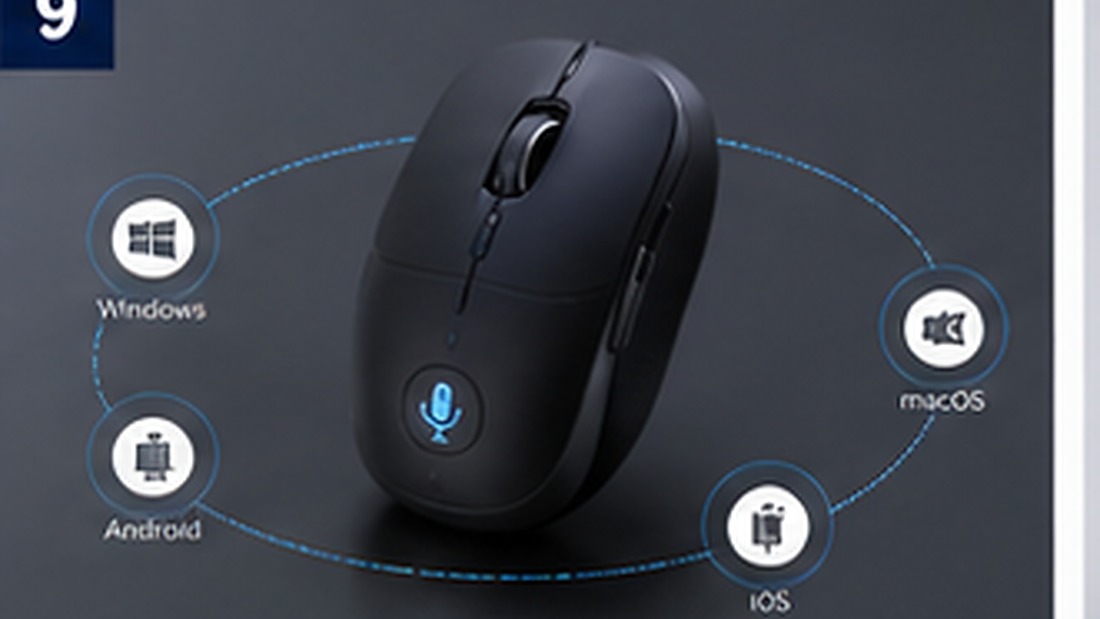
Start by writing a detailed requirement specification. This will be the basis for supplier evaluation and quotation. Include:
- Connectivity: 2.4GHz, Bluetooth, or dual-mode?
- DPI and sensor: What resolution do you need? For office use, 1600-3200 DPI is typical.
- Microphone: Single or dual MEMS? Pickup distance? Noise reduction?
- Software features: Speech-to-text, translation, meeting summary, AI assistant? Which languages?
- Cloud AI provider: OpenAI, Gemini, or customer-owned model?
- Customization level: White-label branding, UI changes, or full custom software?
- Target markets: EU, US, etc., for compliance planning.
- Volume and timeline: MOQ, sample lead time, mass production lead time.
Be specific. Vague requirements lead to vague quotes and mismatched products.
Step 2: Evaluate Hardware Capabilities
Even though AI is software-driven, the hardware must be reliable. Ask about the optical sensor, wireless MCU, and microphone quality. For example, PixArt PAW3212 is a common low-power sensor, while PAW3395 is higher-end. But don’t just take the supplier’s word—ask for the BOM and verify it during sample testing.
Key hardware questions:
- What sensor and MCU are used? Are they from reputable brands?
- What is the microphone configuration? Dual microphones generally improve noise cancellation.
- What is the battery capacity and expected battery life? Typical references are around 1000 mAh and 100 hours of standard use, but these are not guarantees.
- Is the mouse comfortable for long-term use? Ergonomic design matters for office products.
- What is the wireless range and stability? Test for dropouts.
Remember that hardware components are commodity parts. The supplier’s ability to source quality components and assemble them reliably is what matters.
Step 3: Scrutinize Software and AI Integration
This is the most critical step. The software defines the user experience. Ask for a demo of the companion software and test it yourself. Evaluate:
- Speech-to-text accuracy: Test in your target language and with background noise.
- Translation quality: Test a few sentences in different languages.
- AI assistant responsiveness: How fast does it respond? Is the integration stable?
- Cross-platform compatibility: Does it work on Windows and macOS?
- UI/UX: Is the interface clean and intuitive?
Also, ask about the AI architecture:
- Which cloud AI providers are supported? OpenAI, Gemini, Claude, or customer-owned?
- Can you use your own API key or cloud account? This is important for cost control and data privacy.
- Where is voice data routed? Does it go through the factory’s server or directly to the AI provider?
- Who owns the software source code? This affects your ability to maintain and customize the software long-term.
Software customization levels range from basic white-label (logo and splash screen) to full custom (customer-owned backend and AI model integration). Understand what the supplier offers and what it costs.
Step 4: Assess Compliance and Certification Support
For B2B buyers, a useful ai voice mouse supplier also checks documentation, communication and scalability before supplier approval.
For B2B buyers, a useful ai voice mouse supplier also checks documentation, communication and scalability before supplier approval.
AI voice mice are electronic devices, so they need market-specific certifications. Common ones include CE for Europe, FCC for the US, and RoHS for restricted substances. Some markets may require additional certifications like KC (Korea) or PSE (Japan).
Ask the supplier:
- Do you support CE, FCC, and RoHS applications? Can you provide technical documentation and testing support?
- What is the certification process and timeline? It is project-dependent.
- Who holds the certificate? You or the supplier? This affects your market entry.
Be cautious: a supplier may say they support certifications, but that does not mean every model is already certified. Verify model-specific documentation before committing.
Also, consider data privacy compliance. Since voice data is uploaded to the cloud, you need to address GDPR (for EU) and other data protection regulations. Ask about data retention, cross-border transfer, and whether customers can use their own cloud accounts to avoid data passing through the factory’s servers.
Step 5: Review Quality Control Processes
Quality control is non-negotiable. A reliable supplier will have a structured QC process: IQC (incoming), IPQC (in-process), FQC (final), and OQC (outgoing). Ask for details:
- What inspections are done at each stage?
- Do they test microphone pickup, speech recognition, and software integration during FQC?
- What is their AQL (Acceptable Quality Limit) for sampling? Common references are AQL 1.5 or 2.5.
- Do they perform drop tests and button-life tests?
If possible, visit the factory or request a virtual tour. A supplier that is transparent about its QC process is more likely to deliver consistent quality.
Step 6: Request Samples and Run Pilot Tests
Never skip the sample stage. Order samples and test them thoroughly:
- Test basic mouse functions: clicking, scrolling, DPI switching.
- Test wireless stability: move away from the receiver, check for dropouts.
- Test microphone pickup: record in a quiet room and with background noise.
- Test speech-to-text accuracy in your target language.
- Test translation and AI assistant features.
- Test the software on both Windows and macOS if needed.
Document your findings and compare them with the supplier’s claims. If the sample fails, ask for a revised sample or consider another supplier.
Step 7: Negotiate MOQ, Lead Time, and Pricing
The goal of a ai voice mouse supplier is to identify verifiable differences between suppliers and convert them into RFQ questions and acceptance criteria.
MOQ and lead time vary by customization level. For an existing platform with logo and packaging customization, MOQ might be around 500 pieces. For full custom ODM, it could be 3000-5000 pieces. Lead times also vary: 15-30 days for simple customization, 60-90 days for full custom tooling and software development.
Ask for a detailed quotation that breaks down costs: unit price, tooling, software development, certification, and packaging. Be wary of quotes that are too low—they may cut corners on quality or software support.
Also, clarify payment terms, warranty, and after-sales support. A good supplier will offer a warranty and be responsive to issues.
Step 8: Plan for Long-Term Partnership
AI voice mouse software requires ongoing maintenance. Cloud AI APIs change, and new features are added. Choose a supplier that can support long-term software updates and is willing to sign a maintenance agreement.
Also, consider intellectual property. Who owns the firmware, software source code, and cloud backend? Define this in the contract. If you need exclusivity, negotiate it.
Finally, think about scalability. Can the supplier handle your growth? Do they have the capacity for larger orders? A supplier that is flexible and communicative is a better long-term partner.
Buyer Checklist: 20 Questions to Ask an AI Voice Mouse Supplier
| Area | Question |
|---|---|
| Certification documentation, testing and compliance-support capabilities vary by supplier and project. Confirm the exact scope, responsible parties and available records in writing before relying on them. | What optical sensor and MCU are used? |
| Certification documentation, testing and compliance-support capabilities vary by supplier and project. Confirm the exact scope, responsible parties and available records in writing before relying on them. | What microphone configuration? Pickup distance? |
| Certification documentation, testing and compliance-support capabilities vary by supplier and project. Confirm the exact scope, responsible parties and available records in writing before relying on them. | What is the battery capacity and expected life? |
| Certification documentation, testing and compliance-support capabilities vary by supplier and project. Confirm the exact scope, responsible parties and available records in writing before relying on them. | Which cloud AI providers are supported? |
| Certification documentation, testing and compliance-support capabilities vary by supplier and project. Confirm the exact scope, responsible parties and available records in writing before relying on them. | Can we use our own API key or cloud account? |
| Certification documentation, testing and compliance-support capabilities vary by supplier and project. Confirm the exact scope, responsible parties and available records in writing before relying on them. | What customization levels are available? |
| Certification documentation, testing and compliance-support capabilities vary by supplier and project. Confirm the exact scope, responsible parties and available records in writing before relying on them. | Is the software compatible with Windows and macOS? |
| Certification documentation, testing and compliance-support capabilities vary by supplier and project. Confirm the exact scope, responsible parties and available records in writing before relying on them. | Do you support CE, FCC, and RoHS applications? |
| Certification documentation, testing and compliance-support capabilities vary by supplier and project. Confirm the exact scope, responsible parties and available records in writing before relying on them. | Who holds the certificate? |
| Certification documentation, testing and compliance-support capabilities vary by supplier and project. Confirm the exact scope, responsible parties and available records in writing before relying on them. | How do you handle data privacy (GDPR)? |
| Certification documentation, testing and compliance-support capabilities vary by supplier and project. Confirm the exact scope, responsible parties and available records in writing before relying on them. | What is your QC process (IQC, IPQC, FQC, OQC)? |
| Certification documentation, testing and compliance-support capabilities vary by supplier and project. Confirm the exact scope, responsible parties and available records in writing before relying on them. | Do you test speech recognition during FQC? |
| Certification documentation, testing and compliance-support capabilities vary by supplier and project. Confirm the exact scope, responsible parties and available records in writing before relying on them. | What AQL do you use for sampling? |
| MOQ | What is the MOQ for private label vs. full custom? |
| Lead Time | What is the sample lead time? Mass production lead time? |
| Pricing | Can you provide a detailed quotation breakdown? |
| IP | Who owns the firmware and software source code? |
| Certification documentation, testing and compliance-support capabilities vary by supplier and project. Confirm the exact scope, responsible parties and available records in writing before relying on them. | What warranty and after-sales support do you offer? |
| Certification documentation, testing and compliance-support capabilities vary by supplier and project. Confirm the exact scope, responsible parties and available records in writing before relying on them. | Who is our main contact? How responsive are they? |
| References | Can you provide references from similar projects? |
Pineeon Manufacturer-Side Recommendation
From our experience as an OEM/ODM manufacturer, the most successful AI voice mouse projects are those where the buyer and supplier align on software expectations early. Do not underestimate the importance of software customization and cloud AI integration. A supplier that offers a stable software platform with documented API integration is more valuable than one that only provides hardware.
We recommend that buyers:
- Invest time in defining software requirements before contacting suppliers.
- Request a software demo, not just a hardware sample.
- Clarify data routing and privacy controls in the contract.
- Plan for ongoing software maintenance and updates.
- Choose a supplier with a structured QC process and transparent communication.
Certification documentation, testing and compliance-support capabilities vary by supplier and project. Confirm the exact scope, responsible parties and available records in writing before relying on them.
If you are evaluating AI voice mouse suppliers, consider our AI Voice Mouse OEM/ODM solutions. We can help you assess your requirements and recommend a project approach.
Conclusion
Vetting an AI voice mouse supplier requires a structured approach that goes beyond hardware specifications. Focus on software quality, AI integration, compliance support, and QC processes. Use the checklist provided, request samples, and negotiate terms that protect your interests. With the right supplier, an AI voice mouse can be a strong addition to your product lineup.