AI Translator OEM vs ODM Options: Common Mistakes to Avoid
Published November 22, 2026 · Pineeon Insights
Most buyers approach the OEM-versus-ODM decision for an AI translator as a branding question: how much of the product will carry my logo? That framing is the first mistake. On a translation device, the commercially decisive layers are not the enclosure — they are the translation engine, the offline language package, the firmware behaviour and the app or cloud integration. Two projects with identical shells can have completely different cost structures, user experiences and ownership positions depending on which of those layers the supplier actually controls.
This article is written from the manufacturer side, for brands, importers, distributors and procurement teams who are about to commit budget to an OEM AI translator or an ODM-based programme. It lists the mistakes that most often surface after the purchase order — when they are expensive to fix — and gives a verification procedure you can run before signing.
Start with the architecture, not the label
An AI translator is not one product. In current manufacturing practice it is usually one of three hardware forms, and each has a different software centre of gravity:
- Translation pen / stick with display — OCR scanning, photo translation, two-way voice, offline dictionary. The user experience is dominated by camera and OCR performance plus dictionary depth.
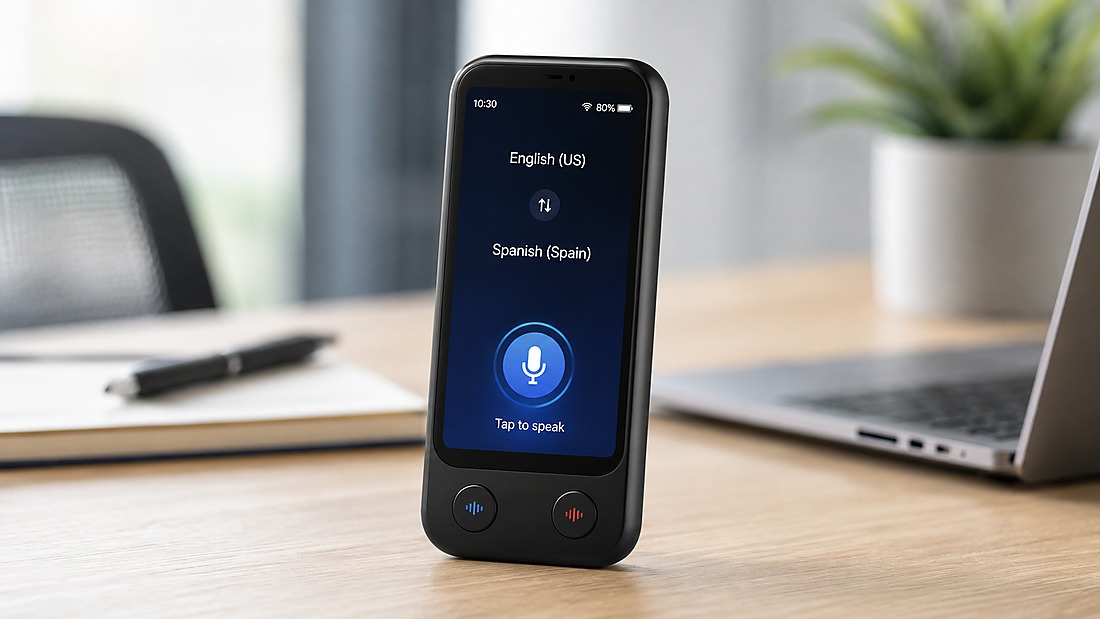
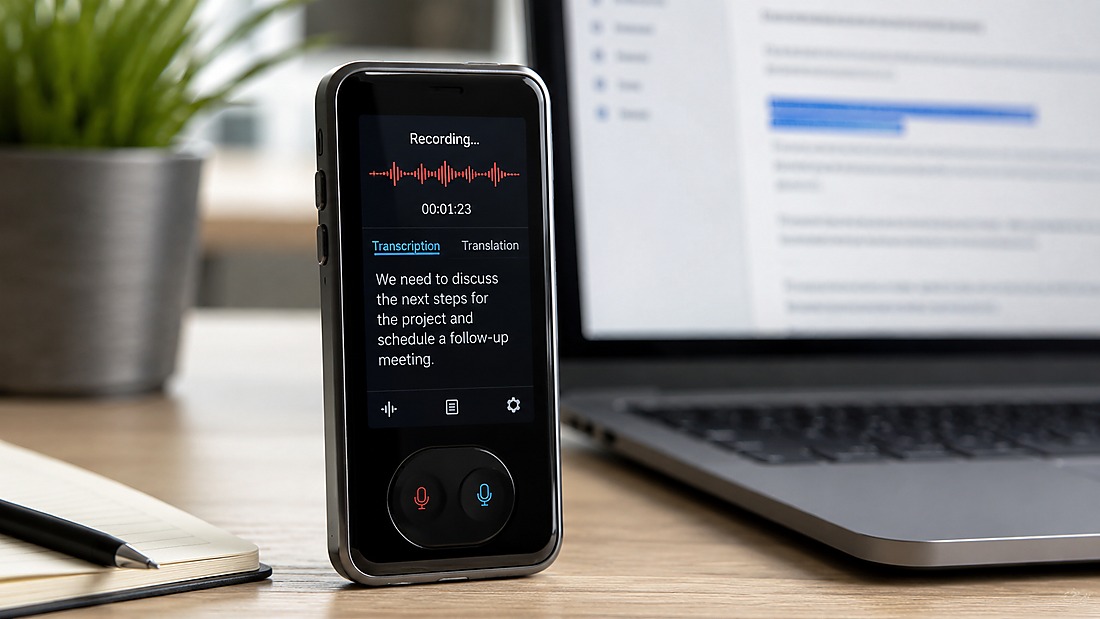
- Pocket touchscreen translator — standalone two-way voice, real-time subtitles, speaker and private-listening modes. The experience is dominated by the device UI and whether it works without a phone.
- Translator earbuds — TWS-style audio capture and playback, with most translation logic handled by the app and/or a cloud service. The experience is dominated by microphone acoustics and Bluetooth stability.
Underneath all three sits a four-layer stack: hardware (SoC, microphone array, screen, battery), firmware (button mapping, indicators, offline package handling), translation engine (ASR speech recognition → NMT machine translation → TTS speech synthesis), and app/cloud integration. OEM and ODM differ mainly in how deep into that stack the supplier will go with you — not in whether your logo appears on the box.
A useful working definition for procurement documents:
- ODM-based programme: you select from an existing platform and customise at the surface layers — logo, packaging, app name and splash screen, language priority, light UI changes. Fastest route to market; least control over the engine and data path.
- OEM / deeper custom programme: you specify hardware structure, firmware behaviour, offline language packages, terminology databases, engine selection or a customer-owned backend. Slower, higher NRE and MOQ, but the product becomes defensible.
The mistake is treating these as a binary. In practice most projects are a mix, and the contract must state exactly which layers are customised and which remain the supplier’s standard platform.
Mistake 1: assuming ODM means no branding control

Buyers sometimes reject ODM because they believe it produces a generic product. In reality, a well-run private label AI translator programme typically covers logo, app name, splash screen, packaging graphics, manual language and accessory selection. What ODM does not usually give you is control of the translation engine, the cloud account, the raw audio path or the firmware source.
The reverse mistake is equally common: buyers assume that because they paid for “OEM”, they automatically own the firmware, the app, the language data and the tooling. Ownership is not implied by the model name. It is created by the signed agreement. If the contract is silent on firmware source access, cloud backend ownership, API account ownership and tooling title, you should assume you do not have them.
Mistake 2: treating “supports 40 languages” as a specification
Language counts are the most abused number in this category. A supplier may quote a large online language count, a much smaller offline count, and a different count again for OCR or photo translation. These are three different capabilities and they are not interchangeable.
Before comparing quotations, force the discussion into separate columns:
- Online languages — available only with network connectivity, usually via a cloud ASR/NMT/TTS chain.
- Offline languages — packaged on the device; require additional local compute, memory and storage, and therefore affect BOM and price.
- OCR / camera languages — relevant only to pen-type devices; dependent on camera module and OCR engine, not on the voice engine.
- Terminology and glossary support — whether you can load brand terms, product names or industry vocabulary, and whether that works offline.
Accuracy and latency claims deserve the same treatment. Supplier-quoted accuracy percentages and latency figures are platform- and network-dependent reference points, not contractual performance. They must be replaced by your own test protocol on your own language pairs, accents and terminology.
Mistake 3: leaving tooling, firmware and data ownership verbal
This is the mistake that costs the most and appears the latest — usually when a buyer tries to move to a second supplier or raise investment. Verbal assurances during a factory visit are not ownership.
Four ownership questions should be answered in writing before any deposit:
- Tooling: who owns moulds and fixtures, who holds them, and under what conditions can they be transferred?
- Firmware and software: is source access included, licensed, or excluded? If licensed, what happens at end of contract?
- Translation engine and cloud: does traffic pass through a factory-operated cloud, or can you use your own API account and switch providers?
- Data: who stores raw voice audio and translated text, for how long, where, and can storage be disabled? Who owns the terminology and language data you supply?
Cloud-first architectures are cheaper on hardware and easier to expand, but they introduce recurring service cost and cross-border data considerations. Offline-capable architectures reduce network dependence but raise hardware cost and language-package management complexity. Neither is wrong — but the choice must be deliberate and documented, because it determines who you depend on for the life of the product.
Mistake 4: skipping acoustic and translation testing at sample stage
Buyers often approve samples on appearance, boot-up and a quick phrase test in a quiet meeting room. That is not a translation test. Speech recognition degrades with distance, background noise, accent and microphone sealing — and on translator earbuds, small assembly deviations in microphone alignment or acoustic sealing can measurably reduce ASR performance without any visible defect.
A sample-stage protocol should include, at minimum:
- Speech recognition across your target accents, not just the supplier’s demo voice.
- Translation latency measured on a real network condition representative of your market.
- Offline package behaviour with the device in airplane mode.
- OCR scanning accuracy on real documents, packaging and screens (pen-type devices).
- Microphone noise reduction in a noisy environment.
- Bluetooth stability and reconnection behaviour (earbuds and app-paired devices).
- Battery endurance under continuous translation, not standby.
Record the results. A signed sample approval with test data attached is a far stronger quality baseline than a photo of a golden sample.
Mistake 5: assuming certification is included, universal or automatic
Certification is project- and market-dependent. A factory’s ability to support CE, FCC and RoHS applications is a capability, not evidence that the specific model you are buying already holds those certificates, and it is certainly not a guarantee of approval.
Most AI translators connect via Wi-Fi, Bluetooth or a phone hotspot, which keeps the certification path relatively simple. If the design includes an independent cellular module, additional cellular and operator approvals must be evaluated. Bluetooth audio devices may also raise Bluetooth qualification questions. Other market-specific schemes apply according to destination and product category.
Before signing, confirm in writing: which certificates are being applied for, in whose name the certificate will be held, who pays for testing and re-testing after design changes, and who supplies technical documentation. Then verify current requirements with the applicable laboratory, authority or qualified regulatory advisor for your target markets.
Buyer decision table: which model fits your customisation depth
Use this table to map your requirement to the right commercial model before requesting quotations. Treat MOQ and lead-time figures as reference ranges only; final values depend on the selected platform and must come from an official quotation.
| Customisation layer | Typical ODM fit | Typical OEM / deep custom fit | What to confirm in writing |
|---|---|---|---|
| Logo, packaging, manual | Yes — standard | Yes | Artwork ownership, packaging MOQ |
| App name, splash screen | Yes — basic white label | Yes | App store account ownership |
| UI layout, language priority | Limited | Yes | Who maintains the UI after launch |
| Offline language package | Usually fixed | Yes, platform-dependent | Storage, memory impact, update path |
| Terminology / glossary | Rarely | Yes | Data ownership, offline availability |
| Translation engine / ASR-NMT-TTS provider | Supplier’s default | Yes, project-dependent | API account, billing, switching rights |
| Firmware behaviour / source access | No | Contract-dependent | Licence scope, escrow, end-of-contract terms |
| Enclosure / tooling | Public mould | Custom tooling | Tooling title, transfer conditions, amortisation |
| Certification documentation, testing and compliance-support capabilities vary by supplier and project. Confirm the exact scope, responsible parties and available records in writing before relying on them. | Supplier’s existing model certificates where applicable | Project-specific applications | Certificate holder, payer, re-test responsibility |
How to verify supplier claims during evaluation
Evaluation is where most of the value is created or lost. Ask for scope confirmation at BOM level rather than brochure level, and separate what is standard from what is optional.
- Request a scope statement per layer. Hardware, firmware, engine, app/cloud, packaging, certification — each marked standard, optional or not offered.
- Ask which components are confirmed for your BOM and which are reference architectures. Audio SoC and local AI SoC choices materially change cost and offline capability; a reference chipset in a presentation is not a confirmed production component.
- Ask for the sample test protocol the factory will run, and compare it with your own list above.
- Ask what the factory’s own final inspection covers — for example whether speech recognition, latency, offline function and Bluetooth stability are checked on every unit or by sampling, and at what AQL.
- Ask who handles certification documentation and testing support, and confirm the scope is limited to applicable markets and configurations.
- Ask for the change-control process — how a firmware or engine change is approved, re-tested and reflected in the certificate file.
If a supplier cannot answer these in writing before you pay for samples, that is itself an evaluation result.
Pre-signature verification checklist
Run this before the deposit, not after the pilot run:
- ☐ Product form fixed: pen, pocket translator or earbuds.
- ☐ Online language list and offline language list documented separately.
- ☐ OCR / camera requirements specified (pen-type only).
- ☐ Connectivity architecture stated: cloud-first, offline-capable or hybrid.
- ☐ Translation engine and API account ownership defined.
- ☐ Raw audio and translated-text storage, location and retention defined.
- ☐ Firmware and software source access defined (included, licensed or excluded).
- ☐ Tooling ownership and transfer conditions defined.
- ☐ MOQ per customisation tier confirmed by official quotation.
- ☐ Sample and mass-production lead times confirmed as project-dependent ranges.
- ☐ Sample test protocol agreed and results attached to sample approval.
- ☐ Certification scope, certificate holder, cost responsibility and re-test rules defined.
- ☐ Packaging, accessories and manual languages specified.
- ☐ Inspection plan and AQL level agreed.
- ☐ Change-control and version-freeze process agreed.
Pineeon Manufacturer-Side Recommendation
Our recommendation to buyers is to decide the architecture before the commercial model. Write a one-page requirement that states the product form, the target markets, the online and offline language lists, whether offline translation is critical, and whether you need to own the engine account and data. Only then ask suppliers whether that requirement sits in their ODM platform or needs an OEM development path.
In our experience evaluating AI translator projects, the projects that run smoothly share three habits: they separate online from offline language claims from day one; they test samples acoustically and on real networks rather than in a meeting room; and they put ownership of tooling, firmware, engine accounts and data into the signed agreement instead of a conversation. Projects that skip these steps tend to discover the gap during certification, during a supplier change, or during the first customer complaint about accuracy.
Certification documentation, testing and compliance-support capabilities vary by supplier and project. Confirm the exact scope, responsible parties and available records in writing before relying on them.
To review the platform options and the customisation layers available for translation pens, pocket translators and translator earbuds, see our AI Translator OEM/ODM product page and request a scope discussion before quotation.
Frequently asked questions
Is ODM suitable if I need my own translation engine?
Usually not at the standard ODM level. Engine selection is a software and cloud-layer change, so it typically belongs to a deeper custom project. It can be evaluated, but the API account, billing, data flow and switching rights must be agreed before development.
Can I get a private label AI translator in small quantities?
Small sample or market-test quantities can sometimes be arranged on selected platforms. Standard logo and packaging private label programmes generally require higher volumes, and deeper software or language customisation requires higher volumes again. Treat all figures as reference until confirmed by an official quotation.
Does a factory’s CE support mean my model is already CE certified?
No. Factory-level support for applicable CE, FCC and RoHS applications is a capability. Model-specific certification status must be verified with documentation for that exact model and configuration, and approval always depends on the laboratory and authority.
Why do translator earbuds fail acoustic testing more often than pens?
Earbuds place the microphone in a very small, sealed assembly where alignment and acoustic sealing directly affect speech capture. Small assembly deviations can reduce ASR performance without any visible defect, so in-process acoustic checks matter more than on pen or pocket devices.
What should I test first on a sample?
Test the thing that decides your product’s value: recognition and translation on your own language pairs, accents and terminology, with the device in the network condition your customers will actually use. Appearance and boot-up come second.
Who owns the language data and terminology I provide?
That must be defined in the contract. Do not assume that supplied glossaries, terminology databases or translated content remain under your control, or that raw audio stays on the device, unless the agreement says so.