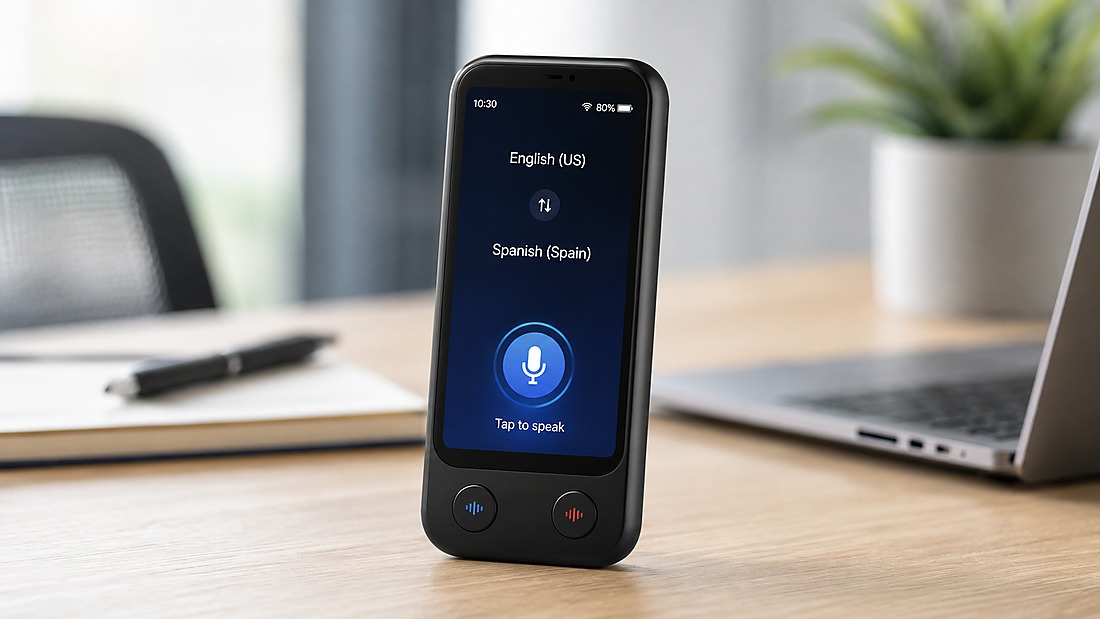
Most dropshipping advice assumes the seller is a solo store owner buying one unit at a time. That is not the situation this article addresses. If you are a wholesaler, importer or distributor, your question is different: can I position myself as the upstream stock-holding or hybrid fulfillment partner for downstream dropshippers selling AI translators — and what breaks if I get the supplier structure wrong?
An AI translator is a poor fit for pure blind dropshipping. The device is only half the product. The other half is a translation engine, a language package, a companion app or standalone firmware, and an OTA update path. When a downstream seller’s customer says “it doesn’t translate Thai offline like the listing said,” the seller cannot fix that. Someone upstream has to. That single fact reshapes how a wholesaler should evaluate wholesale ai translator dropshipping before holding any stock.
Why AI Translators Behave Differently From Typical Dropship SKUs
A phone case fails visibly. An AI translator can fail invisibly — it powers on, connects, and then underperforms on a specific language pair, accent or network condition. Three structural issues drive this:
Firmware and app dependency. Translation logic typically sits in the app and/or a cloud service, not in the audio chip. For translator earbuds, the audio chipset handles capture, transmission and playback while most translation processing happens in software. That means the product’s real performance is defined by a software stack the dropshipper never sees and cannot modify.
Language claims are software claims. Online language counts and offline language counts are not the same thing and should never be marketed as one number. A device may support a broad online language list through a cloud engine while supporting only a much smaller offline set. If your downstream sellers inherit a vague “supports many languages” claim, you inherit the returns.
After-sales requires troubleshooting, not just replacement. A meaningful share of AI translator complaints are configuration, network, app-version or language-package issues rather than hardware defects. A wholesaler without a documented escalation path to the factory will absorb those cases as refunds.
Manufacturer-side view: the product form matters before anything else. Translation pens (OCR and scan-oriented), pocket touchscreen translators (standalone, subtitle and speaker modes) and translator earbuds (TWS, app-assisted) have different acoustic requirements, different software architectures and different failure modes. A wholesaler building a dropship catalog should not treat them as one SKU family with three casings.
Two Fulfillment Models and How Risk Moves Between Them
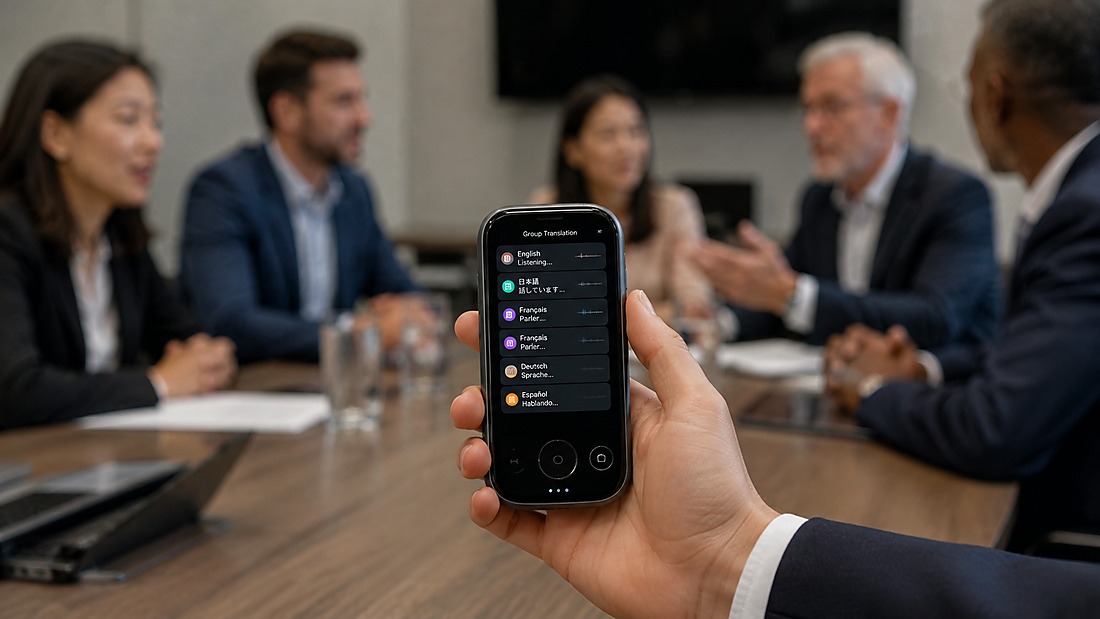
There is no single dropshipping structure. For a wholesaler, the realistic choice is between holding stock and acting as a pass-through, or a hybrid of both. The trade-offs are about lead time, MOQ exposure and who owns the customer problem.
| Model | How it works | Lead time profile | MOQ exposure | Risk allocation |
|---|---|---|---|---|
| Dropship from wholesaler stock | Wholesaler buys bulk AI translator units, holds inventory, ships per downstream order | Short to downstream seller; depends on wholesaler’s own replenishment cycle | Wholesaler carries the full bulk commitment | Wholesaler owns DOA, dead stock and firmware-version drift |
| Direct factory dropship | Factory ships individual orders on the wholesaler’s or seller’s behalf | Longer and more variable; cross-border per-parcel shipping | Low or none per order, but unit economics weaken | Factory owns fulfillment; wholesaler owns the customer relationship and claims |
| Hybrid (recommended for most) | Wholesaler holds a buffer of the highest-velocity configuration and routes long-tail variants or custom-branded units direct | Mixed: fast for core SKU, slower for variants | Moderate; buffer sized to verified sell-through | Split: wholesaler owns core stock, factory owns variant production |
Two practical cautions. First, direct factory dropship of a customized unit is usually uneconomic — private label packaging, logo and app branding carry setup work that does not scale to single parcels. Second, holding stock of a firmware-dependent product means holding a software version, not just hardware. If the factory ships a firmware update mid-cycle, your buffer stock and your new stock may behave differently, and downstream sellers will notice.
For reference, Pineeon’s internal MOQ framework for AI translators distinguishes sample and market-test orders (small evaluation quantities, with selected platforms supporting a minimal evaluation order), standard private label, and deep customization. These are reference ranges, not guaranteed commercial terms — final values depend on the selected model, BOM and official quotation.
A Supplier Verification Procedure for AI Translator Dropshipping
This is the part most wholesalers skip. Before you agree to hold stock or route orders, run the following sequence with any candidate ai translator dropshipping supplier. Each item produces a document or a test result you can hold the supplier to.
- Confirm the product form and architecture in writing. Pen, pocket translator or earbuds. Cloud-first or offline-capable. Standalone operation or mandatory app pairing. Get this in the specification sheet, not in a chat message.
- Separate online and offline language lists. Request two distinct lists with the exact language names and the software version they apply to. Ask which languages are pre-installed versus downloadable.
- Test the actual target language pairs. Do not accept a headline accuracy percentage. Test your downstream sellers’ top language pairs, with at least two accents per language, in a noisy environment and on a weak network.
- Establish OTA update ownership. Who pushes firmware and app updates? How is a version distributed to units already in the field? Who is notified, and how far in advance? What happens to units in a wholesaler’s warehouse during an update cycle?
- Define the DOA and returns window. Get the DOA definition (what counts as dead on arrival), the reporting window, the evidence required (video, serial number, log export) and who pays return freight.
- Confirm who performs first-line troubleshooting. If it is the factory, what is the response channel and language? If it is the wholesaler, what diagnostic scripts and app-version guidance does the factory provide?
- Verify certification documentation scope. Ask which documents exist for the exact model and configuration, and which market they cover. Factory-level compliance support is not the same as a model-specific certificate.
- Confirm serial-number traceability. You need to map a returned unit to a production batch and firmware version, or you cannot separate a defect trend from a user-error trend.
On certification specifically: whether a given supplier can support CE, FCC or RoHS certification or compliance applications, and what documentation or testing support it can provide, must be confirmed for the specific product model, configuration and target market. Final certification scope, required documents, testing scope and approval depend on the specific product model, configuration, target market, laboratory and applicable authority, and approval is not guaranteed. A wholesaler should verify model-specific documentation with the applicable authority, qualified laboratory or regulatory advisor rather than assume it from a supplier’s general capability statement.
What Must Be Contractually Defined Before You Hold Stock
Dropshipping disputes are usually contract gaps, not product failures. For AI translators, four areas need explicit language in the agreement — and all of them are project- and contract-specific rather than standard.
Warranty handling and cost allocation. Define the warranty period, what is covered (hardware defect versus software/configuration issue), who performs diagnosis, who pays inbound and outbound freight, and whether the remedy is repair, replacement or credit. For a dropship model, also define what happens when the end customer returns to the downstream seller rather than to you.
Firmware and software update ownership. State who is responsible for maintaining the app and firmware, for how long, and at what cost. If the translation engine is a third-party cloud service, define who holds that account, who pays for usage, and what happens if the provider changes pricing or terms.
Branding and private label rights. For a private label ai translator program, confirm what you are licensing: logo and packaging only, or also app name, splash screen, UI layout and language-priority configuration. Confirm whether the same hardware configuration can be sold to another buyer in your territory.
Data and language-package rights. Establish whether raw voice audio and translated text are stored, where, and by whom. Confirm whether you can use your own translation API account, whether the engine can be switched, and who owns any custom terminology database you commission. None of these should be assumed — they must be written down.
Where Dropshipping Economics Actually Break
Wholesalers often model dropshipping on unit margin and shipping cost. For AI translators, three cost lines are usually underestimated.
Recurring cloud translation cost. Cloud-first architectures carry an ongoing per-use or per-seat service cost. If your downstream seller prices the product as a one-time hardware sale, that cost lands on someone. Decide early whether it is absorbed, passed through as a subscription, or avoided by choosing an offline-capable configuration for the SKUs where connectivity is unreliable.
Support labor per unit. A translation device generates more pre-sale questions and post-sale troubleshooting than a passive accessory. Budget support time per order, not per defect — the questions arrive before the sale.
Dead stock from version drift. If a newer firmware or a revised language package ships, older buffer stock becomes harder to sell at full price even though the hardware is identical. Keep buffer depth modest and rotate stock on a defined cycle.
There is also a market-fit question. AI translators sell into travel, business meetings, education and language learning. Each segment has different language priorities and different tolerance for offline gaps. A bulk ai translator order built around one segment’s language list may underperform in another. If you serve multiple downstream niches, consider stocking two configurations rather than one compromise SKU.
Pineeon Manufacturer-Side Recommendation

From the factory side of the table, the wholesalers who succeed with AI translator dropshipping are the ones who treat the product as a software-supported device with a hardware component, not the reverse. Concretely, we recommend the following sequence.
Start with a small evaluation order, not a bulk commitment. Use the sample stage to test speech recognition, translation latency, offline language packages, OCR accuracy where applicable, microphone noise reduction and Bluetooth stability against your real target languages. Approve the sample on your own test data, not on a supplier’s summary sheet.
Choose the architecture before the price. Decide whether offline translation is a hard requirement for your downstream sellers. If it is, expect higher hardware cost, larger storage and memory requirements, and more complex language-package management. If it is not, a cloud-first design is cheaper and easier to expand — but you must plan for connectivity dependence and recurring service cost.
Lock the software scope in the same document as the hardware scope. App customization ranges from basic white-label (logo, splash screen, app name) through UI customization (interface layout, language priority, offline-package configuration) to advanced work (enterprise terminology, backend integration, customer-owned app). Each level changes MOQ, lead time and NRE. Confirm which level you are buying before quotation.
Ask about quality control in specifics. Pineeon’s internal quality framework follows IQC, IPQC, FQC and OQC, with final-stage testing covering speech recognition, translation latency, offline-language function, OCR where applicable and Bluetooth stability. For translator earbuds, microphone alignment and acoustic sealing are critical process points because small assembly deviations reduce speech-recognition performance. Ask any supplier how they test acoustic consistency, and whether the answer is visual inspection or functional audio testing.
Plan the after-sales chain before the first shipment. Agree the escalation path, the diagnostic information you will collect, and the firmware-version record you will keep. This is the single highest-leverage operational decision in a dropship model, because it determines whether a complaint becomes a support ticket or a refund.
If you are structuring a private label or OEM program and want to review device form, language priorities and customization scope against your target markets, the AI Translator OEM/ODM product page is the right starting point for a scoped discussion.
Buyer Checklist: Before You Commit to an AI Translator Dropship Program
- Product form confirmed in writing: pen, pocket translator or earbuds
- Online language list and offline language list obtained separately, with software version
- Target language pairs tested with your own accents and terminology
- Connectivity architecture confirmed: cloud-first, offline-capable or hybrid
- OTA update ownership and notification process documented
- DOA definition, reporting window and freight responsibility agreed
- First-line troubleshooting responsibility assigned, with scripts or escalation channel
- Model-specific certification documentation reviewed for your target markets
- Serial-number traceability to batch and firmware version confirmed
- Warranty remedy defined: repair, replacement or credit
- Translation engine account ownership and usage cost allocated
- Data storage, raw audio retention and terminology ownership defined in contract
- Branding rights scope confirmed, including app-level customization
- Buffer stock depth set against verified sell-through, with a rotation cycle
- MOQ, sample lead time and mass production lead time confirmed by official quotation
Final specifications, MOQ, pricing, lead time, certification scope, customization capability, software capability, data access and commercial terms are subject to the selected product model, project requirements, technical evaluation and official quotation. Treat every range in this article as a reference until it appears in your signed agreement.