AI Translator Supply Chain Risk Management: Considerations for Brands Entering Australia
Published November 3, 2026 · Pineeon Insights
Most sourcing problems with AI translators do not appear in the carton. They appear months after launch, when a translation API changes its pricing, an offline language package stops receiving updates, or a microphone batch drifts enough to degrade speech recognition in the field. For a brand entering Australia, the distance from the factory, the small initial order sizes and the local consumer-law environment all amplify those risks.
This guide is written from the manufacturer side of the table. It maps the risk categories that are specific to AI translator hardware, explains which ones matter most for an Australian market entry, and gives you a scoring method to shortlist an ai translator manufacturer before you commit to tooling or mass production. Regulatory points are framed as general considerations only; confirm current requirements with the applicable authority, laboratory or qualified advisor.
Why AI translators carry different supply chain risk than ordinary consumer electronics
A Bluetooth speaker is a closed system. An AI translator is not. Its user-visible performance is the output of at least four layers that may be owned by different parties:
- Hardware — microphone array, acoustic sealing, audio SoC, battery, display or camera module.
- Device firmware — button mapping, power management, Bluetooth behaviour, offline package loading.
- Translation engine — ASR (speech recognition), NMT (machine translation) and TTS (speech synthesis), often cloud-based and often licensed from a third party.
- App or cloud backend — account handling, language selection, data routing and storage.
Each layer has its own failure mode and its own owner. When a buyer asks an ai translator supplier for a quotation, the quote usually covers layers one and two well, and layers three and four only loosely. That gap is where most post-launch risk sits.
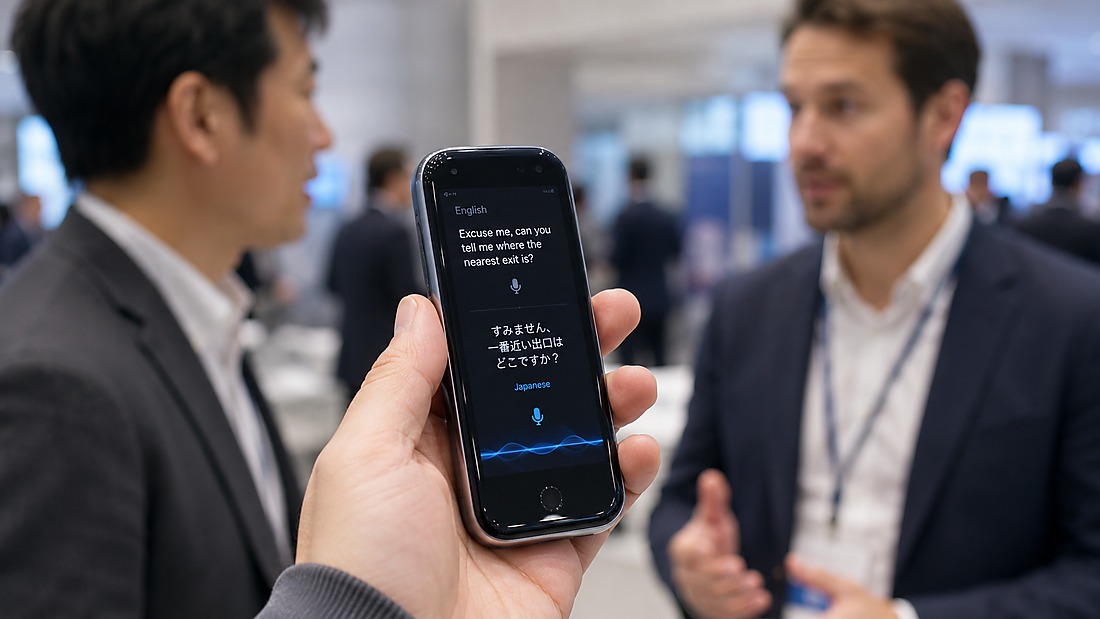
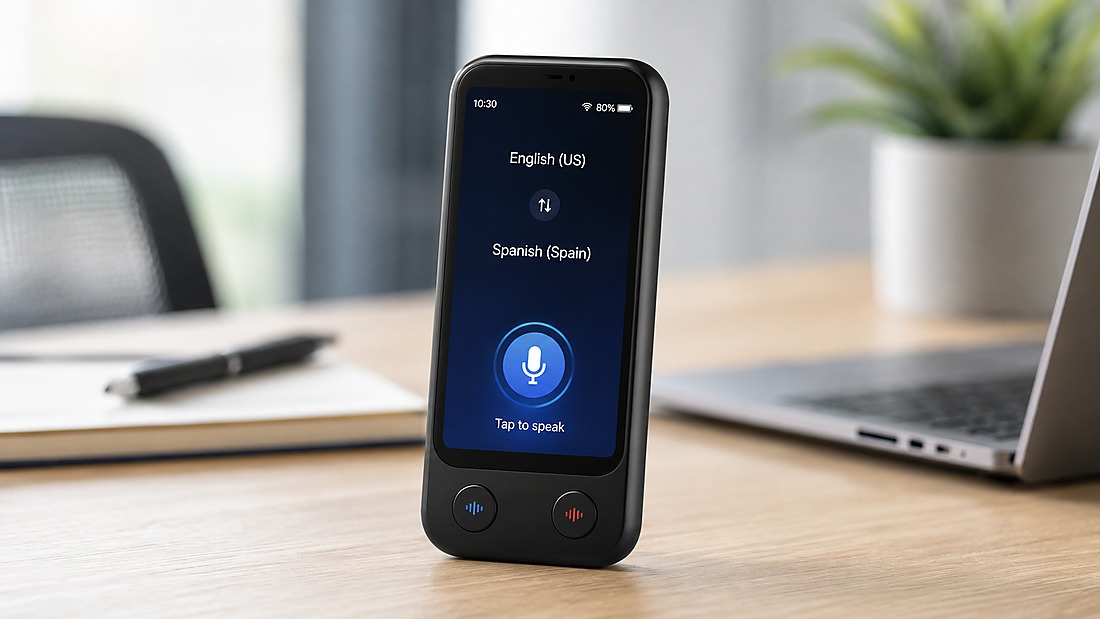
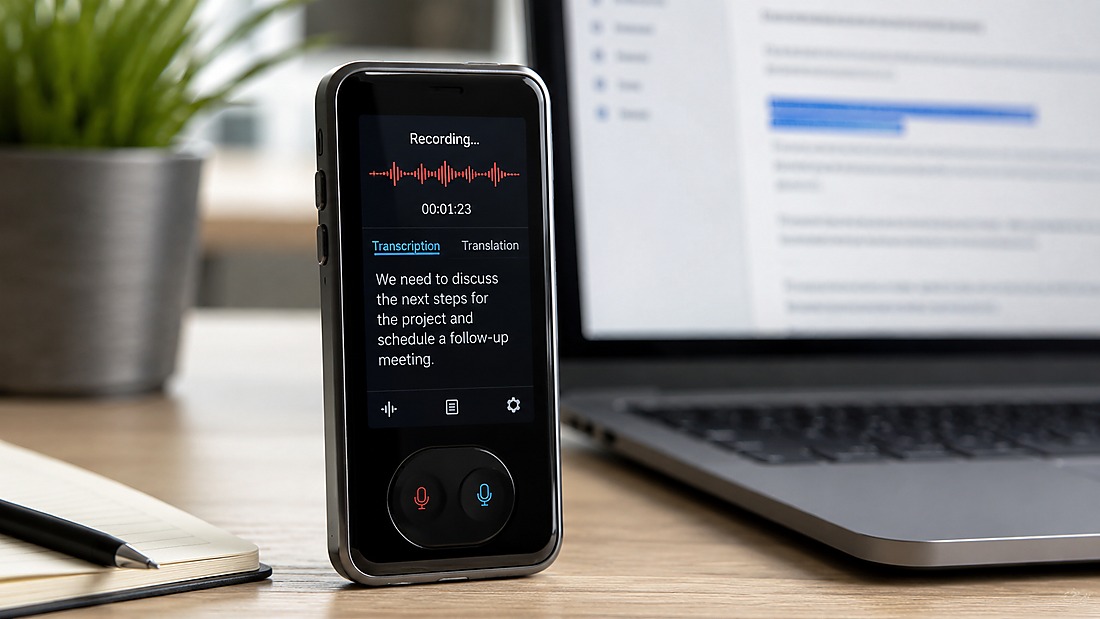
The three common product forms also behave differently. A translation pen (OCR scanning, dictionary, two-way voice) is heavily dependent on camera and OCR quality. A pocket translator is a standalone touchscreen device where the device UI matters more than a companion app. Translator earbuds push most translation logic to the app and cloud, which makes microphone alignment and acoustic sealing the dominant manufacturing risk. Treat them as separate projects, not variants of one.
The five AI translator risk categories that generic logistics advice misses
Freight delays and currency exposure are real, but they are not what sinks a translator brand. These five categories are.
1. Translation engine and API dependency
If your device routes audio through a cloud ASR/NMT/TTS chain, you inherit that provider’s pricing, rate limits, availability and terms. Questions to settle before signing: whose API account is used, who pays for usage, what happens if the provider changes pricing, and whether the engine can be swapped without a hardware change. Engine switching is usually a software or cloud-layer change, which is good news — but only if the architecture was designed for it.
2. Offline language package availability
Offline capability is a hardware-and-storage decision, not a marketing checkbox. It requires local compute, memory and storage, and it raises unit cost. If offline translation is a genuine requirement for your Australian customers — for example, regional travel or enterprise field use — define it before chipset selection. Retrofitting offline capability after tooling is expensive or impossible.
3. Firmware and software update continuity
Who ships the next firmware build in the future? Who fixes a Bluetooth regression after your launch? If the answer is “the factory, informally,” you have an unpriced dependency. Update commitments, response expectations and the party responsible for app-store submissions should be written into the agreement, not assumed.
4. Component sourcing and single-source exposure
Audio SoCs, microphone modules, batteries and display or camera modules each carry lead-time and allocation risk. A reference BOM is not a confirmed BOM. Ask which components have qualified second sources and which do not, and get the answer in writing for the specific model you are ordering.
5. Data handling and cross-border data flow
Voice audio and translated text are personal information in most jurisdictions. Whether raw audio is stored, where it is stored, and whether storage can be disabled are contractual questions. Do not assume the customer controls the cloud account, the engine or the data retention policy unless the contract says so.
Australia-specific compliance touchpoints to verify before ordering
The following is a planning checklist, not legal advice. Requirements vary by product configuration, radio technology, battery design and intended use, and they change. Confirm each item with the applicable authority, an accredited laboratory or a qualified regulatory advisor for your exact model.
| Touchpoint | Why it applies to AI translators | What to confirm |
|---|---|---|
| Electrical safety (RCM framework) | Any mains-connected charger, dock or charging case | Which standards apply to your charger and battery configuration; who holds the declaration |
| EMC | Switching regulators, displays, Bluetooth radios | Test scope for the final configuration, not the prototype |
| Radio communications | Bluetooth and Wi-Fi are standard; cellular modules change the picture | Whether the device is a compliant radio device and under which class; extra scrutiny if a 4G module is added |
| Battery transport | Lithium cells in every translator form | UN38.3 test summary and transport documentation as industry practice; carrier acceptance rules |
| Customs documentation | HS classification, declared value, country of origin | Correct classification for the device form; consistency between invoice, packing list and product labelling |
| Consumer information | Language lists, accuracy claims, warranty terms | That marketing claims match tested performance and that warranty obligations are understood |
Two practical notes. First, a factory’s ability to support certification applications is not evidence that your specific model already holds a certificate — ask for the certificate and confirm the holder and model number. Second, adding a cellular module late in the project can change the compliance path substantially; decide connectivity architecture early.
Supplier due diligence: what to verify beyond the factory audit
A social-compliance audit tells you the factory is well run. It does not tell you whether the translation stack will still work in year two. Split due diligence into two tracks.
Track A — manufacturing and quality system
- Quality management certification and its scope (for reference, Pineeon is ISO 9001:2015-certified).
- IQC/IPQC/FQC/OQC flow, and specifically what is inspected at final QC for acoustic products.
- Whether speech-recognition and translation-latency testing are part of routine final inspection or only engineering validation.
- AQL level, drop test and button or touchscreen life criteria written into the quality agreement.
Track B — software, engine and continuity
- Which ASR, NMT and TTS providers are used, and whether substitution is possible.
- Whether you can bring your own API account or cloud backend.
- Firmware update cadence, bug-fix expectations and who owns app-store releases.
- Offline language package roadmap and how packages are delivered and versioned.
- Spare-part availability and after-sales process for microphones, batteries and displays.
- Ownership of firmware, software, language data and tooling, as defined in the signed agreement.
For a wholesale AI translator programme, Track B is usually the differentiator between two suppliers that look identical on a factory tour.
A buyer verification procedure: sample testing and firmware version control
Sample approval is the cheapest place to find problems. Run it as a protocol, not a demo.
- Freeze the test set before samples arrive. Define target language pairs, at least three accent variants per language, and a terminology list drawn from your actual use case (travel, healthcare administration, education, field service).
- Test in realistic acoustics. Quiet room, café-level noise, and speakerphone distance. Record pass/fail per language pair rather than a single accuracy impression.
- Check microphone and acoustic performance separately from translation quality. A poor result may be a sealing or alignment defect, not an engine problem — and the fix is different.
- Test offline mode with the network disabled. Confirm which languages actually work offline and how the device behaves when a package is missing.
- Measure latency end-to-end on your target network conditions, not the factory’s Wi-Fi.
- Record firmware and app versions on every unit received, and require the same version string on the mass-production units. Version drift between sample and production is a common and avoidable surprise.
- Verify the BOM against the approved sample, including SoC, microphone and battery part numbers.
Keep the approved sample sealed and referenced in the purchase contract. It is the only reliable baseline if a dispute arises later.
Risk-scoring framework for shortlisting AI translator manufacturers
Score each candidate from 1 (weak) to 5 (strong) on the criteria below, weighted for an Australian market entry. Use the weighted total as a discussion tool rather than a pass mark: a low score on engine flexibility or continuity should trigger follow-up questions before you shortlist, regardless of the overall number.
| Criterion | Weight | What a 5 looks like |
|---|---|---|
| Engine flexibility (own API, switchable providers) | 20 | Documented architecture with engine substitution demonstrated |
| Offline capability clarity | 15 | Explicit list of offline languages per model, with storage implications |
| Firmware/software continuity commitment | 15 | Written update and bug-fix expectations, named owner |
| Acoustic process control | 15 | Documented microphone alignment and sealing checks at IPQC and FQC |
| Compliance documentation readiness | 15 | Model-specific certificates and test reports available on request |
| Component second-source and spare-part plan | 10 | Named alternates for critical parts; after-sales spares process |
| Data handling transparency | 10 | Clear statement of what is stored, where, and whether it can be disabled |
Score with evidence, not answers. A supplier that cannot produce a document for a criterion scores 2 regardless of how confident the sales conversation was.
Pineeon Manufacturer-Side Recommendation
From our position as a Shenzhen-based OEM/ODM manufacturer operating since 2000 and serving brands and buyers in more than 40 countries, the pattern we see is consistent: projects fail on the software and continuity layer far more often than on the hardware layer. Our recommendation to brands entering Australia is to sequence the work in this order.
- Decide the architecture before the supplier. Choose device form, online versus offline requirement, and whether you will use the factory’s cloud, your own API account or a customer-owned backend. This decision drives chipset, storage, cost and compliance.
- Buy a small evaluation batch, not a single golden sample. Several units expose unit-to-unit variation in microphone performance that one sample hides.
- Put continuity in the contract. Firmware update expectations, spare-part availability, data ownership and engine-switching rights belong in the agreement, not in email history.
- Treat certification as a project, not a product attribute. Certification scope, required documents, testing scope and approval depend on the specific model, configuration, target market, laboratory and applicable authority, and approval is not guaranteed. For Australia, confirm the applicable requirements for your exact configuration with a qualified advisor.
- Plan a second source before you need one. Even if you single-source initially, know which alternate components and which alternate supplier you would move to, and what re-validation that would require.
If you are scoping an AI translator project for the Australian market, the AI translator OEM/ODM programme page outlines the device forms and customization routes we support. Bring your language list, offline requirement and target market to the first conversation — those three inputs determine most of the risk profile.
What to confirm before you place a purchase order
- Approved sealed sample with recorded firmware and app version.
- Confirmed BOM with part numbers for SoC, microphone, battery and display or camera module.
- Written statement of online versus offline language coverage for the exact model.
- Named owner for firmware updates and app-store releases, with response expectations.
- API account ownership, billing responsibility and engine-switching rights.
- Data storage location, retention policy and whether storage can be disabled.
- Model-specific compliance documents, with certificate holder and model number verified.
- Packaging, manual language versions and accessory list matching the order specification.
- Warranty terms, spare-part process and RMA routing for the Australian market.
- Quality agreement covering AQL, reliability tests and final-inspection criteria.
None of these items is exotic. The risk is that they are assumed rather than documented, and that assumptions surface only after the first container has landed.