Most private label smart watch projects do not fail at the factory. They fail at the briefing stage, because the buyer and the supplier are using the same words — “private label,” “custom,” “branding” — to describe very different scopes of work. A logo on a caseback and a white-labeled companion app with a custom cloud backend are both called “branding” in early emails. They carry different tooling, firmware, software, certification and contract implications.
This framework separates smart watch branding into five layers, explains which sourcing model fits which layer, and gives you a verification procedure to confirm what a smart watch manufacturer actually controls before you request a quotation. It is written from the manufacturer side, for importers, brand owners, distributors and procurement teams who need to specify scope precisely enough to compare quotes.
Why “private label smart watch” needs a definition before a quote
In the smart watch category, the term private label is used loosely. Some suppliers mean an existing model with your logo printed on the strap and a sticker on a factory box. Others mean a full ODM program with custom PCBA, firmware, companion app and cloud platform. Both are legitimate, but they sit at opposite ends of cost, MOQ, lead time and IP complexity.
If you send a brief that says “we want a private label smart watch with our brand,” a supplier has to guess. Guessing usually produces one of two outcomes: a quote that is too low because the supplier assumed the simplest interpretation, or a quote that is too high because the supplier protected itself against scope it could not confirm. Either way, you lose comparison value across suppliers.
The practical fix is to stop treating branding as a single decision and start treating it as a stack of layers. Each layer has its own owner, cost driver and verification method.
The five branding layers of a smart watch

Think of a smart watch program as five layers, from the outside in. The deeper the layer, the more engineering, contract and compliance work it implies.
Layer 1 — Cosmetic and packaging branding
This is the most common entry point for a private label smart watch. It typically includes logo on the caseback, buckle or strap, a custom color box with your artwork, a customized manual and accessory labeling. It does not change the hardware architecture or firmware behavior.
Manufacturer-side reasoning: cosmetic branding is fast because it reuses an existing public mold and an existing production line. It is also the layer most likely to be quoted accurately from a simple brief, provided the artwork files and packaging specification are clear.
Layer 2 — User interface and language branding
Here the watch firmware is adjusted so the on-device experience reflects your brand: boot logo, menu naming, color theme, language packs, and enabling or disabling specific functions. This is still built on an existing platform, but it requires firmware configuration work and a new software build that must be tested.
Manufacturer-side reasoning: UI changes are where buyers often underestimate testing. A language pack or a renamed menu item can affect layout, truncation and font rendering on a small display. Budget for a verification pass on the actual device, not just a screenshot approval.
Layer 3 — Companion app branding
The companion app is where branding becomes a software question. At the basic end, the app can be white-labeled with your name, icon, splash screen and color theme. At the mid level, UI layout and function switches can be adjusted. At the advanced level, you may need customer backend integration, family location features or enterprise health-management functions.
Manufacturer-side reasoning: app branding is frequently the source of post-launch friction because app store accounts, privacy documentation and update responsibility are not always discussed at quotation. Ask early who publishes the app, who owns the store listing, and who is responsible for OS-level compatibility updates after launch.
Layer 4 — Firmware and algorithm behavior
This layer covers sampling rates, sensitivity thresholds, alert logic, GPS reporting frequency, SOS trigger behavior and, in deeper programs, customer-provided algorithms or joint development. It is where a white label smart watch becomes a genuine ODM smart watch.
Manufacturer-side reasoning: firmware behavior changes must be tied to a test plan. A changed SOS trigger or location-reporting interval is not just a setting; it changes how the product behaves in the field and how it should be validated before mass production.
Layer 5 — Hardware, tooling and architecture
The deepest layer includes new industrial design, new tooling, a different chipset architecture, a new sensor stack or a move from an MCU Bluetooth platform to an Android/4G platform. This is full custom development and should be treated as a separate commercial category from private label.
Manufacturer-side reasoning: architecture choice drives everything downstream — BOM, power consumption, software complexity, certification path and MOQ. A buyer who selects a cellular architecture for a product that only needs Bluetooth-connected fitness tracking will pay for complexity the product does not need.
Private label, white label, OEM and ODM: choosing the right model
These four terms are often used interchangeably in smart watch sourcing, but they describe different levels of control and responsibility. The table below is a decision aid, not a contractual definition; final scope belongs in the signed agreement.
| Model | What you typically control | What the supplier typically controls | Typical fit |
|---|---|---|---|
| White label smart watch | Brand name, packaging, basic app skin | Hardware, firmware, app platform, cloud | Fast market entry, test a category, low engineering resource |
| Private label smart watch | Branding across device, packaging, UI and app skin | Core platform and production | Brands with an established identity and a defined channel |
| OEM smart watch | Specification, brand, some hardware or firmware parameters | Design and manufacturing to your spec | Buyers with a clear product definition but no factory |
| ODM smart watch | Product direction, brand, selected customization | Design, engineering, firmware, app, production | Buyers who want a differentiated product without building a full engineering team |
The most common sourcing mistake is buying at white label level while briefing at ODM level. The supplier quotes the white label scope because that is what the platform supports, and the buyer later discovers that the app, data access or firmware behavior they assumed was included is a separate development project.
A buyer verification procedure: confirm what the supplier actually controls
Do not rely on a supplier’s marketing language to determine which branding layers it controls. Verify each layer with a specific question and a specific document. The procedure below can be run during supplier evaluation, before a quotation is issued.
- Tooling ownership. Ask who owns the mold or tooling used for your program, and whether that ownership is stated in the agreement. If new tooling is required, confirm that tooling cost and tooling lead time are quoted separately.
- Firmware strings and build control. Ask which firmware elements can be changed (boot logo, menu naming, language, function switches) and who signs off each build. Request a sample build to test on the actual device.
- App white-labeling and store ownership. Confirm whether the app is white-labeled, co-branded or customer-owned, and who holds the app store developer account. Clarify update responsibility after launch.
- SDK and data access. Ask whether an SDK or API is available for the selected platform, which data fields are exposed, and whether raw sensor data access is included. Treat all of this as project-specific until confirmed in writing.
- Packaging artwork approval. Confirm the artwork approval workflow, dieline ownership and who is responsible for print proofing. Packaging errors are a common cause of launch delay.
- Compliance documentation consistency. Confirm that the model name, brand name and manufacturer details on the label, packaging and compliance documents will match. Mismatches here are a frequent customs and marketplace review issue.
- IP and exclusivity. Confirm in the signed agreement what IP, firmware, source code, tooling and exclusivity terms apply. Do not assume ownership by default.
If a supplier cannot answer these questions with documents rather than assurances, treat the corresponding layer as unconfirmed and price the project accordingly.
Mapping branding decisions to compliance documentation
Branding and compliance are not separate workstreams. Every branding decision that changes a name, a label or a model identifier has a documentation consequence. This is where private label smart watch projects most often create avoidable rework.
The core principle is consistency. The brand name on the device, the model designation on the packaging, the product identifier in the user manual and the details in the compliance file should describe the same product. When they diverge, buyers can face questions at customs, in marketplace compliance reviews, or from distributors who need to match documentation to the physical product.
Practical steps:
- Freeze the model naming convention before packaging artwork is approved, not after.
- Confirm which entity appears as manufacturer or brand owner on the label, and keep that consistent across documents.
- Ask the supplier which compliance documents it can provide for the specific model and configuration, and which are the buyer’s responsibility in the destination market.
- For cellular products, confirm early whether additional market-specific or carrier-related evaluation applies, because this affects timeline and documentation scope.
Whether a supplier can support CE, FCC or RoHS certification or compliance applications, and what technical documentation or testing support it can provide, must be confirmed for the specific product model, configuration, target market, laboratory and applicable authority. Factory-level support is not the same as a model-specific certificate, and approval is not guaranteed. For high-risk regulatory questions, confirm current requirements with the applicable authority, qualified laboratory or regulatory advisor.
Pre-quote briefing checklist
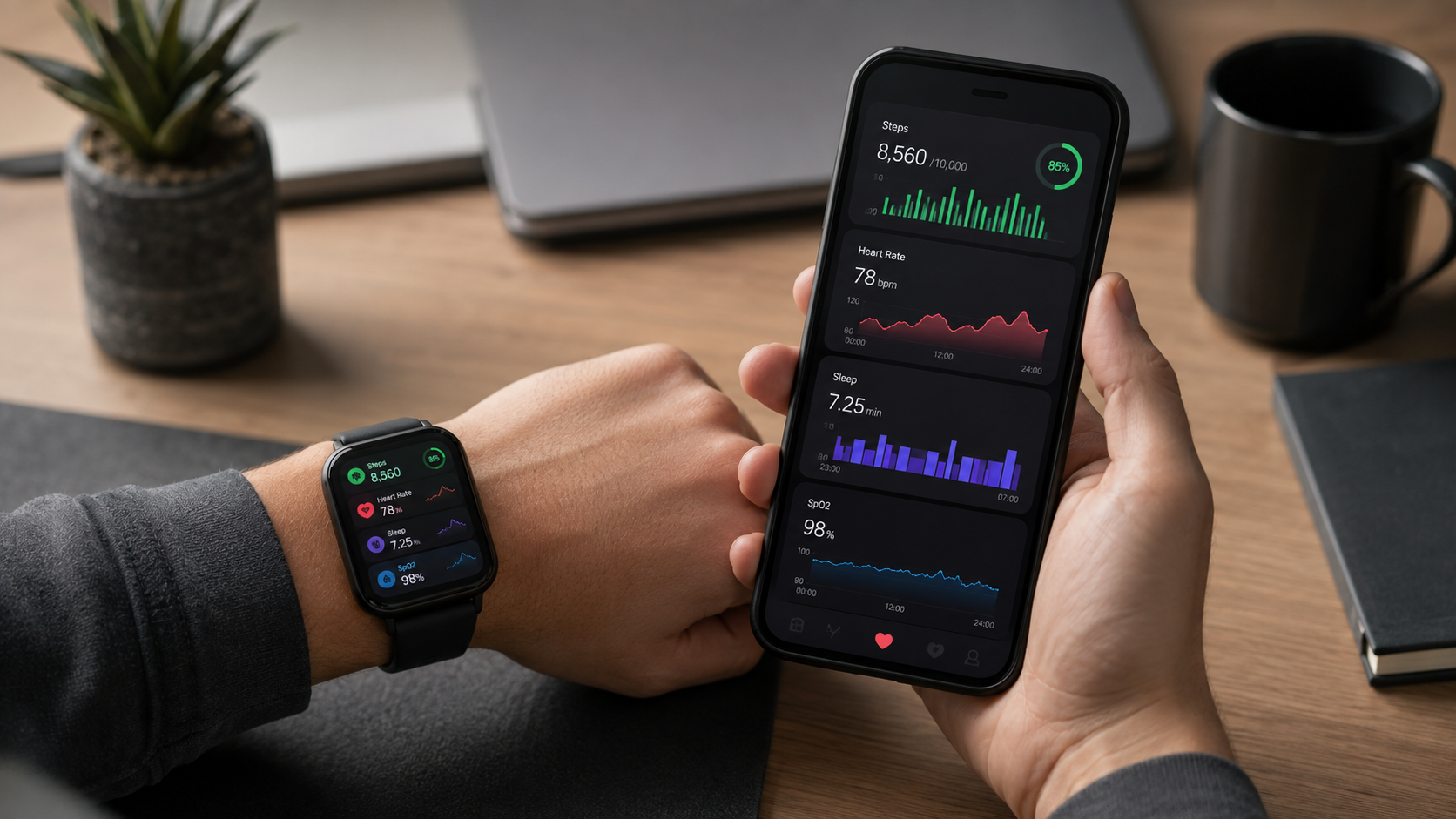
Use this checklist to specify branding scope before requesting a quotation. A brief that answers these points reduces rework and makes supplier quotes comparable.
- Product architecture: MCU Bluetooth or Android/4G? State the intended use case, not just the product category.
- Target markets: List destination countries, because they drive compliance and documentation planning.
- Branding layers required: Tick which of the five layers apply — cosmetic, UI, app, firmware behavior, hardware/tooling.
- App model: White-labeled, co-branded or customer-owned? Who publishes and maintains it?
- Data and SDK needs: Which data fields, integrations or backend connections are required?
- Packaging specification: Standard color box, custom color box, accessory list, manual languages.
- Model naming: Proposed model designation and brand entity for labels and documents.
- Volume expectation: First order and twelve-month forecast, so MOQ and tooling amortization can be discussed realistically.
- IP and exclusivity: What you expect to own, and what you need the supplier to confirm in the agreement.
- Sample and approval path: Who signs off the engineering sample, the pilot run and the production specification.
MOQ and lead time should be treated as reference values until confirmed against the selected model, architecture, customization scope and official quotation. Existing-platform private label programs and full custom Android/4G development sit in very different volume and timeline brackets.
Common sourcing mistakes and how to avoid them
Mismatched model naming across packaging and compliance documents. This is the most frequent and most avoidable error. Freeze naming before artwork approval and check every document against the physical label.
Unclear app rights. Buyers often assume they will own or control the companion app. In practice, app ownership, store listing control and update responsibility vary by platform and must be defined in the agreement.
Unconfirmed tooling and IP ownership. If tooling or firmware ownership is not stated in the signed agreement, do not assume it transfers. This matters most when you plan to scale, change suppliers or raise investment against the product.
Briefing at ODM level, buying at white label level. The gap between the brief and the purchased scope becomes a change order later. Use the five-layer framework to align the two before quotation.
Assuming SDK, raw data or cloud access is included. These are project- and contract-specific. Confirm availability for the selected platform and define data rights separately.
Choosing a cellular architecture without need. Android/4G platforms add BOM cost, power consumption, software complexity and certification work. If the product only needs Bluetooth-connected fitness and wellness functions, an MCU platform is usually the more efficient route.
Pineeon Manufacturer-Side Recommendation
From the factory side, the projects that move smoothly share one habit: the buyer defines the branding layers and the product architecture before asking for a price. That single discipline removes most of the ambiguity that causes quote revisions, sample rework and launch delays.
A staged approach is usually the most practical. Start with the architecture decision, because MCU Bluetooth and Android/4G watches are separate technical families with different BOM, power, software and certification profiles. Then select the branding layers you actually need, and confirm each layer with the verification procedure above. Only then move to quotation, sample and pilot production.
For buyers new to the category, a private label program on an existing MCU Bluetooth platform is usually the lowest-risk way to establish brand presence and channel feedback before committing to deeper ODM development. For buyers with a defined differentiated product, an ODM program with firmware, app and packaging customization is the more appropriate route — provided the scope, IP terms and data rights are agreed in writing before development begins.
Pineeon is an ISO 9001:2015-certified private label Smart Wearable, Computer Peripheral & AI Hardware OEM/ODM manufacturer based in Shenzhen, China, serving brands and buyers in 40+ countries since 2000. You can review the smart watch OEM/ODM and private label programs on our smart watch product page, and use the pre-quote checklist above as the basis for your first briefing.
Final specifications, MOQ, pricing, lead time, certification scope, customization capability, software capability, data access and commercial terms are subject to the selected product model, project requirements, technical evaluation and official Pineeon quotation.