Smart Watch Import Regulations: Key Considerations for 2026
Published November 4, 2026 · Pineeon Insights
Importing a smart watch is not a single-certificate exercise. The compliance profile of a watch changes with its radio set (Bluetooth only versus Bluetooth plus Wi-Fi, GPS or cellular), its battery design, its sensor claims, its charging method and the software it runs. Two watches that look identical on a product page can sit in different regulatory categories once you add a 4G module or a health-related claim.
For 2026 planning, treat import compliance as a configuration-by-configuration exercise that starts before tooling and mass production. This guide is written from the manufacturer side for importers, private label brands and procurement teams. It explains what to confirm with a supplier, how to read the documents you receive, and where change control can quietly invalidate earlier testing. Regulatory requirements are market-dependent and subject to verification; confirm current rules with the applicable authority, qualified laboratory or regulatory advisor before committing to a launch plan.
Why a Single Certificate Checklist Fails for Smart Watches
A generic checklist usually lists CE, FCC and RoHS and stops there. That is a starting point, not a compliance plan. The reason is that smart watches combine several regulated elements in one enclosure:
- Radio transmitters — Bluetooth, Wi-Fi, GPS receivers and, on Android/4G models, cellular modules. Each radio path can trigger different market requirements.
- Batteries — lithium-based cells bring transport and safety documentation questions in addition to product compliance.
- Electrical safety and charging — charging docks, cables and adapters may be assessed separately from the watch itself.
- Substance restrictions — RoHS-type restrictions apply to the product and often to packaging materials.
- Claims and intended use — heart rate, SpO2, sleep, blood pressure or SOS features can change how a product is classified and what evidence is expected.
- Software and data — companion apps and cloud services can raise data protection questions that sit outside hardware certification.
The practical consequence: a supplier may legitimately support CE, FCC and RoHS applications at company level while a specific model, in a specific configuration, still needs its own verification. Company capability is not model certification. Buyers who conflate the two often discover the gap at customs, at retail onboarding or during a marketplace listing review.
Map the Configuration Before You Map the Market

The most useful pre-order step is to write down exactly what you intend to import. Compliance scope follows the configuration, so define it in writing before requesting quotations.
| Configuration element | What to specify | Why it matters for import planning |
|---|---|---|
| Architecture | MCU Bluetooth watch or Android/4G application-processor watch | Cellular models generally carry additional network and market-specific evaluation compared with Bluetooth-only models. |
| Radios | Bluetooth version, Wi-Fi, GPS, NFC, cellular bands | Each transmitting path may need its own assessment; cellular bands must match destination networks. |
| Battery | Cell type, capacity, charging method, whether a charger is bundled | Battery documentation and transport rules are separate from product certification. |
| Sensors and claims | PPG heart rate, SpO2, sleep, ECG, blood pressure, SOS | Wellness wording and medical wording lead to different evidence expectations. |
| Ingress protection | Exact rating claimed (for example IP67, IP68 or 5ATM) and test basis | Ratings are not interchangeable; the claim must match the tested model. |
| Software | Companion app owner, cloud platform, SDK/API use, data storage location | App and data questions are often overlooked in hardware-only compliance plans. |
| Packaging | Languages, symbols, importer details, manuals | Labeling and language requirements vary by market and are frequently a launch delay. |
Once this table is filled in, the market questions become specific: which markets are you entering, which radio approvals apply there, what battery transport documentation is needed, and which claims will appear on the box and in the app store listing.
Market-by-Market Considerations Without Guesswork
Requirements change and vary by product classification, so this section describes the categories of questions to ask rather than fixed rules. For each target market, confirm the following with a qualified laboratory or regulatory advisor:
- European Union: CE marking obligations for radio equipment, electromagnetic compatibility and electrical safety; RoHS-type substance restrictions; REACH-type chemical obligations where applicable; declaration of conformity and technical file expectations; labeling, language and importer identification. A CE marked smart watch should be supported by documentation that names the model and the applicable directives and standards.
- United States: FCC equipment authorization for intentional and unintentional radiators, depending on the radio configuration; RF exposure evaluation where applicable; state-level battery or e-waste rules may also apply. An FCC certification smart watch claim should be traceable to a specific model and grantee.
- United Kingdom: UKCA-related requirements may apply alongside or instead of CE depending on current rules and market; confirm the current position before printing packaging.
- Canada, Australia, Japan and other markets: radio and telecom equipment frameworks differ; some require local registration or labeling. Cellular watches may need carrier or network acceptance in addition to product certification.
- China: CCC-type requirements may apply to specific product categories; confirm applicability for the exact model.
Two rules keep this manageable. First, do not assume that a certificate issued for one market satisfies another. Second, do not assume that a Bluetooth-only approval covers a 4G variant of the same watch. The radio configuration is part of the product identity for compliance purposes.
How to Read Supplier Compliance Documentation Critically
When a smart watch manufacturer sends a folder of certificates, the useful question is not “do you have CE?” but “which model, which configuration and which scope does this document cover?” Use the following verification procedure.
- Match the model identifier. The certificate or test report should reference the exact model or family covered. A family certificate may not cover a variant with a different radio module or battery.
- Check the holder and the factory. Confirm who holds the certificate and whether the manufacturing site in the document matches the site producing your order.
- Read the scope, not just the cover page. Look at the standards cited, the radio bands tested and any exclusions or conditions.
- Check dates and validity. Standards are revised; an older report may not reflect current requirements.
- Separate product certification from component certificates. A Bluetooth module certificate does not certify the finished watch.
- Ask for the declaration of conformity and technical file structure where applicable, not only the test report.
- Confirm labeling and manual content against the market’s language and symbol requirements.
- Record what is still missing in a compliance risk register with an owner and a due date.
A supplier that answers these questions precisely is easier to work with than one that sends a large file without model-level mapping. If a document cannot be matched to your configuration, treat the claim as unverified until it is resolved.
Change Control: What Can Invalidate Earlier Testing
Compliance is not frozen at the sample stage. Several routine engineering or sourcing changes can move a product outside the scope of earlier testing:
- Changing the Bluetooth, Wi-Fi or cellular module, or the antenna design.
- Changing battery cell, capacity or charging architecture.
- Changing enclosure sealing, speaker or microphone openings in ways that affect an ingress protection claim.
- Adding or removing a sensor, or changing the algorithm behind a health-related claim.
- Changing firmware in ways that alter radio behavior, power output or displayed claims.
- Changing the companion app’s data handling or the cloud provider.
- Changing packaging text, symbols or the identified importer.
Build a change-control clause into your supplier agreement: any change to these items triggers a documented review of whether re-testing or re-documentation is required. This is cheaper than discovering the issue after the container ships.
High-Risk Claims: Health, Water Resistance and Battery Life
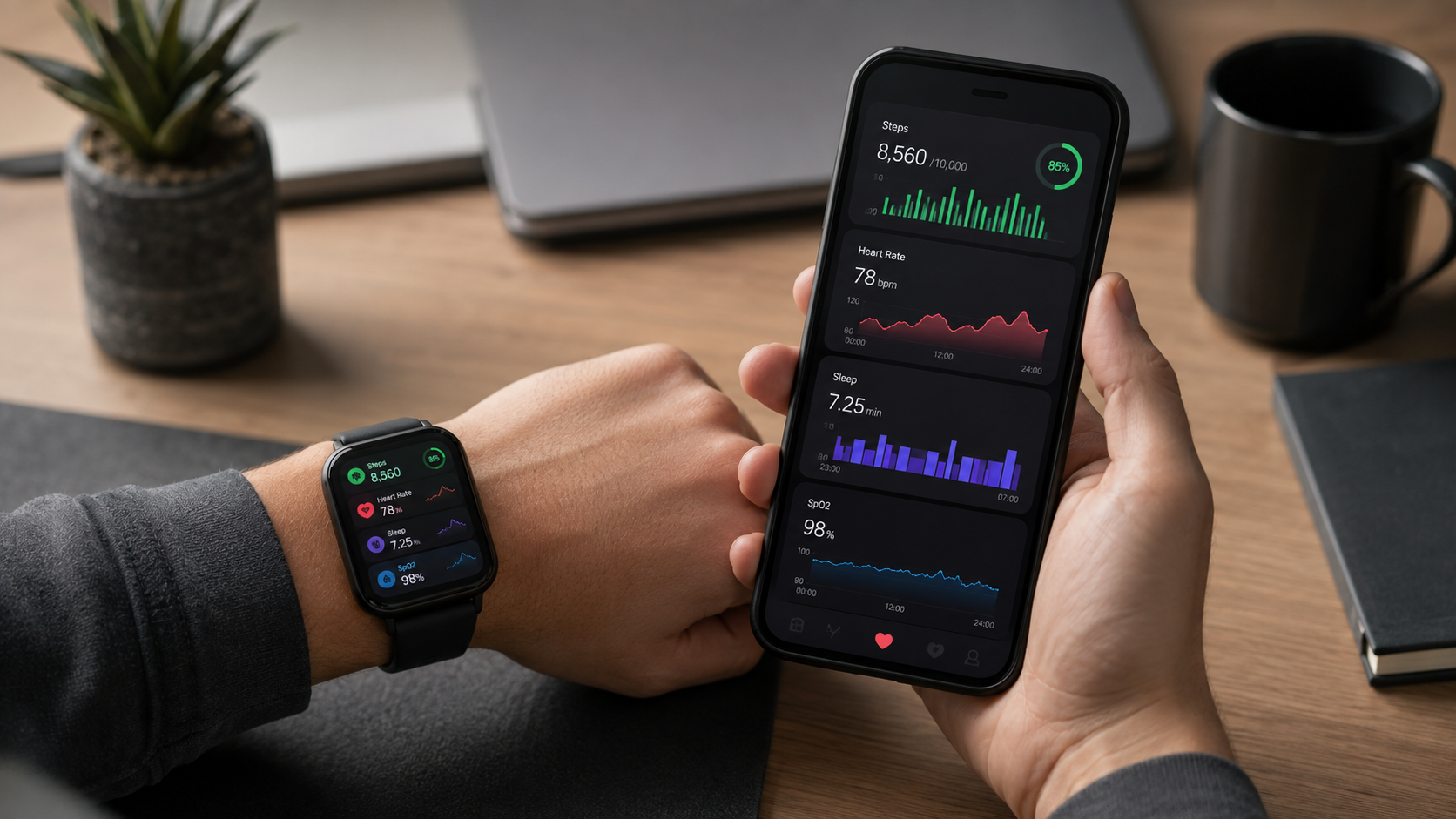
Marketing claims are a compliance surface. Three categories deserve particular discipline.
Health and wellness. Heart rate, SpO2 and sleep features are commonly presented as wellness information. Wording that implies diagnosis, treatment or medical-grade accuracy moves the product toward a different regulatory pathway. Keep consumer wellness language separate from medical claims, and only use medical wording where the product and its evidence support it.
Water resistance. IP67, IP68 and 5ATM are different ratings with different test bases and usage conditions. Do not let a listing say “swimming-proof” unless the exact model’s rating and test documentation support that use. Sealing around speakers, microphones and SIM openings on cellular watches deserves specific attention.
Battery life. Published endurance depends on display, connectivity, GPS use, sensor sampling and firmware. Treat battery figures as typical reference ranges unless model-specific testing supports a firmer statement, and make sure the claim matches the configuration being imported.
Pineeon Manufacturer-Side Recommendation
From the factory side, the projects that clear import compliance smoothly share a pattern: the buyer defines target markets and the exact configuration before tooling, and the compliance documents are mapped to that configuration before mass production.
Certification documentation, testing and compliance-support capabilities vary by supplier and project. Confirm the exact scope, responsible parties and available records in writing before relying on them.
Our practical recommendation for a 2026 smart watch program:
- Decide MCU Bluetooth versus Android/4G architecture first, because it drives both certification complexity and MOQ.
- Freeze the radio, battery and sensor configuration before requesting compliance quotations.
- Request model-level documentation, not company-level brochures, and map each document to your configuration.
- Plan labeling, manuals and importer details at the same time as the hardware, not after pilot production.
- Keep a compliance risk register with owners, and review it at sample approval and again before mass production.
If you are evaluating a custom smart watch program, start with the Pineeon smart watch OEM/ODM range and bring your target-market list to the first technical discussion.
Buyer Checklist: Pre-Order Compliance Verification
| # | Item to confirm | Evidence to request | Status |
|---|---|---|---|
| 1 | Target markets and launch dates | Written market list agreed with supplier | ☐ |
| Certification documentation, testing and compliance-support capabilities vary by supplier and project. Confirm the exact scope, responsible parties and available records in writing before relying on them. | Architecture and radio configuration | Model specification sheet listing radios and bands | ☐ |
| 3 | Battery design and transport documentation | Battery specification and applicable transport documents | ☐ |
| 4 | Model-level certification status | Certificate or test report naming the model and scope | ☐ |
| 5 | Declaration of conformity and technical file structure | Document list and availability confirmation | ☐ |
| 6 | Ingress protection claim and test basis | Rating statement and test reference for the exact model | ☐ |
| 7 | Health and wellness claim wording | Approved claim list matching tested functions | ☐ |
| 8 | Labeling, manual languages and importer details | Draft artwork for review before printing | ☐ |
| 9 | App and data handling | App owner, data storage location and privacy documentation | ☐ |
| 10 | Change-control process | Contract clause covering component, firmware and enclosure changes | ☐ |
Use this checklist as a gate: do not release tooling or mass production until every line is either verified or explicitly accepted as a documented risk with an owner.
FAQ
Does a CE marked smart watch automatically satisfy FCC requirements?
No. CE marking and FCC authorization are separate market frameworks with different technical standards and documentation. A product may hold both, but each must be verified for the specific model and radio configuration.
Can a Bluetooth-only certificate cover a 4G version of the same watch?
Generally not. Adding a cellular module changes the radio configuration and may introduce network and market-specific requirements. Treat the 4G variant as a separate compliance scope and confirm with a qualified laboratory.
Is RoHS compliance the same as REACH compliance?
No. They address different substance and chemical obligations. Confirm which regulations apply to your product and packaging in each target market, and request documentation that names the applicable regulation.
What should I do if a supplier cannot provide model-level documentation?
Record the gap in your compliance risk register, request a written explanation, and consider independent testing or a different supplier before committing to mass production. Company-level capability statements are not a substitute for model-level evidence.
Do firmware updates require new certification?
Not always, but changes that affect radio behavior, power output or displayed claims should trigger a documented review. Include firmware change notification in your supplier agreement.
Who is responsible for import compliance, the factory or the importer?
Responsibility depends on the market and the commercial arrangement. In many frameworks the importer or brand placing the product on the market carries obligations. Clarify roles in writing and confirm with a regulatory advisor for your specific markets.
Editorial note: This article provides general B2B sourcing and manufacturing information. Legal, regulatory, certification, intellectual-property and market-entry requirements vary by jurisdiction and project. Obtain qualified professional advice and verify the requirements that apply to your product and target market.