Smart Watch Sourcing for Fitness Brands: Considerations for Brands Entering Australia
Published October 25, 2026 · Pineeon Insights
A fitness brand entering Australia is not shopping for a generic smart watch. It needs a wearable that supports its training positioning, integrates with its companion app or coaching platform, and survives the scrutiny of Australian buyers who expect clear water-resistance ratings, honest battery claims, and documentation that matches the product in the box. The sourcing decision therefore starts with product architecture and supplier capability, not with a price list.
This guide is written from the manufacturer side of the table. It explains how to choose between MCU Bluetooth and Android/4G architectures for a fitness use case, how to vet a smart watch manufacturer on firmware and app integration, how customization layers affect quoting and sample rounds, and what to plan for when importing into Australia. Regulatory and certification details are market- and project-dependent and should be confirmed with the applicable authority or an accredited laboratory.
Start with the fitness use case, not the watch
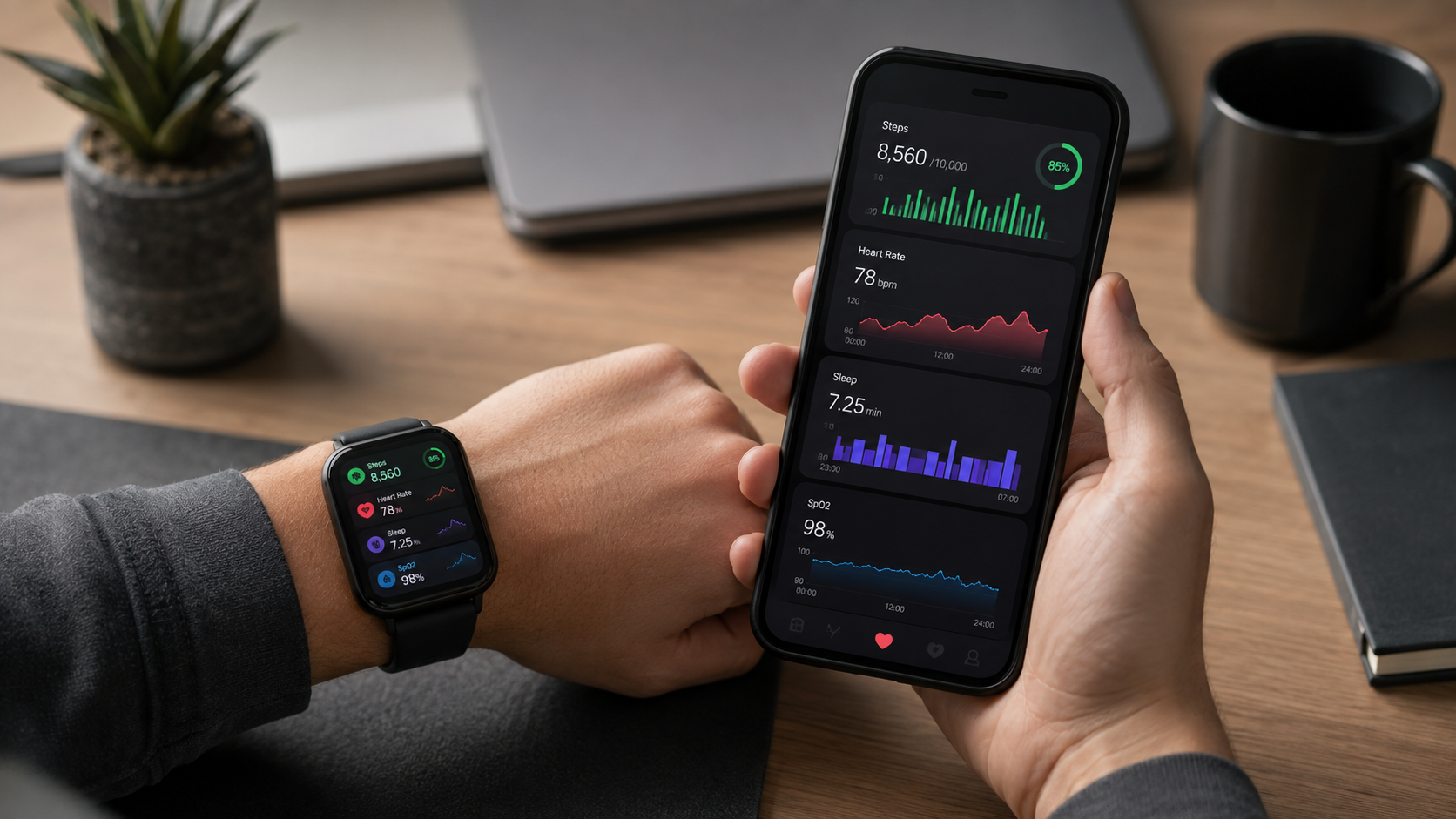
Fitness brands usually need a subset of smart watch functions done well: continuous or interval heart-rate tracking, step and calorie estimation, sleep tracking, multiple sport modes, and reliable Bluetooth synchronization to a phone app. Some brands also want GPS, SpO2, or stress-related wellness indicators. The mistake is to specify every possible sensor before deciding how the data will be used.
Ask three questions before approaching any supplier:
- What does the app do with the data? A brand that only displays workout summaries needs a different integration depth than one that runs adaptive training plans or coach dashboards.
- Does the watch need to work independently of the phone? If yes, you are in Android/4G territory. If no, an MCU Bluetooth platform is usually the more efficient route.
- What claims will appear on packaging and in marketing? Water resistance, battery life, and health metrics all need model-specific evidence. Claims drive testing and documentation requirements.
These answers determine architecture, BOM, certification scope, and sample timeline. They should be settled before a supplier quotes, because a quote built on the wrong architecture wastes everyone’s sample round.
MCU Bluetooth vs Android/4G: the architecture decision that shapes everything

Pineeon treats MCU Bluetooth smart watches and Android/4G smart watches as two separate technical product families. They differ in chipset, power profile, software stack, certification path, and minimum order quantity. For a fitness brand, the choice is usually straightforward once the app requirement is clear.
| Decision factor | MCU Bluetooth watch | Android/4G watch |
|---|---|---|
| Typical fitness fit | Sports tracking, wellness monitoring, Bluetooth companion app | Independent connectivity, children/elderly safety, cellular communication |
| Battery reference | Longer endurance in daily use; standby may extend further depending on use | Shorter endurance under heavy use; GPS/4G models typically drain faster |
| Software integration | SDK/API availability depends on platform; app customization ranges from white-label to backend integration | Android-based development where supported; Google services depend on configuration and market |
| Certification complexity | Simpler radio path; Bluetooth-focused | Additional cellular and market-specific telecom evaluation may apply |
| Reference MOQ | Existing platform private label from approximately 1,000 pcs | Full custom Android/4G from a substantially higher initial order; confirm with quotation |
Treat these as reference ranges, not contractual values. Final MOQ, lead time, and specification depend on the selected model, customization scope, and official quotation. The practical point is that an MCU platform lets a fitness brand launch a private label smart watch with modest volume and a shorter certification path, while an Android/4G platform is justified only when independent networking or a richer application ecosystem is a core product requirement.
Battery life deserves special attention in fitness positioning. A watch marketed for multi-day training blocks cannot use an Android/4G power profile. Conversely, a brand promising standalone music streaming or cellular calls cannot deliver that on an MCU platform. Match the claim to the architecture before the claim reaches the packaging designer.
Vetting a smart watch manufacturer for fitness-brand requirements
Most supplier audits focus on factory systems. For a fitness brand, the higher-risk questions are about firmware, sensor validation, and app integration. Use the checklist below during supplier evaluation and ask for evidence rather than verbal assurance.
Supplier vetting checklist
- Architecture clarity: Can the supplier explain which chipset family and RTOS/Android stack each proposed model uses, and why it fits your use case?
- Sensor validation: What is the supplier’s process for verifying heart-rate and SpO2 behavior across skin tones, activity levels, and wrist fit? Ask for the test protocol, not just a pass statement.
- Firmware customization: Which parameters can be adjusted (sampling rate, sensitivity thresholds, sport-mode logic), and which require deeper development?
- App and SDK: Is an Android/iOS SDK available for the selected platform? Which data fields are exposed? Is raw sensor data accessible, and under what contract terms?
- Cloud and data ownership: If the app uses a supplier cloud, who owns the data, where is it processed, and what happens at contract end?
- Quality system: Does the supplier follow IQC, IPQC, FQC, and OQC stages? What reliability tests are standard versus optional?
- Certification support: Can the supplier provide technical documentation and testing support for applicable CE, FCC, and RoHS applications? Remember that factory support does not equal a model-specific certificate.
- Water-resistance documentation: Is the IP rating tied to a specific test specification, and does it account for speakers, microphones, or SIM openings?
- Change control: How are component substitutions, firmware revisions, and BOM changes communicated and approved?
Pineeon is based in Shenzhen, China, has operated since 2000, is ISO 9001:2015-certified, and serves brands and buyers in more than 40 countries. Those facts describe company capability and quality management, not the specification of any individual model. Always verify the model-specific BOM, test reports, and certificate holder before publishing a certified smart watch claim.
Customization layers and how they affect quoting and sample rounds
Custom smart watch projects are rarely one decision. They are a stack of customization layers, and each layer adds scope, cost, and time. Understanding the layers helps a fitness brand decide where to spend and where to use standard options.
Layer 1: Branding and packaging
Logo on the case, strap color, retail box graphics, manual language, and accessory selection. This is the fastest path for a private label smart watch and typically suits an existing MCU platform. Sample turnaround for logo and packaging changes on an existing platform is comparatively short, subject to material availability.
Layer 2: UI and language
Watch-face design, menu layout, language packs, and function enable/disable settings. This layer usually requires firmware configuration rather than new hardware. Sample time for UI or function-switch adjustments on an existing platform is longer than a packaging-only change and should be scheduled with the supplier.
Layer 3: Hardware and housing
Case shape, display choice, strap interface, sensor combination, and button layout. If new tooling is required, tooling cost and tooling lead time are quoted separately. MCU ODM projects involving appearance or mainboard changes require a longer sample round than an existing-platform private label project.
Layer 4: Firmware and algorithm
Sampling-rate adjustment, alert logic, sport-mode behavior, and integration of customer-provided algorithms. Deep customization such as source-code access or OTA authority must be defined in the signed project agreement; it is not automatic.
Layer 5: App and cloud integration
White-label app branding, UI adjustment, customer backend integration, or a fully customer-owned app and cloud platform connected through SDK/API. Android/4G projects with application and cloud integration require the longest sample planning of the five layers. Data access, raw-data rights, and cloud ownership should be settled before development begins.
Each layer should be priced and scheduled separately in the quotation. A supplier that bundles all five layers into one line item makes it difficult to compare offers or to descope later if the budget tightens.
Sample-to-mass-production approval workflow
A structured approval workflow protects both the brand and the manufacturer. The sequence below reflects how Pineeon typically structures smart watch projects; exact steps and durations depend on the selected platform and customization depth.
- Requirement confirmation: Architecture, target market, square or round design, display and case requirements, sensor combination, app requirements, and connectivity.
- Quotation and sample fee: Confirm product quotation and sample fee. Sample fees may be credited or refunded after a qualifying bulk order according to the commercial agreement.
- Structure and ID confirmation: Industrial design and mechanical structure. New tooling is quoted separately.
- Engineering sample: Functional testing and water-resistance testing according to project requirements.
- Pilot run: Validate yield, functional consistency, and production stability where required.
- Mass production approval: Approve pilot results, confirm the production specification, and release mass production.
For fitness brands, the pilot run is the moment to test the watch against real training conditions: sweaty wrists, interval sessions, cold morning runs, and app synchronization under poor connectivity. A sample that passes a bench test may still fail a Saturday long run. Build field testing into the approval timeline rather than discovering issues after mass production.
Australia-specific compliance and import planning

Australia has its own regulatory framework, and requirements vary by product configuration, radio technology, battery design, and intended use. The notes below are planning considerations, not legal advice. Confirm current requirements with the applicable Australian authority, an accredited laboratory, or a qualified regulatory advisor before import.
- Electrical and radio compliance: Australia uses the RCM marking framework for applicable electrical and radio communications products. Whether a specific smart watch requires RCM marking, and which standards apply, depends on the product’s radio and electrical characteristics. Confirm with the applicable authority or laboratory.
- Bluetooth and radio: Bluetooth-enabled watches are radio communications devices. Test evidence and documentation requirements should be confirmed for the exact model and configuration.
- Battery shipping: Lithium batteries are subject to transport regulations. UN38.3 test summaries are commonly requested as a general industry reference for shipping lithium batteries; the actual documentation required depends on the carrier and mode of transport.
- Electrical safety: Charging docks and cables may fall under separate electrical safety requirements from the watch itself. Confirm the accessory scope with your laboratory.
- Health and wellness claims: Consumer wellness features should not be presented as medical diagnosis unless the product has the appropriate regulatory evidence. Keep marketing language aligned with the device’s actual status.
- Customs and labeling: Import documentation, country-of-origin marking, and packaging labeling requirements should be confirmed with your customs broker or trade advisor.
CE and FCC are not Australian requirements, but test evidence prepared for other markets is sometimes useful when assembling an Australian compliance file. Whether any particular document is accepted, and what testing or documentation a specific model needs, must be confirmed for the individual project with the applicable Australian authority, an accredited laboratory, or a qualified regulatory advisor. No supplier can guarantee final certification or regulatory approval.
Pre-order verification checklist
Before releasing a purchase order, confirm the following in writing. This checklist is designed to catch the gaps that most often surface after deposit.
- Selected architecture and chipset family documented in the quotation.
- Model-specific specification sheet covering display, battery capacity, sensor list, and water-resistance rating.
- SDK/API availability and data fields confirmed for the selected platform.
- App customization scope and ownership terms defined in the contract.
- Firmware ownership, OTA authority, and source-code access (if any) stated in the agreement.
- Certification scope and document responsibilities assigned; model-specific certificates verified where claimed.
- Battery shipping documentation requirements confirmed with the freight forwarder.
- Packaging artwork, manual language, and accessory list approved.
- QC plan and AQL acceptance criteria agreed, including any optional reliability tests.
- Pilot run requirement and approval criteria defined.
- Mass-production lead time and shipping schedule confirmed in the order acceptance.
- Warranty terms, spare-parts policy, and RMA process documented.
Pineeon Manufacturer-Side Recommendation
For most fitness brands entering Australia, the pragmatic route is an MCU Bluetooth platform with a well-defined private label smart watch scope: branding, packaging, UI language, and a focused app integration. This keeps the certification path simpler, supports a reference MOQ from approximately 1,000 pieces on an existing platform, and allows sample rounds measured in days to weeks rather than months. Reserve Android/4G development for products where independent connectivity is a genuine differentiator, and budget for the higher MOQ and longer certification planning that come with cellular architecture.
Before requesting a quotation, write a one-page product brief covering the training use case, the app’s data needs, the claims you intend to make, and the Australian market entry timeline. A supplier can quote more accurately against that brief than against a list of desired features. If you are evaluating custom smart watch options for a fitness program, review the Pineeon smart watch OEM/ODM range and share your brief for a project-specific assessment.
Finally, separate verified facts from assumptions in your own decision file. Company certifications, model certificates, test reports, and MOQ commitments are different categories of evidence. Treat each one according to what it actually proves, and confirm anything that will appear on a retail box or in a regulatory file with the appropriate laboratory or authority.