Wholesale pricing for an AI voice mouse rarely fails because the unit price is too high. It fails because the quote and the project scope do not match. A buyer compares three quotations, picks the lowest unit price, and later discovers that the software integration, cloud API routing, packaging artwork, or compliance documentation was never included. The effective cost then rises after the purchase order is signed.
This guide explains how AI voice mouse pricing is actually structured on the manufacturer side, which line items scale with volume, which are fixed non-recurring costs, and how procurement teams can compare quotations on a like-for-like basis for 2026 programs. It is written for importers, distributors, private label brands and enterprise buyers who need a defensible pricing strategy rather than a single number.
Why AI voice mouse pricing is not a single unit price
An AI voice mouse is a mature optical mouse platform combined with microphone input, companion desktop software and cloud AI services. The AI capability is primarily implemented in software and cloud services rather than through a dedicated AI processor inside the mouse. That architecture has a direct pricing consequence: the quotation covers several different cost categories that behave differently as volume changes.
On the manufacturer side, a quotation typically combines:
- Hardware bill of materials (BOM): optical sensor, wireless MCU, MEMS microphone, battery, switches, scroll encoder, housing and PCB assembly.
- Tooling and mechanical development: existing public mold versus new enclosure tooling.
- Firmware configuration: DPI levels, button mapping, indicator behavior, power parameters and shortcut triggers.
- Companion software: white-label branding, UI changes, language packages, AI workflow logic and cloud-service integration.
- Packaging and accessories: standard color box, custom box, manuals, USB receiver and cable.
- Testing and compliance support: functional validation, plus applicable CE, FCC and RoHS documentation and testing support.
- Commercial terms: payment terms, Incoterms, warranty, spare-parts policy and reorder commitments.
Only some of these items fall when volume rises. Others are fixed, and a few actually increase with customization depth. A wholesale AI voice mouse strategy that treats every line as negotiable per-unit cost will usually produce a weaker commercial outcome than one that separates recurring from non-recurring costs.
Which cost drivers scale with volume and which do not
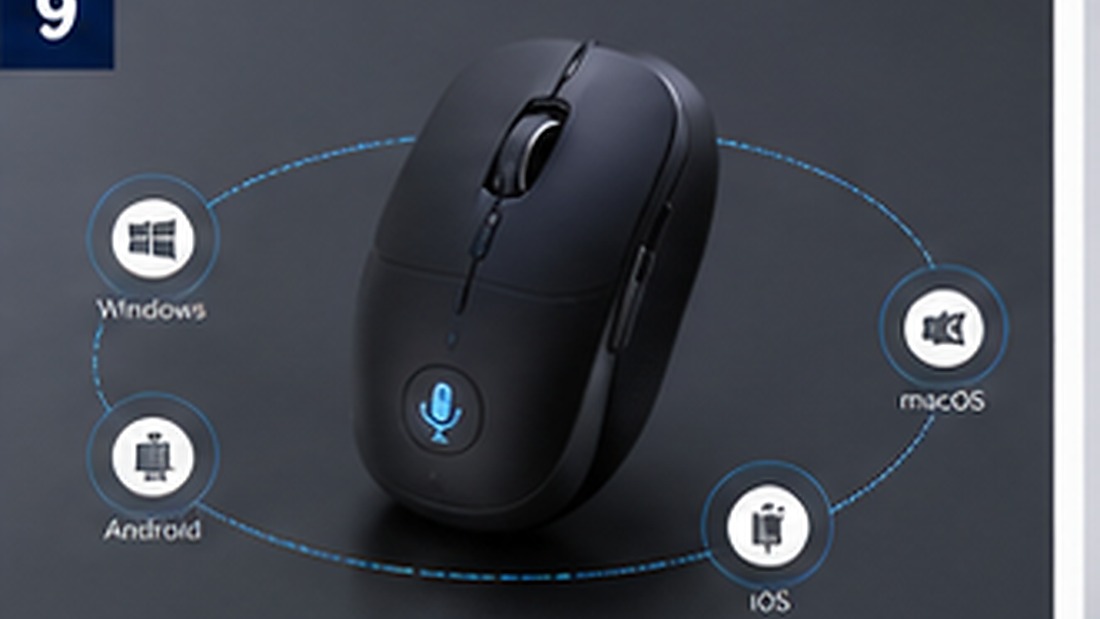
The clearest way to plan a 2026 budget is to sort every quotation line into three behaviors: variable, step-fixed and non-recurring.
| Cost category | Behavior as volume increases | Buyer implication |
|---|---|---|
| Core BOM (sensor, MCU, microphone, battery, switches, housing) | Variable; unit cost generally declines with volume and component consolidation | Main lever for bulk AI voice mouse unit price |
| PCB assembly and SMT | Variable; setup amortized across the run | Small runs carry a higher effective per-unit setup share |
| Enclosure tooling | Non-recurring; one-time or amortized | Negotiate tooling ownership and amortization separately from unit price |
| Firmware configuration | Step-fixed; engineering hours do not scale linearly | Confirm whether configuration is included or billed as NRE |
| Companion software white-label | Step-fixed; branding and build effort | Ask what is included in the base and what is a change request |
| Cloud AI integration and API routing | Step-fixed development plus ongoing usage cost | Clarify who pays for API consumption after shipment |
| Packaging print setup | Step-fixed per SKU and per language | Multiple language versions multiply setup, not unit cost |
| Testing and compliance documentation | Step-fixed per model and market | Model-specific certification scope must be quoted explicitly |
Manufacturer-side reasoning: the BOM is where volume negotiation works. Software, tooling and compliance are where scope negotiation works. Buyers who push only on unit price often end up with a stripped software scope, which shifts cost to the buyer later in the form of development change orders or a companion app that cannot be maintained.
How customization depth changes the pricing structure
Custom AI voice mouse projects are usually quoted at one of four levels. Each level changes both the unit price and the non-recurring charges, and each has a different reference MOQ range that must be confirmed for the specific project.
1. Private label on an existing platform
Logo, packaging and basic desktop-client branding on an existing public-mold product. This is the lowest-complexity route. The internal reference MOQ for standard private label is approximately 500 pcs, and sample lead time for existing mold with simple logo or packaging customization is typically 15–30 days. Pricing here is dominated by BOM and packaging, with limited engineering content.
2. Semi-custom OEM
Existing platform with limited functional or branding modification, such as button-function changes, language packages or UI adjustments. Reference quantities for selected semi-custom projects may be approximately 50–200 pcs, while fuller OEM customization is referenced at approximately 1000 pcs. Expect firmware configuration and software UI work to appear as separate line items rather than being absorbed into unit price.
3. Advanced software and AI integration
Customer-selected LLM provider, OpenAI or Gemini integration, customer-owned AI model, enterprise terminology dictionary or custom AI modules. This is where AI voice mouse pricing diverges most from a standard mouse. The hardware may be nearly identical to a private label unit, but the software and cloud architecture work is a substantial non-recurring engineering cost. Buyers should expect this to be quoted as development, not as a per-unit adder.
4. Full custom ODM
New enclosure, new firmware and dedicated software ecosystem. Reference mass-market volumes are 3000–5000 pcs, with niche custom programs at 1000–3000 pcs. Full custom tooling sample lead time is typically 60–90 days or longer, and mass production for full custom ODM is typically 60–90 days or longer. In this tier, tooling, firmware and software development dominate the commercial discussion, and unit price is only meaningful once the development scope is frozen.
A common mistake is to request a full custom ODM quotation and then compare its unit price against a private label quote. They are not the same product, and the comparison hides the non-recurring costs that determine total project cost.
Building a like-for-like quotation comparison
Before negotiating, normalize every supplier quotation against the same scope template. A practical comparison framework for bulk AI voice mouse procurement:
- Hardware configuration: connectivity (2.4GHz, Bluetooth or dual-mode), sensor class, microphone configuration (single or dual MEMS array), battery capacity and charging interface. Confirm whether reference components are proposed or confirmed production BOM.
- Firmware scope: DPI levels, button mapping, shortcut triggers, indicator behavior and whether source-code access is included or contractually separate.
- Companion software scope: white-label only, UI customization, language packages, AI workflow logic, Windows and macOS compatibility where required.
- Cloud AI architecture: which provider, whether the factory operates a relay server, whether the customer can use its own API key or cloud account, who stores raw audio and transcription results, and retention policy.
- Ongoing service cost: API consumption, server hosting, software maintenance and update responsibility after shipment.
- Packaging and accessories: box type, manual languages, USB receiver, cable, software download and activation instructions.
- Testing and compliance support: which markets, which documentation, and whether model-specific certification is already held or must be applied for.
- Commercial terms: MOQ, price tiers, payment terms, Incoterms, warranty, spare parts and reorder lead time.
If a quotation cannot answer items 3, 4 and 5 in writing, it is not yet a comparable price. Those items are where the largest post-order cost surprises occur in AI voice mouse programs.
Negotiation levers that actually move the number
Volume tiering is the most visible lever, but it is not the only one. Manufacturer-side, the following levers tend to produce real movement:
- Consolidate SKUs. Fewer color, language and packaging variants reduce setup and changeover cost more reliably than a small volume increase spread across many SKUs.
- Commit to a reorder program. A forecast with scheduled releases supports better component planning than a single large order with no follow-on visibility.
- Separate NRE from unit price. Paying tooling and software development as a defined non-recurring charge often produces a cleaner unit price and clearer ownership terms than amortizing everything into the piece price.
- Use existing molds where the product allows. Tooling is a fixed cost; avoiding it is a pricing decision, not a negotiation tactic.
- Define the software change-request boundary. Agree in writing what counts as included configuration versus a billable change. This protects both sides.
- Align payment terms with production milestones. Deposit, pilot approval and balance terms affect the supplier’s working-capital position and can be part of the commercial package.
What does not move the number reliably: asking for a lower unit price without changing volume, scope or terms. Suppliers typically respond by reducing scope quietly, which is the worst outcome for the buyer.
2026 procurement planning checklist
Total cost of ownership, not unit price, should drive the 2026 plan. Use this checklist before issuing a purchase order:
- Scope frozen in writing: hardware configuration, firmware behavior, software features, cloud architecture and packaging all confirmed in the order specification.
- Pricing separated: unit price, tooling, NRE, packaging setup, compliance support and any ongoing service fees quoted as distinct lines.
- Volume tiers defined: price breaks tied to actual committed quantities, not aspirational forecasts.
- Currency and payment terms: currency of quotation, exchange-rate exposure and payment schedule agreed.
- Tariff and duty exposure: destination-market duties and any applicable trade measures reviewed with a qualified customs advisor; these are market-dependent and subject to change.
- Lead-time buffer: sample, pilot and mass production timelines mapped backward from the retail or deployment date, with buffer for tooling and software debugging.
- Compliance scope: applicable CE, FCC and RoHS documentation and testing support confirmed for the specific model and target market; other market-specific requirements reviewed with the applicable authority or laboratory.
- Data governance: voice-data routing, storage, retention and processor/subprocessor responsibilities documented, especially for EU customers where GDPR-related requirements apply.
- Ownership terms: tooling, firmware, software source code, cloud backend and API rights defined in the signed agreement.
- After-sales plan: warranty, spare parts, software update responsibility and reorder lead time confirmed.
Common quote-comparison mistakes that inflate effective cost
Several recurring errors make a low quote more expensive than a higher one:
- Comparing a private label quote to a full custom ODM quote. Different products, different non-recurring costs.
- Ignoring cloud API consumption. If the buyer pays per-request AI costs after shipment, the landed cost per unit is not the quoted unit price.
- Assuming software maintenance is included indefinitely. Long-term maintenance responsibility should be contractual.
- Treating reference MOQ and lead time as guarantees. They are reference ranges and must be confirmed for the specific project.
- Assuming model-specific certification is already held. Factory-level support for applicable CE, FCC and RoHS applications does not mean every model already holds every certificate.
- Leaving packaging language versions undefined. Each additional language version adds setup cost and a potential delay.
Pineeon Manufacturer-Side Recommendation
Pineeon is a private label Smart Wearable, Computer Peripheral & AI Hardware OEM/ODM manufacturer based in Shenzhen, China, operating since 2000 and ISO 9001:2015-certified, serving brands and buyers in 40+ countries. From our side of the quotation, the most reliable way to control AI voice mouse cost is to freeze scope before price negotiation.
Our recommendation to procurement teams planning 2026 programs:
- Decide the customization tier first — private label, semi-custom OEM, advanced AI integration or full custom ODM — because the pricing structure differs at each tier.
- Request a quotation that separates unit price, tooling, NRE, packaging setup, compliance support and ongoing service costs.
- Confirm the cloud AI architecture and data routing in writing before development begins, including whether customer-owned API keys or cloud accounts are supported.
- Validate pricing through the sample-to-pilot-to-mass-production path rather than accepting a unit price at the quotation stage.
- Define ownership of tooling, firmware, software and cloud backend in the contract.
Project approach, scope and quotation should be confirmed for the specific project before development begins. For the product platform itself, see the AI Voice Mouse OEM/ODM product page. Final specifications, MOQ, pricing, lead time, certification scope, customization capability, software capability and commercial terms are subject to the selected product model, project requirements, technical evaluation and official Pineeon quotation.
FAQ
Does a higher volume always lower the wholesale AI voice mouse unit price?
Not automatically. Volume reduces the variable BOM and assembly share, but tooling, software development, packaging setup and compliance documentation are step-fixed or non-recurring. A larger order with more SKUs and more customization can carry a higher effective cost than a smaller, simpler order.
Should tooling and software development be amortized into the unit price or billed separately?
Both structures exist. Separate billing gives clearer ownership and change-request boundaries; amortization gives a simpler per-unit figure but can obscure what happens if volumes fall short. The choice should be defined in the commercial agreement.
Who pays for cloud AI API usage after the products ship?
This is project-dependent. Some architectures route requests through a factory-operated relay server; others support customer-owned API keys or cloud accounts. The billing party, account ownership and data-processing responsibilities should be agreed before development.
Can I compare a private label quote with a full custom ODM quote?
Only after normalizing scope. Private label on an existing platform and full custom ODM with new tooling and dedicated software are different products with different non-recurring costs. Comparing their unit prices alone hides the development and tooling investment.
How should compliance costs be handled in a 2026 quotation?
Ask for compliance support to be quoted per model and per target market. Certification scope, required documents, testing scope and approval depend on the specific product model, configuration, target market, laboratory and applicable authority, and should be confirmed for the specific project with the applicable authority or laboratory. Approval is not guaranteed.
What is the single most useful question to ask an AI voice mouse supplier during pricing negotiation?
Ask which items in the quotation are recurring and which are non-recurring, and request that each be listed separately. That one question exposes most of the hidden cost differences between competing wholesale ai voice mouse quotations.