AI Voice Mouse Supplier Vetting Steps: Key Considerations for 2026
Published October 31, 2026 · Pineeon Insights
An AI Voice Mouse is not a conventional peripheral with a microphone bolted on. The hardware is mature, but the product experience depends on companion software, cloud speech services and data routing. That split changes how you vet an AI Voice Mouse supplier. A factory that can mold a shell and assemble a sensor may still be the wrong partner if it cannot explain where voice audio goes, who maintains the desktop client, or how firmware and app updates are controlled.
This guide gives procurement teams a stage-by-stage vetting workflow for 2026. It focuses on the questions that separate a credible AI Voice Mouse manufacturer from a trading intermediary, and on the AI-specific checks that generic peripheral audits miss. All certification, MOQ and lead-time points are project- and market-dependent and should be confirmed in writing before you commit to tooling or bulk orders.
Stage 1: Define the Product Architecture Before You Shortlist
Before contacting suppliers, write a one-page architecture brief. Most AI Voice Mouse designs follow a similar data flow: the microphone captures voice, audio is transmitted to a PC or mobile device over USB or Bluetooth, companion software receives it, and the software sends audio or text to an ASR or LLM cloud service. Results return to the software for display, dictation, translation or meeting summaries.
This matters commercially because it tells you where customization effort and cost will land. In most projects, the mouse hardware is the simpler half. The companion software, cloud API integration and long-term maintenance are the harder half. If your brief assumes on-device AI processing, verify that architecture explicitly; do not let a supplier imply local inference when the product actually depends on a cloud service.
Your brief should state:
- Connectivity: 2.4GHz, Bluetooth, or dual-mode.
- Microphone configuration: single or dual MEMS microphone, and expected pickup distance for your use case.
- Core software functions: dictation, real-time translation, AI assistant, meeting transcription and summary, screenshot translation.
- Cloud AI route: supplier-operated relay, customer-owned API key, customer-owned cloud account, or customer-developed backend.
- Platforms: Windows only, or Windows and macOS.
- Branding scope: logo and packaging only, UI branding, or full white-label software.
Suppliers who ask detailed questions about this brief are usually closer to the engineering reality than suppliers who quote immediately.
Stage 2: Separate Factories from Trading Companies
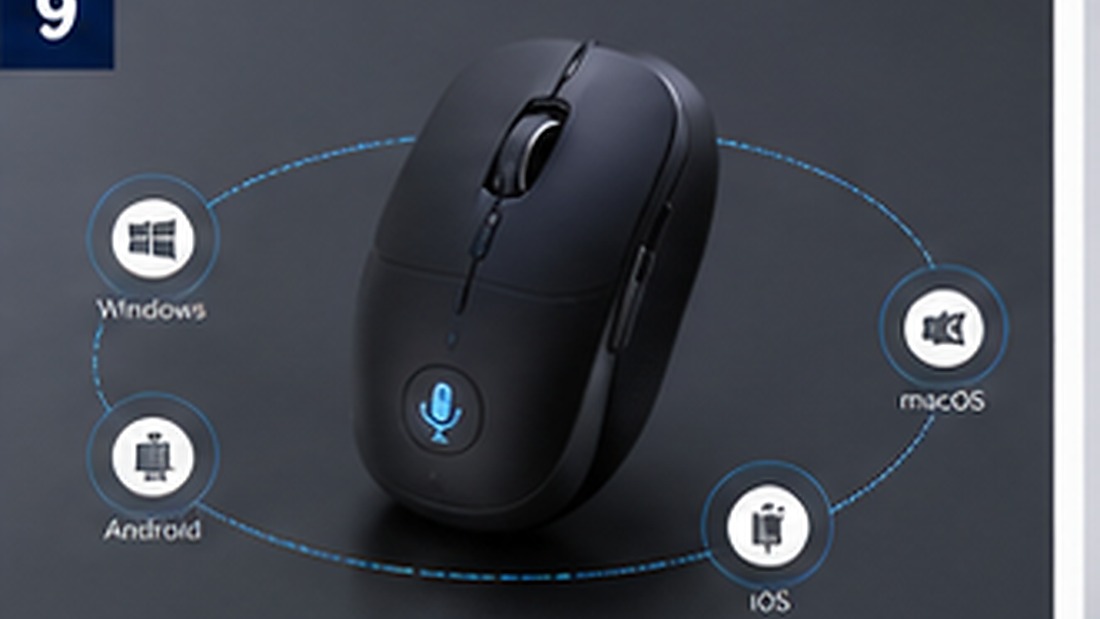
China AI Voice Mouse sourcing includes many trading companies that present as factories. Some add value through software partnerships; others simply resell. You need to know which model you are buying into, because it determines who controls quality, firmware changes and after-sales fixes.
Practical verification steps:
- Ask for the legal entity name and cross-check it against business registration records and the ISO 9001:2015 certificate holder. The certificate should name the entity you are contracting with, not a related trading arm.
- Request a short live video walkthrough of the production line, IQC area and final test station. Recorded marketing videos are easy to reuse; a scheduled live call is harder to fake.
- Ask which processes are in-house: SMT, housing assembly, firmware flashing, final functional test, packaging. Subcontracted SMT is common and acceptable, but the supplier should say so.
- Ask who writes and maintains the companion software. If the answer is a third-party software house, ask how fixes and feature requests are escalated and who owns the code.
- Compare the quotation’s line items with the claimed capability. A supplier that cannot break down tooling, software customization and certification support separately is often reselling.
A factory with in-house assembly and a documented software partner is a workable model. A trading company with no visibility into firmware or app maintenance is a supply-chain risk, especially after the first order.
Stage 3: The AI-Specific Supplier Questionnaire
Generic supplier questionnaires do not cover voice data, app ownership or cloud dependencies. Add the following questions and require written answers, not verbal assurances.
| Area | Question to ask | Why it matters |
|---|---|---|
| Firmware | Which parameters are configurable (DPI levels, button mapping, indicator behavior, power settings)? Can button functions trigger software shortcuts such as one-click recording or translation? | Determines whether the hardware can support your intended workflow. |
| Companion software | Who develops and maintains the desktop client? What is the update mechanism and release cadence? | Software quality drives perceived product value more than firmware. |
| Cloud AI | Which ASR and LLM providers are supported? Can we use our own API key or cloud account? | Affects cost, control, vendor lock-in and data routing. |
| Data handling | Where is voice audio uploaded? Is there a factory-operated relay server? Who stores raw audio and transcripts, and for how long? | Core privacy and procurement question for enterprise buyers. |
| Data agreements | Can you sign a data-processing agreement? Can data storage be disabled? | Needed for GDPR-related and enterprise procurement reviews. |
| Ownership | Who owns firmware, software source code, cloud backend and API rights? What is defined in the contract? | Prevents dependency on a supplier you cannot replace. |
| Localization | Which languages are supported, and by which software platform? | Language counts vary by platform and must be verified, not assumed. |
| Compliance | Which certifications apply to this model and market? Who holds the certificate? | Factory capability does not equal model-specific certification. |
Score each answer as documented, partially documented or undocumented. Undocumented answers on data handling and ownership should be treated as red flags, not as details to resolve later.
Stage 4: Document and Certification Checks
For AI Voice Mouse projects, compliance splits into two tracks: hardware certification and software/data governance. Buyers often conflate them.
Hardware track. Depending on the model and destination market, relevant items may include CE for the EU, FCC for the US, RoHS for restricted substances, and market-specific schemes such as CCC, KC, PSE or SASO where legally required. Bluetooth models may require BQB qualification. Ask for the certificate or test report for the exact model and configuration you are buying, and check the certificate holder. A supplier’s ability to support CE, FCC and RoHS applications is useful, but it is not evidence that your specific model already holds those certificates.
Software and data track. If voice audio is uploaded, you need to understand the controller and processor roles, retention periods, cross-border transfer and subprocessor arrangements. These are contractual and architectural questions, not traditional hardware certificates. Do not accept a statement that the software is GDPR-compliant without seeing the actual data flow and the agreement that governs it. Confirm requirements with the applicable authority, qualified laboratory or regulatory advisor for your market.
A practical document checklist:
- Business license and legal entity name matching the quotation.
- ISO 9001:2015 certificate with the correct certificate holder.
- Model-specific test reports or certificates for the target market, where applicable.
- BOM summary for the quoted configuration, with key components identified.
- Software architecture description and data-flow diagram.
- Draft data-processing terms and retention policy.
- Sample test report and firmware/software version log.
Stage 5: Sample Evaluation Scorecard
Samples should be tested against your workflow, not just handled for feel. Build a scorecard before samples arrive so that multiple reviewers score consistently.
| Test area | What to test | Pass criteria (define for your project) |
|---|---|---|
| Basic mouse function | Tracking, DPI steps, button feel, scroll wheel, wireless stability | No dropouts in a defined office test; buttons and wheel meet your feel standard |
| Voice pickup | Dictation at normal desk distance, with and without background noise | Acceptable recognition rate in your actual office environment |
| Wake word / trigger | False triggers during calls, typing and silence; missed triggers | False-trigger rate acceptable for your users; trigger reliably works |
| Latency | Time from speech end to text or translation appearing | Within the range your users will tolerate for the workflow |
| Software integration | Install, login, language settings, meeting summary, export | No blocking bugs; settings persist after restart |
| Cross-platform | Windows and macOS if both are required | Feature parity or documented differences |
| Update process | How firmware and software updates are delivered and rolled back | Documented process with version control |
| Data behavior | Network traffic during dictation; account and API key settings | Matches the documented data flow |
Record firmware and software versions for every sample. If a supplier cannot tell you which software build you are testing, you cannot compare revisions or approve a production freeze later.
Stage 6: Customization Scope and Quotation Discipline
Custom AI Voice Mouse projects range from logo printing on an existing platform to a new enclosure with dedicated software. Clarify scope before quotation, because the same word means different things to different suppliers.
- Hardware: existing public mold, modified housing, or new tooling. New tooling materially increases lead time and cost.
- Firmware: DPI and button mapping changes are routine; deep changes or source-code access are contractual matters.
- Software: white-label branding and splash screen, UI layout and language packages, custom AI prompts and terminology libraries, or integration with your own backend.
- Packaging: standard color box with sticker, custom color box, manual language and accessory set.
Ask for a quotation that separates hardware, tooling, software customization, certification support and packaging. Reference MOQ ranges vary by scope: existing-platform private label projects are typically lower volume than full-custom ODM. Treat any MOQ or lead time as a reference until confirmed in the official quotation for your selected model and scope.
Red Flags Specific to AI Voice Mouse Suppliers
Some warning signs are generic; others are specific to voice and AI products.
- Vague AI claims. Statements such as “built-in AI” without naming the software architecture, cloud provider or data route. Ask for a data-flow diagram.
- Unverified accuracy or language claims. Recognition accuracy and supported language counts depend on the software platform, language and environment. Ask for the test conditions behind any claim.
- Unclear ownership. No clear answer on who owns the firmware, app, cloud backend or API rights. If it is not in the contract, assume you do not control it.
- Hidden relay servers. Voice audio passing through a factory-operated server without disclosure or a data-processing agreement.
- No update path. No documented process for firmware or software updates, or no way to roll back a bad release.
- Certification confusion. Presenting factory-level CE, FCC or RoHS support as proof that your model is certified, or refusing to name the certificate holder.
- Software orphan risk. A companion app maintained by an unnamed third party with no maintenance commitment after the first order.
Pineeon Manufacturer-Side Recommendation
From the manufacturing side, the most common mistake we see is buyers spending most of their diligence on the mouse and too little on the software and data layer. The hardware is comparatively mature: optical sensors, wireless controllers and MEMS microphones come from established supply chains, and hardware supply volatility is generally lower than for complex wearable or AI glasses projects. The real differentiation, and the real risk, sits in the companion software, cloud AI integration and long-term maintenance.
Our recommendation is to run vetting in this order: architecture brief, factory verification, AI-specific questionnaire, document check, scored sample, then commercial negotiation. Do not let a low quotation pull you past the data-handling and ownership questions. For enterprise or EU-bound projects, settle the data-processing terms before sample approval, not after.
Certification documentation, testing and compliance-support capabilities vary by supplier and project. Confirm the exact scope, responsible parties and available records in writing before relying on them.
Use that profile as a benchmark, not a shortcut. Ask every candidate the same questions and compare written answers side by side.
Implementation Checklist for Procurement Teams
- Write the architecture brief and define the cloud AI route.
- Verify the legal entity, certificate holder and in-house processes.
- Send the AI-specific questionnaire and require written answers.
- Collect model-specific certification documents and software data-flow documentation.
- Score samples against a pre-agreed scorecard and record software versions.
- Define customization scope and request a line-item quotation.
- Negotiate data-processing terms, ownership and maintenance commitments before tooling.
- Run a pilot batch and freeze hardware and software configuration before mass production.
Vetting an AI Voice Mouse supplier is ultimately a test of whether the supplier can explain its own product. A supplier that can describe the data flow, name the software owner and show model-specific documents is a safer partner than one that only quotes a price.
Related Pineeon Resources
For product specifications, available configurations and OEM/ODM project information, see the AI Voice Mouse product page.