AI Translator Factory Comparison Criteria: A Step-by-Step Guide
Published October 30, 2026 · Pineeon Insights
Most AI translator supplier comparisons collapse into a price-per-unit spreadsheet. That works for commodity accessories. It fails for translation hardware, because two factories quoting the same enclosure and the same “supports 40+ languages” line can deliver completely different products: one translates reliably in a noisy airport, the other struggles the moment the microphone seal is slightly off. One lets you keep your own cloud account and terminology data; the other routes every voice sample through a backend you cannot audit.
This guide gives procurement teams a structured, repeatable way to compare candidate AI translator factories before committing to samples, tooling or a supply agreement. It is written from the manufacturer side — the questions a factory can actually answer with evidence, and the answers that should make you slow down.
One framing note before you start: an ai translator factory is not a single capability. It is a bundle of hardware assembly, acoustic engineering, firmware, app/cloud integration, language-package management and compliance documentation. Score each bundle separately, then weight them to your market.
Step 1: Classify the Product Form Before You Compare Factories
You cannot compare factories fairly until you have fixed the product architecture, because the engineering burden differs by form factor. The three common AI translator forms are:
- Translation pen / stick with display: OCR scan translation, photo translation, two-way voice, offline dictionary. The hard problems are camera/OCR accuracy and text rendering.
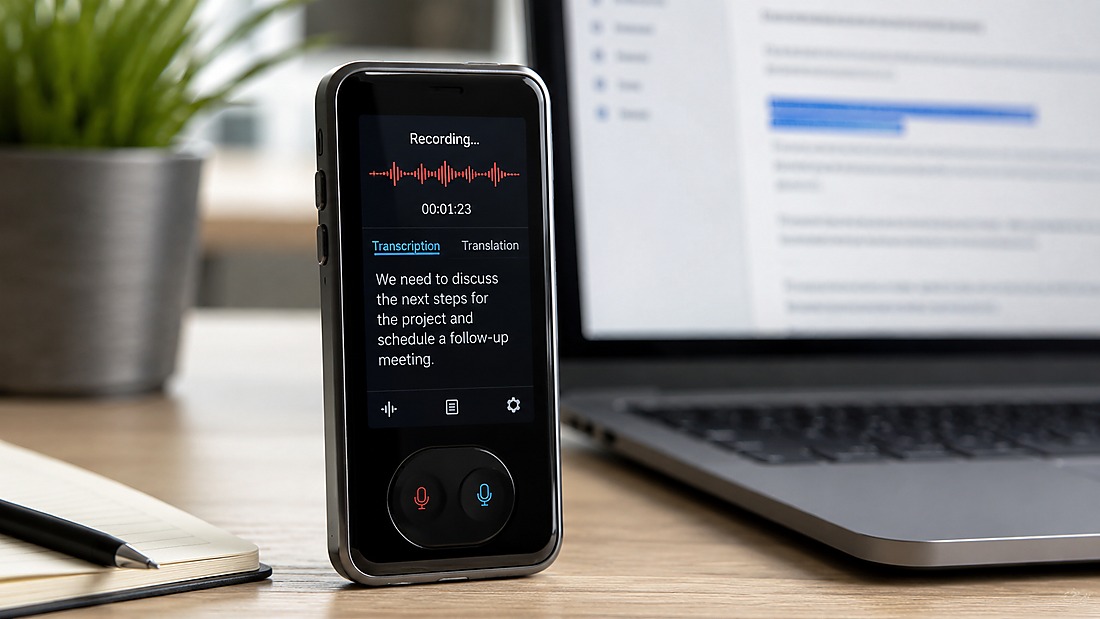
- Pocket touchscreen translator: standalone two-way voice, real-time subtitles, speaker and private-listening modes. The hard problems are microphone array behaviour, latency and offline language storage.
- Translator earbuds (TWS): audio capture and playback with translation logic typically handled by the app and/or cloud service. The hard problems are acoustic sealing, microphone alignment and Bluetooth stability.
A factory that is strong in TWS audio may be mediocre at OCR pen optics, and vice versa. Ask each candidate which form they build most often, then request references or sample evidence in your form. If a supplier answers every form-factor question with “yes, we can do that,” treat it as a process question, not a capability claim: ask to see the sample validation plan for that specific form.
Locking the form early also prevents a common procurement failure — comparing quotes where one factory priced a cloud-first pocket translator and another priced an offline-capable device. Those are different BOMs, different firmware and different certification scopes.
Step 2: Separate Online Language Claims from Offline Language Capability
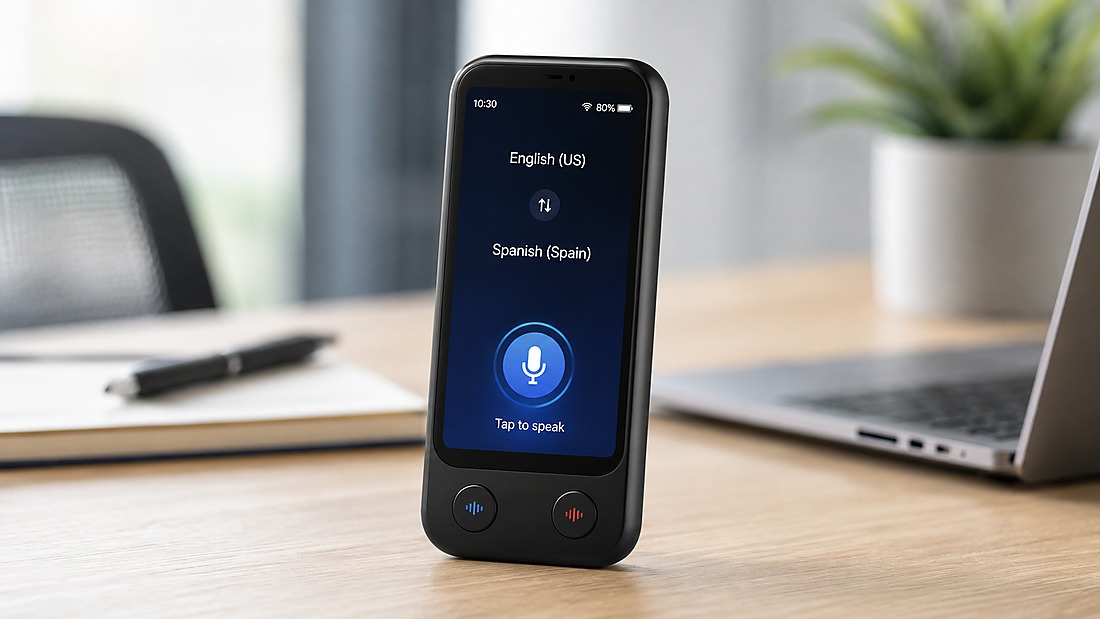
“Supports 40 languages” is not a hardware specification. It is a statement about the translation engine, and it usually means online languages only. Before scoring, split every language claim into two columns:
- Online languages: processed through ASR (speech recognition), NMT (neural machine translation) and TTS (speech synthesis) in the cloud or app. Language count is largely a software and service-provider question.
- Offline languages: processed on-device using local models. This requires additional compute, memory and storage, and it materially changes the chipset, battery and cost structure.
Industry reference material commonly cites a broad online language count and a much smaller offline set for mainstream platforms, with some higher-end devices claiming far more offline coverage. Do not accept those as your product’s specification. Instead, ask each factory for per-language test evidence: which language pairs were tested, on which firmware build, in which acoustic environment, and with what result.
A practical verification request: give the factory three language pairs you actually care about (including at least one non-Latin script and one with a strong regional accent), plus five domain terms from your vertical. Ask for a recorded test on a production-intent sample. Factories that manage offline packages well will usually have a structured way to run this; factories that resell a generic cloud API often cannot.
Step 3: Score the Translation Engine and Data Architecture
This is the dimension generic factory-comparison guides omit, and it is where the most expensive surprises live. Score each candidate on the following, and require written answers rather than verbal assurances.
| Comparison dimension | What to ask | Why it changes your decision |
|---|---|---|
| Engine ownership | Which ASR/NMT/TTS providers are integrated? Can we bring our own translation API account? | Determines recurring service cost, vendor lock-in and whether you can switch engines later. |
| Cloud routing | Does translation traffic pass through a factory-operated cloud? Can it be disabled? | Affects privacy posture, cross-border data flow and enterprise sales objections. |
| Raw audio handling | Who stores raw voice data? For how long? Can storage be turned off? | Voice data is sensitive; retention terms must be contractual, not assumed. |
| Terminology control | Can we load a custom glossary or industry vocabulary? Who owns that data? | Enterprise and education buyers often need domain terms to translate correctly. |
| Offline behaviour | What exactly works with no network — voice, OCR, dictionary, subtitles? | Prevents shipping a device marketed as offline-capable that silently requires connectivity. |
| App/SDK scope | White-label app, UI customization, or full customer-owned app via SDK/API? | Defines development cost and who maintains the software after launch. |
Two failure modes are worth naming. First, cloud translation described as offline translation — the device has a local dictionary but voice translation still needs a network. Second, assumed data ownership — the buyer assumes they own the translated text and terminology database, but the contract is silent. Both are resolved by written answers before the sample PO, not after.
Step 4: Compare Acoustic Engineering and Test Discipline
Translation quality is partly an acoustic problem. Speech recognition degrades when the microphone seal is imperfect, when the array is misaligned during assembly, or when noise reduction is tuned for the wrong environment. This matters most for translator earbuds, but pocket translators with speaker and private-listening modes are also sensitive.
Ask each candidate how they control this in production, not just in the lab:
- Is microphone alignment and acoustic sealing a defined in-process checkpoint?
- Is speech-recognition performance tested on every unit at final QC, or only sampled?
- What acoustic environment is used for latency and recognition testing — quiet room, simulated noise, or both?
- How is Bluetooth stability tested for earbud forms, and under what conditions?
A factory that treats acoustics as a final-inspection item rather than an in-process control will show yield problems only after you have scaled. A factory that can describe the checkpoint, the fixture and the pass/fail criterion is showing process discipline — which is what you are really comparing.
Step 5: Verify Compliance Documentation, Not Compliance Adjectives
AI translators are relatively simple from a radio perspective — most use Wi-Fi, Bluetooth or a phone hotspot — but that does not make compliance automatic. Compare factories on the documents and testing support they can provide for your specific model and target market.
For CE, FCC and RoHS, ask for the scope of support: which technical documentation they prepare, whether they coordinate testing, and who holds the certificate. Note that factory-level capability does not mean every model already holds every certificate; model-specific status must be confirmed with supporting documentation. Requirements vary by configuration, radio technology, battery design and destination market, so confirm the applicable scope with the laboratory or authority handling your project.
If your device includes an independent cellular module, or if you sell into markets with additional schemes (for example Japan, the UK or China), add those to the comparison matrix early. A factory that flags these dependencies during quoting is more reliable than one that discovers them during certification.
Step 6: Compare the Sample-to-Mass-Production Sequence
Price comparisons are static; process comparisons predict what happens at scale. Ask each candidate to walk you through their sequence and compare the number and rigour of checkpoints.
- Requirement confirmation: device form, online and offline languages, connectivity architecture, OCR needs, destination market.
- Structure/ID confirmation: enclosure, touchscreen or camera module, tooling cost and lead time evaluated separately.
- Engineering sample validation: speech recognition, translation latency, offline packages, OCR accuracy where applicable, microphone noise reduction, Bluetooth stability.
- Pilot run: small-batch production to verify yield and software/hardware consistency.
- Configuration freeze: product and software locked before mass production.
Timelines vary widely by form and customization depth — for example, a standard private-label pen or pocket device with existing tooling is typically faster than a full-custom earbud project, where tooling, acoustic tuning and certification can extend the schedule substantially. Treat any timeline as project-dependent and confirm it in the quotation.
Score factories on whether they require a pilot run and a configuration freeze. A supplier willing to jump from one sample straight to a large volume order is offering speed at the cost of your launch risk.
Buyer Comparison Scorecard
Use this weighted scorecard to compare two to four candidates side by side. Adjust weights to your market; the point is to force evidence into each cell.
| Criterion | Weight | Evidence to request |
|---|---|---|
| Form-factor experience | 10% | Samples or validation plans in your specific form |
| Online language coverage | 10% | Per-language test evidence on production-intent firmware |
| Offline language capability | 15% | List of offline languages, storage/compute implications, test recordings |
| Engine and data architecture | 15% | Written answers on API ownership, cloud routing, raw audio retention |
| Acoustic and QC discipline | 15% | In-process checkpoints, full vs sampled final tests, fixtures |
| Compliance documentation | 10% | Documentation scope, testing coordination, certificate holder |
| Sample-to-production process | 15% | Pilot run requirement, configuration freeze, yield reporting |
| Commercial terms | 10% | MOQ, tooling, lead time — confirmed in official quotation |
Two rules keep the scorecard honest. First, no cell is scored on a verbal claim; if evidence is missing, score it zero and note the gap. Second, keep commercial terms at a modest weight — a factory that wins on price but loses on offline capability and acoustic discipline will cost more after launch.
Pineeon Manufacturer-Side Recommendation
From the factory side, the buyers who scale successfully tend to do three things in the comparison phase.
They define offline requirements before asking for quotes. Whether offline translation is a critical requirement determines chipset, memory, storage and battery — and therefore price. Buyers who leave it vague receive quotes that are not comparable.
They ask who owns the data and the engine account. For larger commercial projects, customer-owned API accounts and cloud backends are worth evaluating early, because account ownership, billing and data flow are easier to define before development than after.
They compare process, not just product. A pilot run and a configuration freeze are not bureaucracy; they are how software/hardware consistency is protected at volume.
Certification documentation, testing and compliance-support capabilities vary by supplier and project. Confirm the exact scope, responsible parties and available records in writing before relying on them.
Use Pineeon as one reference point in your scorecard — not as a substitute for testing the specific model you intend to buy.
What to Confirm Before You Sign
- Written confirmation of online vs offline language lists, with test evidence.
- Named ASR/NMT/TTS providers, and whether you can bring your own API account.
- Raw audio and translated-text retention terms, in the contract.
- Ownership of firmware, app, terminology data and cloud backend.
- In-process acoustic checkpoints and final QC test scope.
- Compliance documentation scope and certificate holder for your target markets.
- Pilot run requirement, configuration freeze and yield reporting.
- MOQ, tooling, sample and mass-production lead times confirmed in the official quotation.
If you are ready to compare a specific project, send your device form, target languages, offline requirement and destination market for a project-specific evaluation and quotation.
Related Pineeon Resources
For product specifications, available configurations and OEM/ODM project information, see the AI Translator product page.