AI Translator Sourcing for Travel Companies Explained for New Importers
Published October 23, 2026 · Pineeon Insights
Travel companies buy AI translators for a different reason than consumer electronics brands do. A tour operator, hotel group, airline ground service or travel-retail distributor is not chasing a gadget trend; it is trying to remove a communication failure that costs money at the counter, on the coach or at the gate. That changes the sourcing brief. The device has to work in noisy lobbies, on weak roaming networks, across the specific language pairs your customers actually speak, and it has to survive being handed between staff or rented to guests.
This guide is written for new importers and procurement teams inside travel businesses. It explains how to turn travel use cases into a sourcing brief, how the three main device forms differ, which specifications genuinely matter, how to vet an ai translator supplier, and how to sequence a first order without overcommitting. It deliberately avoids promising language counts, accuracy figures or certification outcomes, because those depend on the selected platform, software and target market.
Start with the travel use case, not the product listing
Most sourcing mistakes begin when a buyer opens a supplier catalogue before defining the deployment. A translation device used by a front-desk agent is a different product from one rented to a traveller or sold in an airport shop. Before requesting quotations, write down four things:
- Who holds the device. Staff-operated devices need simple menus, fast wake-up and a clear speaker mode. Guest-facing or rental devices need durability, tamper resistance and a reset or privacy-clear function.
- Where it is used. Indoor reception desks, outdoor excursion points, moving vehicles and airport terminals impose different noise, light and network conditions.
- Which language pairs matter. A supplier may advertise broad coverage, but your operation may live on a small set of specific pairs. Test those pairs, not the headline number.
- Whether connectivity can be assumed. This is the single most consequential decision for travel use, and it is covered in its own section below.
Once these four answers are written down, the product form usually selects itself. Without them, every supplier quotation looks comparable when it is not.
The three device forms and what each means for travel

AI translators are not one product category. The current manufacturer framework separates them into translation pens, pocket translators and translator earbuds. They share many consumer-electronics components, but their user experience, acoustic requirements and software architecture differ.
| Form factor | Typical travel use | Sourcing considerations |
|---|---|---|
| Translation pen / stick with display | Reading menus, signage, documents; guided-tour support; language-learning add-ons | OCR and camera performance matter more than continuous voice; offline dictionary depth is a key differentiator |
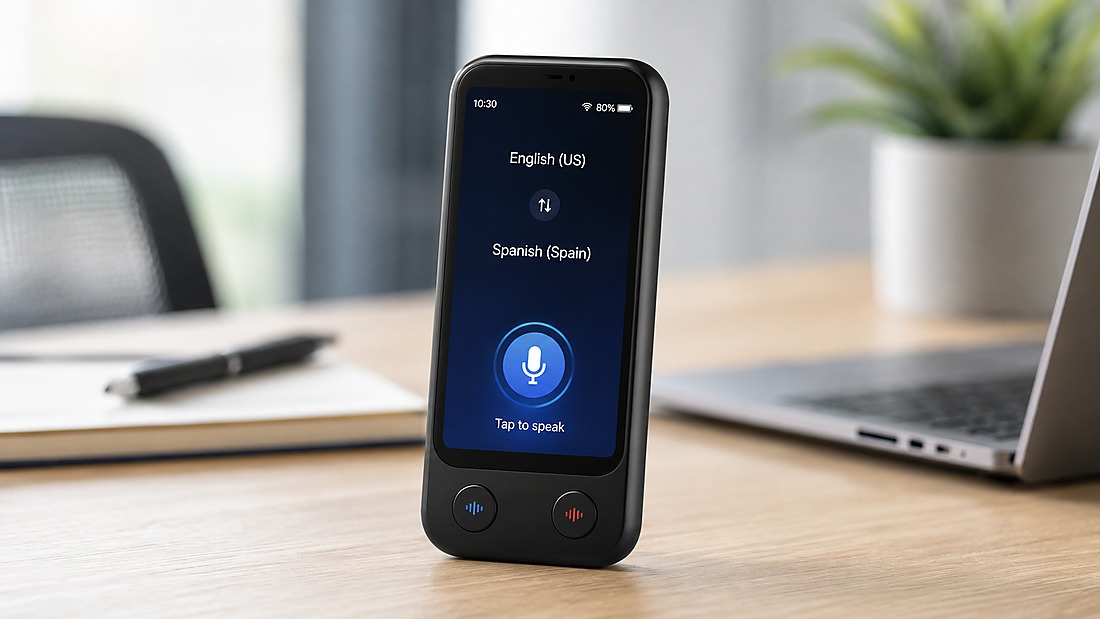
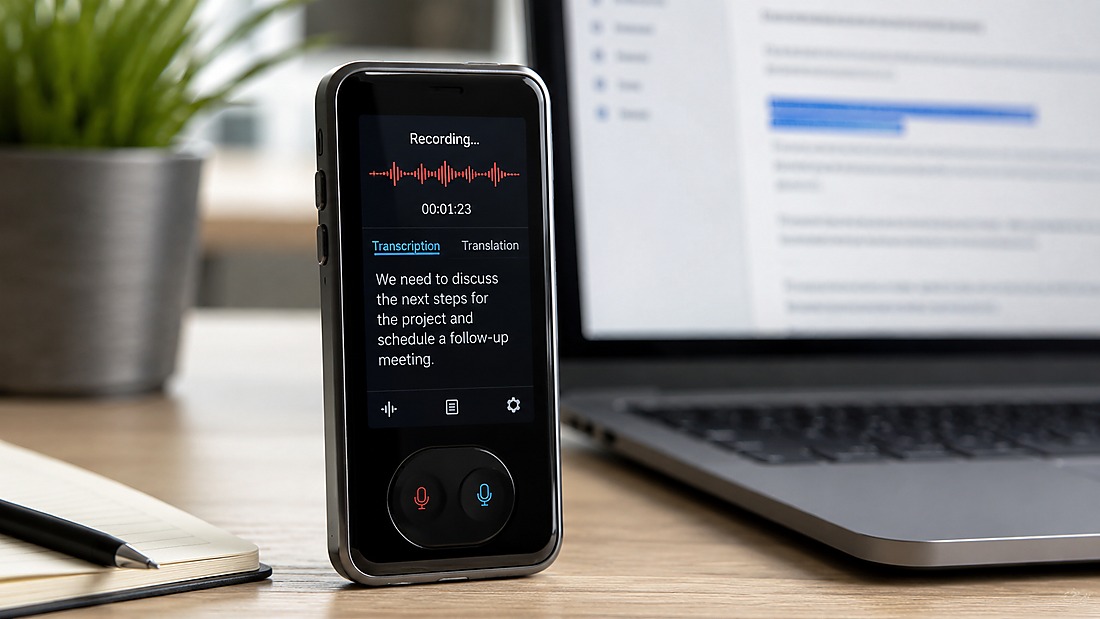
| Pocket touchscreen translator | Front desk, ticket counters, tour leaders, face-to-face service | Standalone operation without mandatory phone pairing; speaker and private-listening modes; screen durability |
| Translator earbuds | Guided conversation, hands-free travel, staff on the move | Microphone alignment and acoustic sealing are critical; most translation logic sits in the app or cloud, not the earbud chip |
For a travel company, the pocket translator is often the easiest first deployment because it is self-contained and can be handed to a staff member without pairing instructions. Earbuds suit guided experiences but raise acoustic quality-control questions. Pens suit document and signage translation but are a weaker fit for live conversation. Choosing the form before the software architecture is the normal sequence; choosing the software architecture before the form is how projects stall.
Offline translation: the requirement that reshapes the whole project
For an offline ai translator requirement, the buyer must be explicit. Many devices described as translation products are cloud-first: audio is captured on the device, then speech recognition, machine translation and speech synthesis run through an app or cloud service. That architecture keeps hardware cost lower and makes adding languages easier, but it depends on connectivity and introduces recurring service cost and data-flow questions.
Offline-capable devices carry local language packages and require more compute, memory and storage. In practice, offline coverage is usually narrower than online coverage, and the gap is where travel buyers get caught. A device may support a broad online language list while its offline package covers only a smaller set of major languages. If your customers travel between markets where roaming is unreliable, that gap is a service failure, not a specification detail.
Ask suppliers to separate three things clearly: online languages, offline languages, and offline languages available on the exact model and firmware you will ship. Then ask what happens when the device loses connection mid-conversation. A good answer describes a defined fallback; a vague answer usually means there is none.
Build a sourcing brief and sample test plan
A sourcing brief converts travel operations into engineering language. It should state the device form, target online languages, required offline languages, connectivity assumption, OCR or camera needs, destination markets, and language-package priorities. Add the commercial frame: expected first-order quantity, whether branding is logo-and-packaging only or extends to software, and who will own the app and cloud accounts.
The sample test plan should be written before samples arrive, so results are comparable across suppliers. A practical sequence:
- Language-pair accuracy. Test your real pairs with native speakers, including accents and regional vocabulary. Do not rely on a supplier accuracy percentage.
- Noise conditions. Test in a quiet room, a busy lobby and outdoors. Speech recognition degrades before translation quality does, so listen for capture failures.
- Offline validation. Disable Wi-Fi and mobile data, then test each offline language package end to end, including switching between languages.
- Latency. Measure response time on your own network conditions, not the supplier’s demo network.
- Battery under real load. Continuous translation drains faster than standby. Test a realistic shift, not a standby claim.
- Handling and durability. Drop, button-life and screen-life expectations should be agreed in the quality plan rather than assumed.
- OCR and camera where applicable, using real menus, signage and documents rather than printed test pages.
Record results in a simple scoring sheet. Suppliers who ask for your test criteria before shipping samples are usually the ones with a real engineering process behind them.
How to vet an ai translator manufacturer
Supplier vetting for this category is mostly about software and acoustics, not enclosure quality. Use a staged sequence rather than a single questionnaire.
Stage 1 — capability questions. Ask which device forms the supplier actually builds, whether offline packages can be customized, which translation engines can be integrated, whether a customer-owned API account is possible, who stores raw audio and translated text, and how firmware updates are delivered after shipment. Ask for the quality-control flow and where acoustic testing sits inside it.
Stage 2 — sample rounds. Request an engineering sample, not a retail demo unit. Confirm the firmware version and language packages in writing. Test against your plan and compare suppliers on the same script.
Stage 3 — quality and inspection expectations. Agree the inspection standard before production: incoming component checks, in-process checks on microphone alignment and acoustic sealing, final functional testing of speech recognition and offline functions, and outgoing AQL sampling. For earbuds, insist that acoustic consistency is tested, because a sealing defect can pass visual inspection and still ruin recognition.
Stage 4 — reading the quotation. A factory quote should separate hardware, branding and packaging, software or language customization, tooling where applicable, certification support, and sample fees. If offline language work or app customization is bundled into a single unit price with no assumptions listed, the scope is probably undefined. Ask what is excluded.
Certification and compliance planning
Most AI translators connect through Wi-Fi, Bluetooth or a phone hotspot, which keeps the compliance path relatively simple compared with cellular devices. If a model includes an independent SIM-based cellular module, additional cellular and operator approvals must be evaluated.
Certification documentation, testing and compliance-support capabilities vary by supplier and project. Confirm the exact scope, responsible parties and available records in writing before relying on them.
Two commercial points are often missed. First, factory certification support does not mean every model already holds every certificate — ask for model-specific evidence. Second, decide who holds the certificate and in whose name it is issued, because that affects your ability to sell the product under your own brand.
Commercial planning for a first order
Treat MOQ and lead time as reference ranges until confirmed in an official quotation. As a planning reference, sample or market-test quantities can start very small, standard private-label logo and packaging work typically sits in a mid-hundreds to one-thousand-piece band, and deeper customization — structural changes, UI work, offline language packages — generally requires higher volumes. Sample lead time depends on form and customization; a standard public-mold pen with logo and packaging is faster than a custom earbud or a touchscreen UI project.
Sequence the order in stages: engineering sample, pilot batch, then mass production. Freeze the product and software configuration after the pilot, because language packages and firmware changed after mass-production start are expensive to correct. Agree payment terms, warranty handling and update responsibility in writing. For travel deployments, also plan spare units and a replacement process — a failed device at a service counter is an operational problem, not a warranty statistic.
Common first-importer mistakes
- Trusting the headline language count. Online coverage is not offline coverage, and neither is a guarantee for your language pairs.
- Ignoring offline package limits. Confirm exactly which languages work without a network on the shipping firmware.
- Skipping firmware and update planning. Ask how updates are delivered and who pays for them after launch.
- Leaving software and data rights vague. App ownership, cloud accounts, raw audio storage and terminology data must be defined in the contract.
- Assuming earbuds translate locally. In most designs the translation logic runs in the app or cloud.
- Testing on the supplier’s network with the supplier’s script. Bring your own language pairs, accents and environments.
Pineeon Manufacturer-Side Recommendation
From the factory side, the projects that run smoothly share one habit: the buyer defines the offline requirement and the language pairs before the chipset and software architecture are chosen. That single decision determines hardware cost, storage, language-package management and recurring cloud cost. We recommend new travel-sector importers start with a pocket translator or a standard private-label pen, validate real language pairs in real noise, and only then move to earbuds or deep software customization.
Certification documentation, testing and compliance-support capabilities vary by supplier and project. Confirm the exact scope, responsible parties and available records in writing before relying on them.
Related Pineeon Resources
For product specifications, available configurations and OEM/ODM project information, see the AI Translator product page.
Frequently asked questions
Can a travel company start with a very small order?
Sample and market-test quantities can be small, and selected platforms may support a few units for evaluation. Standard private-label branding normally requires a larger first order, and deeper customization raises the threshold. Confirm the applicable MOQ for your chosen model in the quotation.
Is a pocket translator better than earbuds for front-desk use?
Usually yes, because it is self-contained, does not require pairing and can be handed between staff. Earbuds suit guided conversation and hands-free use but depend more on acoustic consistency and app behavior.
How do we verify offline translation before ordering?
Disable all connectivity on the sample, test each required language package end to end, and confirm in writing which languages are included on the shipping firmware. Do not accept an online language list as evidence of offline capability.
Who owns the app and translation data?
That is project- and contract-specific. App ownership, cloud accounts, raw audio storage, translated-text retention and terminology data rights should be defined in the signed agreement before development begins.
What should we ask about certification?
Ask which certificates the exact model holds, who the certificate holder is, and which markets they cover. Factory support for CE, FCC and RoHS applications is a capability, not proof that a specific model is already certified.