Smart Watch Sourcing for Fitness Brands: A Beginner’s Overview
Published October 23, 2026 · Pineeon Insights
A fitness brand entering wearables usually starts with the same question: can we get a custom smart watch that matches our training philosophy, our app, and our price band without funding a hardware program from zero? The honest answer is that it depends on which of three sourcing routes you take, and on one engineering decision that most first-time buyers make too late — the product architecture.
This overview is written from the manufacturer side. It explains what a custom smart watch project actually involves for a fitness brand, where OEM, ODM and private label diverge, and which checkpoints should be verified before you approve a sample or place a bulk smart watch order. Commercial values such as MOQ and lead time are discussed as project-dependent reference points only; final terms always depend on the selected model, customization scope and official quotation.
Start with the architecture, not the logo
Before comparing suppliers or requesting a private label smart watch quote, define what the watch must do when it is not connected to a phone. That single question separates the two architecture families used in smart watch manufacturing.
MCU Bluetooth smart watches use a low-power microcontroller running an RTOS-class system. They are optimized for sports and fitness tracking, wellness monitoring and Bluetooth-connected use cases. Typical characteristics are lower BOM cost, longer battery endurance and a simpler certification path. They do not normally operate as an independent Android application platform.
Android/4G smart watches use an application processor and support independent connectivity, richer application execution and, where implemented, GPS, Wi-Fi and cellular communication. They carry higher BOM cost, higher power consumption, shorter battery life and materially more complex software and certification requirements.
For a fitness brand, the practical split usually looks like this: if the watch is a training companion that streams data to your app, an MCU platform is the rational starting point. If the watch must place calls, run independently of a phone, or serve as a safety device for children or elderly users, you are in Android/4G territory and should plan budget, timeline and MOQ accordingly.
Choosing the chipset before choosing the architecture is the most common sequencing error in first projects. It locks the brand into a BOM, a power profile and a certification scope before the product positioning is settled.
OEM, ODM and private label: what each route changes for a fitness brand

These three terms are often used interchangeably in supplier conversations. They should not be, because each implies a different owner for tooling, firmware, app and timeline.
| Route | What is customized | What the brand typically owns or controls | Best fit |
|---|---|---|---|
| Private label | Logo, packaging, UI language, selected function switches on an existing platform | Brand assets and packaging artwork; hardware and firmware remain the platform | First launch, fast market test, limited engineering resource |
| OEM | Existing hardware with brand-specific branding, packaging and defined configuration | Brand, packaging, agreed configuration; firmware ownership is contract-defined | Brands with a clear product spec but no hardware team |
| ODM | PCBA, firmware and application customization based on an existing architecture | Depends on contract: app, cloud, firmware and tooling rights must be written down | Brands needing differentiated features or app integration |
| Full custom | New tooling, new chipset architecture, new application and cloud development | Defined entirely by the signed agreement | Funded programs with a multi-year wearable roadmap |
Two contract points deserve attention early, because they are difficult to renegotiate later. First, firmware and OTA authority: who can push updates, and who approves them. Second, app and data ownership: whether your brand’s application is customer-developed and integrated through an SDK or API, or built on the supplier’s platform, and where the resulting data resides. Neither is automatic in any sourcing route; both must be explicit in the agreement.
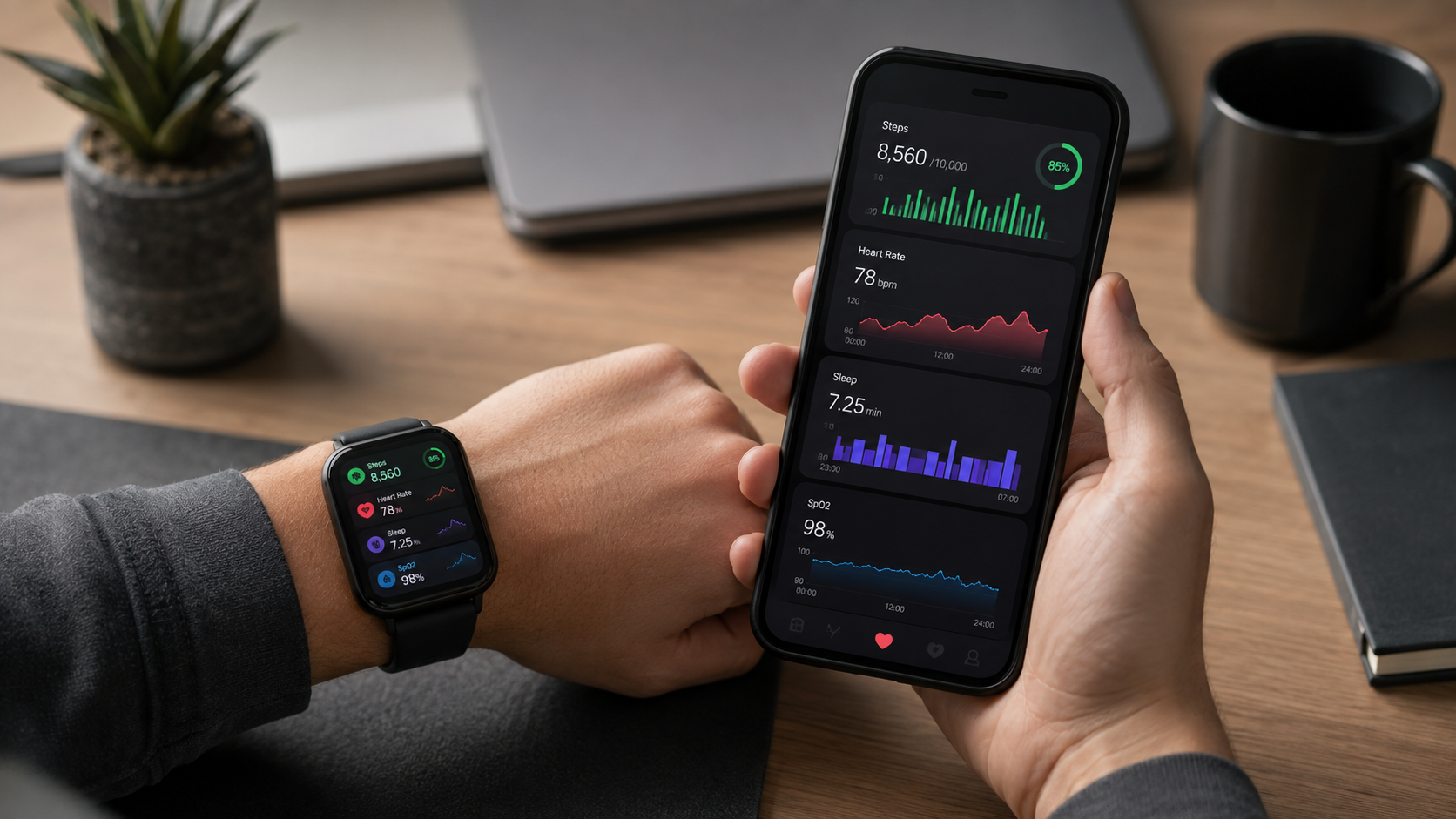
SDK and API availability is similarly platform-specific. Some MCU Bluetooth platforms offer Android and iOS SDKs exposing structured data such as heart rate, SpO2, sleep-related data and step counts. Other platforms, particularly factory-specific 4G watch systems, vary in openness. Do not assume open SDK access, raw sensor data or cloud API access on every model — confirm it for the exact platform you select.
What fitness brands specifically need to specify
Generic consumer sourcing and fitness-brand sourcing diverge in a few concrete places. A smart watch supplier who mainly ships fashion watches may not raise these questions, so the brand should raise them first.
- Sensor stack and sampling behavior. Which sensors are included (PPG heart rate, SpO2, accelerometer, gyroscope, barometer where supported), and how sampling rate and thresholds can be adjusted. These settings affect both data usefulness and battery endurance.
- Data fields exposed to your app. Define the exact fields your training logic consumes, then verify they are available on the selected platform before sample approval.
- Workout and activity logic. Sports modes, auto-detection behavior, sedentary reminders and alert thresholds. Some of this can be adjusted in standard firmware; deeper algorithm work is a separate feasibility discussion.
- Battery expectations under real training use. GPS frequency, screen-on time, sensor sampling and connectivity all reduce endurance. Treat published battery figures as typical reference ranges unless model-specific testing is available.
- Water resistance for the intended activity. IP67, IP68 and 5ATM are not equivalent, and swimming should never be assumed without model-specific confirmation and documentation.
- Wellness versus medical framing. Consumer wellness features should not be presented as diagnosis. Any medical positioning requires separate regulatory evaluation and is not a standard consumer-watch pathway.
Writing these into a short product requirements document before requesting quotations changes the quality of the responses you receive. Suppliers can then quote against a defined scope rather than a general idea.
Buyer verification checklist before you commit
The following checklist is structured in the order a first project usually moves. Each item should produce a document or a written confirmation, not a verbal assurance.
| Stage | Verify | Why it matters |
|---|---|---|
| Supplier qualification | Business scope, quality management system, experience with your product category, named contact for engineering and quality | Establishes whether the supplier can support the project after the sample stage |
| Architecture and platform | MCU or Android/4G; confirmed chipset family; confirmed sensor list; confirmed connectivity | Prevents specification drift between quotation and production |
| Software scope | SDK/API availability, data fields, app customization level, firmware customization level, OTA authority | Determines whether your app strategy is feasible on this platform |
| Commercial terms | MOQ, tooling cost and ownership, sample fee and credit terms, packaging scope, lead time basis | Confirms the project is viable at your volume and cash cycle |
| Certification planning | Target markets, applicable CE/FCC/RoHS scope, cellular certification needs for 4G models, documentation responsibilities | Certification is market- and configuration-dependent and drives timeline |
| Sample approval | Functional test results, appearance, water-resistance test where required, UI language, packaging proof | Creates the reference standard for production |
| Pilot run | Yield, functional consistency, production stability | Surfaces assembly and firmware issues before a full order |
| QC plan | IQC/IPQC/FQC/OQC scope, AQL criteria, reliability tests included for this order | Defines acceptance, not aspiration |
On quality control, a typical manufacturer framework runs incoming inspection on main controller, battery, display and sensors; in-process checks at SMT and assembly; final functional, display and appearance inspection with battery aging and water-resistance pressure testing where required; and outgoing AQL sampling with reliability tests such as aging, drop, UV life or IPX protection testing where applicable. The exact test list and acceptance criteria should be agreed in the project quality specification — not every optional test is performed on every order.
Certification planning without unrealistic timelines
Certification is where first-time importers most often lose schedule. The reason is usually planning, not testing: the required scope depends on the product configuration, the radio technologies used, the battery design and the destination market.
For Bluetooth-only MCU watches, CE, FCC and RoHS are the common reference points for European and US markets, with Bluetooth qualification as a separate consideration. For Android/4G watches, cellular-device and market-specific telecom requirements may apply in addition, and these require separate evaluation for the destination country and network configuration. China-market requirements such as CCC apply where legally required for the specific product.
Certification documentation, testing and compliance-support capabilities vary by supplier and project. Confirm the exact scope, responsible parties and available records in writing before relying on them.
Commercial variables to confirm before quotation

Quotations are only comparable when they are built on the same scope. Ask each candidate smart watch manufacturer to state the following explicitly, in writing:
- MOQ by route. MOQ varies substantially by architecture and customization depth. Existing MCU Bluetooth platforms with logo and packaging customization sit at the lower end; standard ODM projects involving PCBA, firmware and application work sit higher; and new Android/4G programs with new tooling and application development are the highest tier. Ask each supplier to state the MOQ for your exact configuration rather than a headline figure.
- Sample lead time. Simple logo and packaging changes on an existing MCU platform are typically the fastest; UI or function adjustments take longer; MCU ODM work involving appearance or mainboard changes longer still; and Android/4G projects with application and cloud integration the longest. Request a written sample schedule tied to your specification.
- Mass-production lead time. Standard MCU private label is typically the shortest cycle, moderate MCU customization longer, ODM full customization longer again, and fully customized Android/4G programs the longest. Pilot builds add their own stage. Q3–Q4 and periods of chipset or module supply constraint can extend delivery.
- Tooling and packaging. Whether new tooling is required, who owns it, and what packaging level is included — factory standard color box with sticker and manual language changes, or fully custom graphics and accessories.
- App and SDK access. The customization level (white label, UI and function switches, advanced features, or customer-owned app and cloud) and the commercial terms attached to it.
All of the above are project-dependent. Final values are subject to the selected model, project requirements, technical evaluation and official quotation.
Common first-project mistakes
Most failures in a first wearable program are predictable, which means they are avoidable.
- Skipping the pilot run. Moving from approved sample directly to a full order hides yield and consistency problems until they are expensive.
- Unclear firmware and app ownership. Assuming source-code access, OTA authority or cloud ownership without a signed clause creates a dependency the brand cannot unwind later.
- Unrealistic certification timelines. Treating certification as a formality rather than a market- and configuration-dependent process compresses the launch window.
- Specification drift. Quotation, sample and production specification not being the same document.
- Battery promises without usage context. Quoting endurance figures that assume light use to buyers who train daily.
- Assuming SDK openness. Building an app roadmap on a platform whose data access has not been confirmed.
- Ignoring seasonality. Placing a Q4 launch on a production plan that assumes Q3 capacity is freely available.
Pineeon Manufacturer-Side Recommendation
For a fitness brand’s first custom smart watch, we recommend starting on an existing MCU Bluetooth platform with private label branding, packaging and UI language customization, and a defined data-field list for your app. This route keeps tooling exposure low, keeps the certification path simpler than a cellular product, and produces a real product you can test with your community before committing to deeper development.
Move to ODM customization — PCBA, firmware and application work on an existing architecture — once you can name the specific functions your brand needs that the platform does not provide. Reserve full custom Android/4G development for programs with a funded multi-year roadmap, because new tooling, a new chipset architecture and application development change the MOQ, timeline and certification profile substantially.
In all three cases, insist on three documents before mass production: a frozen product specification, an agreed QC and acceptance plan, and a signed statement of firmware, app, data and tooling ownership. Pineeon evaluates customer requirements before recommending a project approach, and final project scope should be confirmed before quotation and development. You can review the current smart watch OEM/ODM and private label range as a starting point for a scoped conversation.
Pineeon is a private label Smart Wearable, Computer Peripheral and AI Hardware OEM/ODM manufacturer based in Shenzhen, China, operating since 2000, ISO 9001:2015-certified, and serving brands and buyers in more than 40 countries.